
How Affiliate Marketing Works for Financial Services

Affiliate marketing in financial services works best when partner activity is controlled, tracked, and aligned with compliance requirements from the start.
This approach reduces fraud risk, improves attribution accuracy, preserves brand safety, and ensures every commission is tied to verified, auditable customer activity.
Here’s what matters most:
- Controlled partner access for approved financial affiliates only
- Pre-approved messaging and compliant landing page control
- Accurate tracking across devices and verified conversions
- Commission rules tied to approved, verified outcomes
- Ongoing monitoring for fraud, gaps, and anomalies
- Structured workflows with clear audit trails and tracking
Email address-based tracking keeps referrals connected to verified users across devices and sessions.
Flexible attribution windows ensure commissions remain valid across longer financial decision cycles without losing attribution continuity.
The sections below explain how affiliate marketing works in financial services, how to manage compliance and fraud risks, and how to build a scalable program with reliable tracking, controlled payouts, and defensible reporting systems.
Why Affiliate Marketing Works Differently in Financial Services
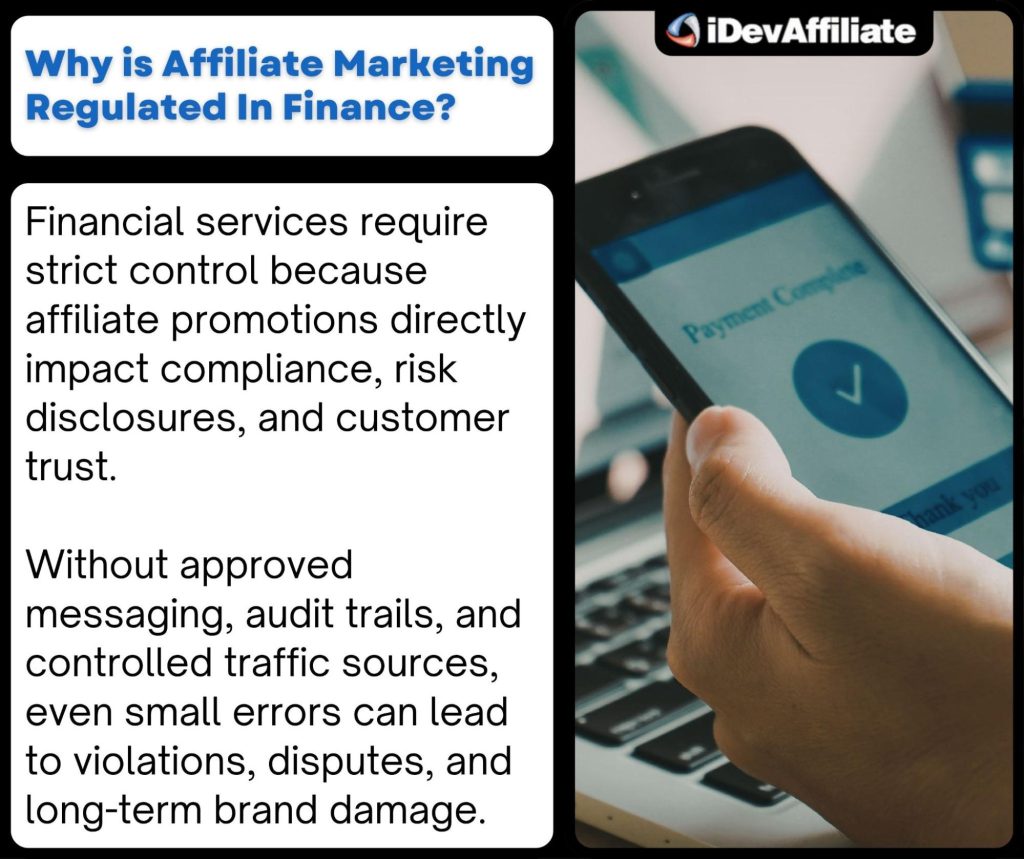
Affiliate marketing in financial services only works when treated as a controlled, auditable distribution channel rather than open partner marketing.
Supervision defines success, including who promotes, what they say, and where traffic is directed. Without control, small gaps quickly turn into compliance, tracking, and trust issues.
Affiliates Function as External Sales Representatives
In financial services, affiliates operate like external sales teams representing your brand in market.
Their messaging directly influences customer perception and compliance exposure. Without oversight, even small claim variations can introduce risk and misaligned expectations.
Messaging Control Directly Impacts Compliance Outcomes
Affiliate promotions are not just traffic drivers, they are regulated communication surfaces. Unapproved claims or simplified messaging can create compliance violations quickly.
Clear rules and pre-approved messaging reduce ambiguity and keep partner activity aligned with policy.
Tracking and Auditability Are Non-Negotiable Requirements
Every click, claim, and conversion must be traceable back to a specific affiliate action.
Audit trails ensure you can verify what was said, when it ran, and what outcome it produced. This visibility protects both compliance and partner accountability.
Landing Pages Become Controlled Compliance Assets
Each landing page affiliates promote represents an approved version of your offer. Allowing uncontrolled destinations creates inconsistencies between messaging and actual product terms.
Pre-approved pages ensure alignment between promotion, disclosures, and customer experience.
Trust and Brand Risk Outweigh Commission Costs
In financial services, trust is more expensive to lose than commissions are to pay. Misleading claims or tracking gaps can damage credibility with both customers and partners.
Structured processes ensure consistency, reducing disputes and protecting long-term program stability.
Helpful Resource → How Affiliate Tracking Software Actually Works
Compliance and Regulatory Controls Before Affiliate Launch
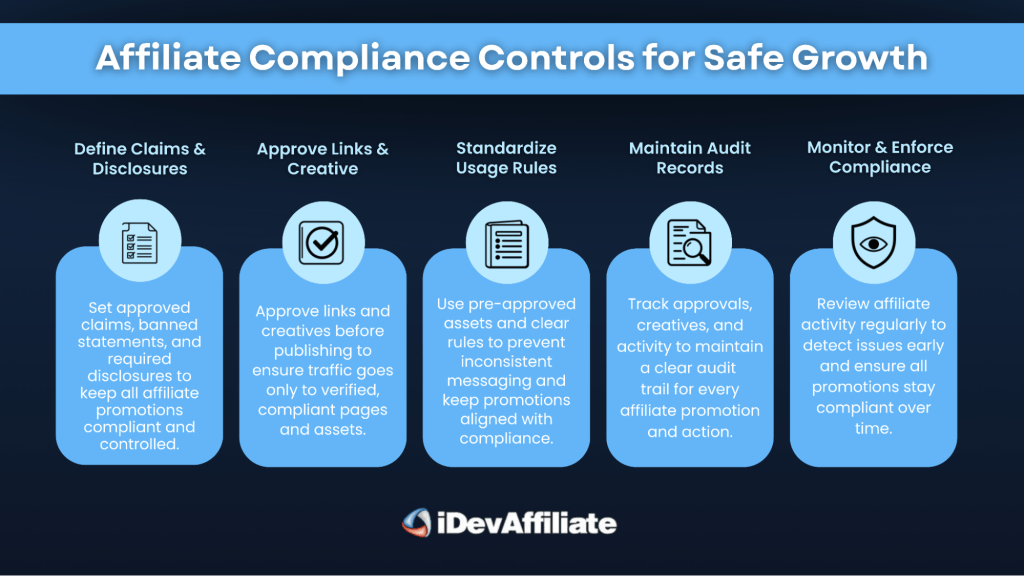
In financial services, compliance must be structured before affiliates begin promoting your offer. Clear rules, approval workflows, and documented oversight reduce risk before it scales.
Without these controls, small messaging or tracking gaps quickly become regulatory issues.
1. Define Claim Boundaries and Required Disclosures
Clear claim boundaries define what affiliates can and cannot communicate across all promotions.
These rules must include approved language, prohibited claims, and required disclosures tied to specific offers. Consistency ensures messaging aligns with compliance expectations and reduces interpretation errors.
2. Enforce Pre-Approval for Links and Creative Assets
Pre-approval ensures affiliates only promote approved messaging and send traffic to verified destinations.
This removes risk from unreviewed pages, misleading copy, or unauthorized campaign variations. Controlling both links and creative eliminates ambiguity in partner execution.
3. Standardize Creative and Link Governance Rules
Structured governance defines how affiliates access and use marketing materials across channels.
Providing pre-approved assets reduces reliance on partner interpretation and prevents inconsistent messaging. Clear usage rules ensure all promotions remain aligned with brand and regulatory requirements.
4. Build Audit Trails for Every Partner Activity
Audit trails provide a verifiable record of what was published, approved, and performed.
Each promotion should connect to a tracking link, approved creative, and timestamped record. This visibility enables faster reviews and supports compliance accountability.
5. Monitor Performance and Enforce Ongoing Oversight
Ongoing monitoring ensures affiliate activity remains aligned with defined rules after launch.
Regular reviews help identify anomalies such as traffic spikes, conversion mismatches, or unapproved changes.
Continuous oversight prevents small issues from scaling into larger compliance risks.
How Tracking and Attribution Work in Financial Campaigns
Financial affiliate tracking must handle long journeys, multi-device behavior, and delayed conversions.
Accurate attribution depends on linking clicks, validating conversions, and maintaining continuity across sessions.
Without structured tracking, even valid conversions can turn into disputes or missed commissions.
Tracking Links and Conversion Validation
Tracking starts by capturing referral data and validating it at the point of conversion.
A tracking link passes identifiers through the journey, while pixels or APIs confirm the final action. This dual validation ensures every conversion connects back to a verified affiliate source.
Attribution Windows for Long Buying Cycles
Financial decisions rarely happen instantly, so attribution windows must reflect longer research cycles.
Flexible tracking duration ensures referrals remain valid across delayed conversions. This prevents attribution loss when customers return later or switch sessions before completing actions.
Identity-Based Tracking Across Devices
Modern systems extend tracking beyond browser sessions using persistent identifiers.
Email address tracking connects referrals to verified users, maintaining attribution across devices and time. This ensures commissions stay linked even when cookies fail or sessions expire.
Integrated Systems for Reliable Tracking
Reliable attribution depends on systems that communicate consistently across touchpoints.
Automated integrations using APIs, webhooks, and tracking pixels ensure data flows accurately between platforms. This reduces gaps caused by redirects, form steps, or multi-stage funnels.
Validation Systems to Prevent Disputes
Consistent validation processes ensure every tracked action is accurate and defensible. Testing tracking links, verifying conversion events, and reconciling reports prevent mismatches early.
A repeatable system builds trust and keeps affiliate relationships stable as programs scale.
Common Fraud Risks in Financial Affiliate Programs
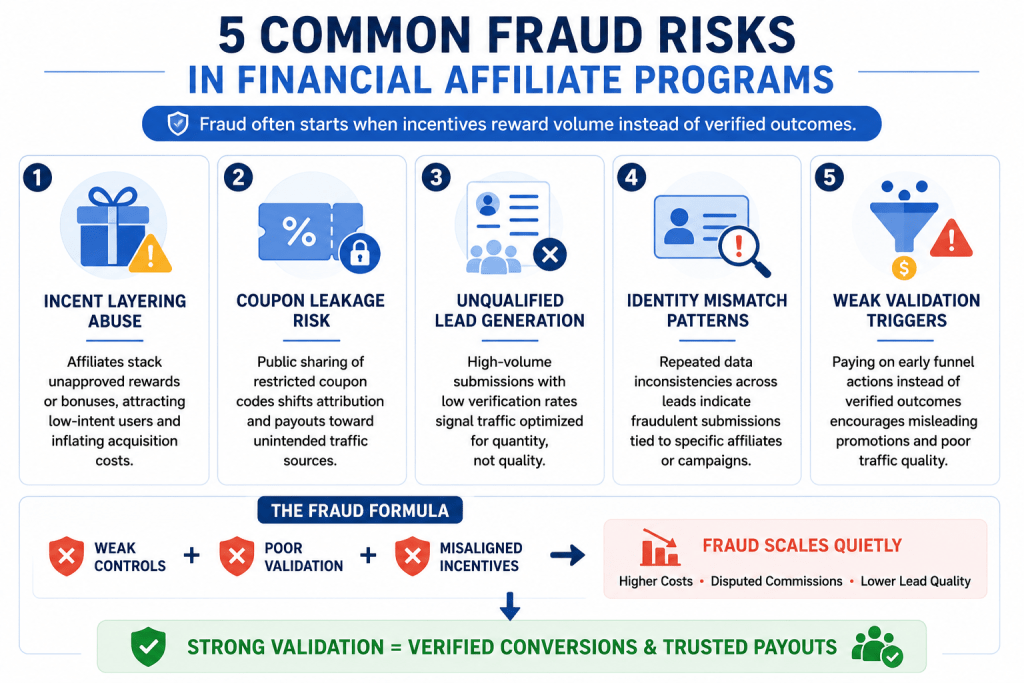
Common fraud patterns in financial affiliate programs usually come from misaligned incentives and weak validation points.
When controls are unclear, affiliates optimize for payouts instead of verified outcomes, which increases risk and acquisition costs.
- Incent Layering Abuse: Affiliates stack unapproved rewards or bonuses, attracting low-intent users and inflating acquisition costs without delivering qualified conversions.
- Coupon Leakage Risk: Public sharing of restricted coupon codes shifts attribution and payouts toward unintended traffic sources.
- Unqualified Lead Generation: High-volume submissions with low verification rates signal traffic optimized for quantity, not quality.
- Identity Mismatch Patterns: Repeated data inconsistencies across leads indicate fraudulent submissions tied to specific affiliates or campaigns.
- Weak Validation Triggers: Paying on early funnel actions instead of verified outcomes encourages misleading promotions and poor traffic quality.
When incentives and validation points are not aligned, fraud scales quietly through normal-looking performance data.
Strengthening controls ensures commissions reflect real, verified customer activity rather than manipulated conversion signals.
Best Practices to Build a Compliant and Scalable Program
A scalable affiliate program in financial services depends on structured rules, controlled access, and clear traffic routing.
When incentives, permissions, and destinations are aligned, programs grow without introducing compliance or tracking risk.
Commission Rules That Prevent Mis-Selling
Strong commission structures start by aligning payouts with verified outcomes instead of early funnel actions.
This reduces incentive for exaggerated claims and ensures affiliates focus on qualified conversions, not just volume.
- Pay commissions only on approved, verified conversions
- Disqualify duplicates, cancellations, and self-referred transactions
- Ban misleading claims like guaranteed approvals or outcomes
- Tie payouts to events that support audit validation
When commission logic is tied to real outcomes, partner behavior aligns naturally. This creates a system where payouts reflect actual value, not promotional exaggeration.
Tiered Access Based on Partner Risk
Not all affiliates should operate with the same level of access from the start. A tiered system allows you to expand permissions only after performance and compliance consistency are proven.
- Start new partners with limited creatives and pages
- Expand access after consistent, compliant performance signals
- Restrict high-risk partners to tighter promotion boundaries
- Offer custom terms only to proven low-risk affiliates
This approach reduces early-stage risk while supporting long-term growth. It ensures that higher access is earned through reliable, compliant performance.
Marketing Groups for Controlled Traffic Routing
Traffic control is critical in financial services, where every landing page must align with compliance requirements.
Marketing groups ensure affiliates only send traffic to pre-approved destinations tied to specific disclosures.
- Assign one marketing group per approved landing page
- Set alternate incoming pages for controlled routing
- Match creatives with correct disclosures and landing pages
- Avoid reusing pages across unrelated affiliate groups
When traffic routing is controlled, compliance becomes easier to maintain. It ensures every conversion path is consistent, traceable, and aligned with approved messaging.
Bottom Line: How Affiliate Marketing Works for Financial Services
Instant account set up. All features unlocked in base plan. Professional onboarding included.
Create Your Affiliate Program
Affiliate marketing in financial services only works when control, tracking, and compliance operate together as one system.
By structuring partner access and attribution rules, it creates a reliable connection between promotions and verified outcomes.
Control and accountability determine everything.
When affiliate programs are built on verified tracking and approved workflows, they scale with fewer disputes, stronger compliance, and clearer performance visibility:
- Controlled partner access: ensures only approved affiliates promote regulated financial offers.
- Pre-approved messaging: keeps promotions compliant across all channels and placements.
- Accurate attribution tracking: connects every click to verified conversions across devices.
- Outcome-based commission rules: align payouts with approved, validated customer actions.
iDevAffiliate brings these elements into one structured system, where tracking, compliance, and payouts remain consistent across every partner interaction.
Affiliate programs grow stronger when every action is controlled and measurable.
Start a free trial of iDevAffiliate to see how structured tracking and compliant workflows perform in real financial campaigns.
Frequently Asked Questions (FAQS)
You may also like

How to Set Up an Affiliate Program on BigCommerce

How to Set Up an Affiliate Program on WooCommerce

How to Set Up an Affiliate Program on Shopify

First Steps: 6 FREE Marketing Ideas For Your New Affiliate Program
Create Your Affiliate Program
- Unlimited Affiliates
- Unlimited Commissions
- Built-In SEO Links
- Social Media Sharing
- Affiliate Program Directory
