
How to Start a Financial Affiliate Program

Affiliate tracking in financial programs requires structured attribution, controlled messaging, and verified conversion logic from the start. This ensures every referral is accurately credited, commissions reflect real outcomes, and reporting stays aligned with actual customer activity.
Here’s what matters most:
- Attribution rules that reflect longer financial buying cycles
- Tracking that connects clicks to verified conversions
- Commission logic tied to approved and completed outcomes
- Reduced attribution gaps across devices and return visits
- Consistent reporting aligned with real revenue data
- Stronger partner trust through transparent tracking systems
Affiliate software assigns each partner a unique tracking link or identifier, connecting referral activity to a specific source from the first click.
More advanced setups also use email address tracking, linking that referral to a verified customer identity instead of relying only on browser sessions.
Attribution windows define how long that referral remains valid, ensuring affiliates still receive credit even when customers return later or switch devices.
With this structure in place, each conversion is matched back to the correct affiliate once, keeping attribution accurate and preventing duplicate or missing commissions.
The sections below explain how financial affiliate programs operate differently, how to structure compliance and payouts correctly, and how to build a tracking system that delivers accurate, scalable, and defensible performance.
What Makes Financial Affiliate Programs Different
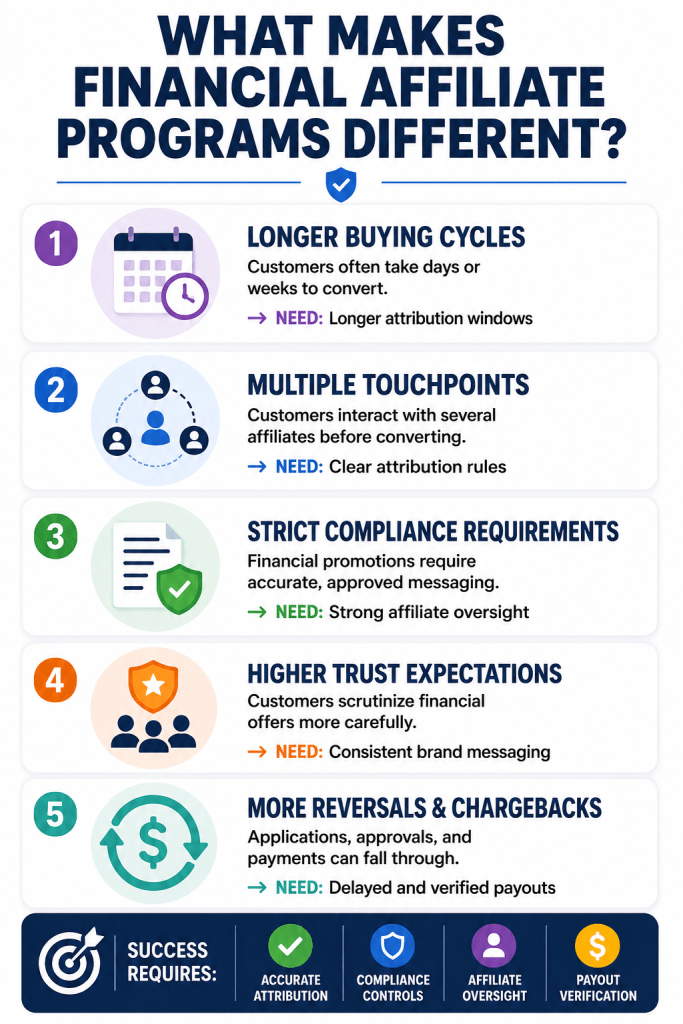
Financial affiliate programs require more structure than standard performance channels.
Longer buying cycles, stricter messaging rules, and higher reversal rates change how attribution, compliance, and payouts must be handled.
Without alignment, small gaps quickly turn into disputes.
Longer Buying Cycles Require Smarter Attribution
Financial purchase decisions rarely happen on the first click, often involving multiple sessions across days or weeks.
Short attribution windows miscredit conversions and undervalue early-stage partners who influence consideration.
Longer, clearly defined windows ensure attribution reflects real customer journeys.
Multi-Touch Journeys Complicate Credit Assignment
Customers interact with multiple affiliates before converting, making single-touch attribution models unreliable. Without defined rules, credit shifts unpredictably toward final interactions instead of true demand drivers.
Structured attribution logic ensures consistent, defensible commission decisions across complex journeys.
Strict Messaging Control Increases Oversight Needs
Financial products require precise, compliant messaging, where even minor claim variations can create regulatory exposure. Affiliates often simplify messaging to improve conversions, increasing risk.
Pre-approved claims and active monitoring ensure all promotions remain accurate, consistent, and compliant.
Higher Trust Requirements Amplify Brand Risk
Customers evaluate financial offers with greater scrutiny, making affiliate messaging a direct reflection of your brand.
Misleading claims or exaggerated benefits damage credibility quickly. Controlled communication and clear enforcement processes protect both customer trust and long-term program stability.
Frequent Reversals Demand Strong Payout Controls
Finance programs experience more reversals due to failed applications, verification issues, or chargebacks. Paying too early increases clawbacks and disputes with affiliates.
Defining clear conversion triggers and delayed payouts ensures commissions align with verified, completed outcomes.
When these factors are understood early, you avoid misattribution, compliance gaps, and payout conflicts before they scale.
The next step is turning this understanding into clear rules, approvals, and controls that govern how affiliates actually operate.
Compliance and Legal Requirements Before Affiliate Launch
Compliance in financial affiliate programs must be structured before any promotion begins.
Clear rules, approval systems, and enforcement processes ensure affiliates operate within defined boundaries.
Without this foundation, small messaging gaps quickly turn into regulatory and payout risks.
Define Allowed Claims and Required Disclosures
Before affiliates promote your offer, you must control exactly what they can say. This reduces improvisation and ensures all messaging aligns with compliance standards.
- Create approved claims affiliates can use directly
- Ban guarantees, exaggerated benefits, and misleading phrasing
- Define where disclosures must appear across channels
- Restrict edits to sensitive product or results claims
Clear claim boundaries reduce ambiguity and prevent risky messaging. When affiliates know exactly what is allowed, compliance becomes easier to maintain.
Standardize Incentive and Coupon Rules
Incentives can drive growth, but without control, they create misleading expectations. You need consistent rules that define how offers, bonuses, and coupons are presented.
- Assign unique coupon codes to each affiliate
- Prohibit stacking or unapproved promotional combinations
- Define exact wording for bonuses and incentives
- Clarify reversal triggers tied to incentive misuse
Consistent incentive rules ensure one version of the offer everywhere. This keeps promotions aligned and prevents payout disputes from unclear messaging.
Build a Structured Enforcement Process
Rules only work when enforcement is predictable and consistently applied. A clear enforcement system ensures violations are handled quickly and fairly.
- Define warning, suspension, and termination stages clearly
- Set deadlines for correcting non-compliant promotions
- Pause commissions until violations are resolved
- Apply rules consistently across all affiliate partners
Structured enforcement removes subjectivity from compliance decisions. It ensures affiliates understand consequences and adjust behavior accordingly.
Create a Repeatable Audit Routine
Ongoing audits ensure affiliate promotions stay aligned after launch. Without regular checks, small issues can scale into compliance risks quickly.
- Review new affiliates more frequently early on
- Audit top-performing partners on a regular schedule
- Re-check content after offer or disclosure changes
- Validate claims, disclosures, and incentive messaging
A consistent audit cadence keeps promotions accurate over time. It allows you to catch and correct issues before they spread.
Maintain Documentation and Evidence Trails
Every compliance action should be documented and easy to verify. This creates accountability and protects your program during disputes or reviews.
- Store screenshots, URLs, and timestamps of promotions
- Record policy violations with exact rule references
- Maintain logs of enforcement actions and decisions
- Keep version history of approved marketing materials
Strong documentation makes compliance defensible and transparent. It ensures every decision can be explained, verified, and repeated consistently.
When compliance is structured clearly, affiliates operate within defined boundaries instead of assumptions.
The next step is aligning commissions and payouts with these rules so every conversion translates into predictable, defensible outcomes.
Structure Commission Logic and Payout Rules You Can Defend
A strong commission structure aligns payouts with real business value while keeping incentives clear for affiliates.
When rules are predictable and tied to verified outcomes, disputes decrease and partner trust increases.
Align Commission Models With Product Value
Commission structures should reflect the actual value and effort behind each conversion. This ensures affiliates are rewarded fairly without putting pressure on your margins.
- Set product specific commissions based on offer value
- Use CPA, percentage, or recurring payout models
- Apply sliding scale commissions for higher-value transactions
- Define clear rules for commissionable conversion events
When commissions match product economics, payouts stay sustainable. This creates a system affiliates trust and you can defend financially.
Use Tiered and Performance-Based Incentives
Not all affiliates perform equally, so your payout structure should reflect that. Tiered incentives encourage growth while rewarding high-quality traffic sources.
- Create payout levels for different affiliate tiers
- Offer performance bonuses for high-converting partners
- Increase payouts based on consistent performance milestones
- Reward affiliates who drive higher-value customer actions
Performance-based structures motivate better partner behavior over time. They also help you scale without overpaying low-quality traffic.
Control Payout Timing With Status Triggers
Separating tracked events from payable commissions reduces conflicts and errors. Affiliates should see progress clearly from tracked to approved conversions.
- Delay commissions until conversion meets approval criteria
- Use delayed commission processing for validation periods
- Define clear approval triggers for payout eligibility
- Set consistent payout schedules across all affiliates
Status-based payouts prevent premature payments and clawbacks. They create transparency and reduce “missing commission” disputes.
Define Recurring and Long-Term Commission Logic
Some financial products generate ongoing value, requiring long-term payout rules. Recurring structures must be clearly defined to avoid duplicate or inflated commissions.
- Offer recurring commissions for subscription-based products
- Set limits on rebills or lifetime commission eligibility
- Tie recurring payouts to active, verified customer status
- Prevent duplicate triggers across billing cycles
Clear recurring rules ensure affiliates are rewarded correctly over time. They also prevent overpayment caused by misconfigured renewal tracking.
Build Clear Clawback and Reversal Rules
Reversals are common in financial programs and must be handled consistently. Clear clawback rules protect your margins while maintaining affiliate trust.
- Define triggers like refunds, fraud, or verification failures
- Set time limits for valid commission reversals
- Apply partial or full reversals based on event type
- Document dispute handling and required evidence clearly
Consistent clawback rules reduce friction and confusion. They ensure every payout reflects verified, completed customer activity.
When commission rules are clearly defined, payouts become predictable instead of reactive.
The next step is ensuring your tracking and attribution systems support these rules with accurate, consistent data across every conversion path.
Set Up Tracking and Attribution Systems for Traffic
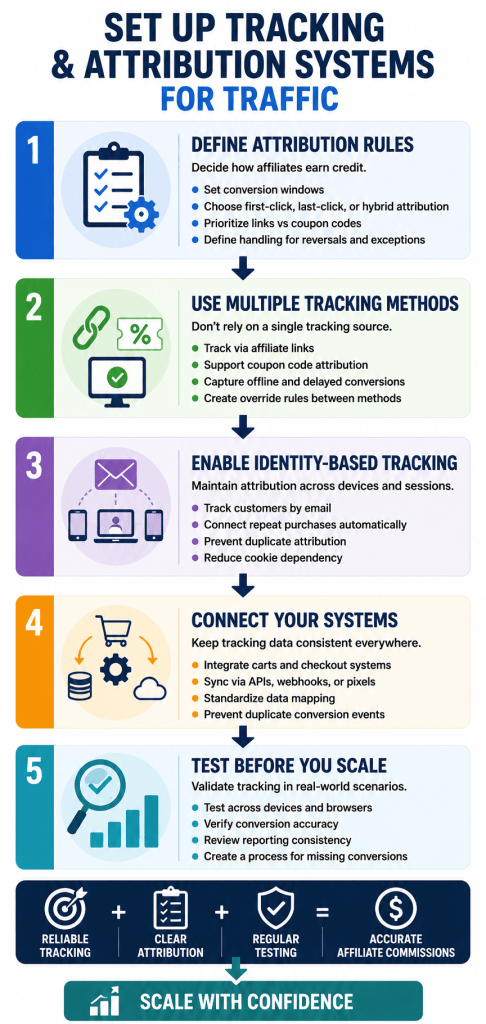
Reliable tracking systems combine clear attribution rules with flexible, multi-layered data capture.
When tracking logic, integrations, and validation methods align, you reduce missing conversions and ensure every action maps to a single, verifiable outcome.
Define Conversion Windows and Attribution Priorities
Attribution starts with clear rules that determine how and when affiliates earn credit. Without defined priorities, multi-touch journeys create inconsistent and disputed outcomes.
- Set adjustable tracking duration based on buying cycles
- Define attribution model: last-click, first-click, or hybrid
- Establish clear priority between links and coupon codes
- Document exception handling for missing or reversed conversions
Consistent attribution rules eliminate ambiguity in commission decisions. They ensure affiliates understand exactly how credit is assigned across journeys.
Combine Multiple Tracking Methods for Accuracy
No single tracking method captures every real-world scenario effectively. Using layered tracking ensures conversions are recorded even when one method fails.
- Use tracking pixels for standard conversion flows
- Enable coupon/promo codes for link-free attribution scenarios
- Support offline or delayed conversions through code usage
- Define clear override rules between tracking methods
Multi-method tracking improves coverage across devices and sessions. It also reduces attribution gaps caused by broken links or user behavior shifts.
Implement Identity-Based Tracking for Continuity
Session-based tracking alone cannot handle long or multi-device journeys. Identity-based systems maintain attribution even when sessions break or reset.
- Use email address tracking to link users persistently
- Maintain one-to-one relationship between customer and affiliate
- Prevent duplicate attribution across multiple sessions
- Support long-term attribution without relying on cookies
Identity tracking ensures conversions remain connected over time. It eliminates duplication risks caused by fragmented user journeys.
Standardize Integrations Across Systems
Disconnected tools often create duplicate signals and attribution conflicts. Consistent integrations ensure data flows cleanly between all systems.
- Use automated integration with carts and checkout systems
- Sync data via API calls, webhooks, or tracking pixels
- Ensure consistent data mapping across all platforms
- Prevent duplicate triggers from overlapping integrations
Standardized integrations reduce silent tracking failures. They create a unified system where every conversion is captured once.
Test Tracking Systems Across Real Scenarios
Testing should focus on how tracking behaves under real conditions. Most issues appear during edge cases, not standard conversion flows.
- Run cross-device and multi-session test conversions
- Validate tracking across browsers, mobile, and blockers
- Check reporting fields for accuracy and consistency
- Create escalation process for missing conversion cases
Testing ensures your system performs reliably before scaling. It prevents disputes by validating attribution under real-world conditions.
When tracking and attribution are aligned, conversions are recorded accurately instead of inconsistently.
The next step is scaling this system carefully so growth does not introduce new gaps, disputes, or operational friction.
Launch and Scale Without Constant Fixes
Scaling a financial affiliate program requires structure before speed.
Controlled rollout, standardized processes, and consistent tracking ensure growth does not introduce compliance gaps or payout disputes.
Start With a Controlled Pilot Cohort
Begin with a small group of vetted affiliates you can monitor closely. Early-stage validation ensures your tracking, attribution, and payout systems work before scaling volume.
- Limit initial partners to a manageable pilot group
- Approve affiliates manually based on verified traffic sources
- Run test campaigns to validate attribution end to end
- Reconcile clicks, conversions, and commissions before scaling
A controlled pilot prevents small tracking issues from scaling. iDevAffiliate helps validate conversions early through structured reporting and test tracking flows.
Validate Tracking Before Expanding Partner Volume
Scaling without validated tracking leads to disputes and rework. You need to confirm that every tracking element behaves correctly across real-world scenarios.
- Test tracking links across devices and browsers
- Confirm pixel fires correctly on final conversion events
- Validate attribution rules against real user journeys
- Run test purchases to confirm accurate commission assignment
Early validation builds confidence in your tracking system. It ensures you scale only after your data is reliable and defensible.
Standardize Onboarding and Asset Distribution
Consistent onboarding reduces confusion and prevents off-brand promotions. Every affiliate should follow the same setup, messaging, and traffic routing process.
- Create a single onboarding checklist for all partners
- Provide approved creatives and links in one location
- Use marketing groups to control landing page selection
- Define clear rules for claims and promotional methods
Standardization creates repeatable affiliate behavior. This keeps compliance and attribution aligned as your partner base grows.
Centralize Tracking, Links, and Reporting Systems
Fragmented systems create tracking gaps and inconsistent reporting. Centralizing these elements ensures every affiliate action is recorded and validated correctly.
- Assign unique tracking links to each affiliate
- Use one system for clicks, conversions, and reporting
- Enable real-time dashboards for affiliate visibility
- Maintain consistent attribution rules across all channels
Platforms like iDevAffiliate simplify this by combining tracking, attribution, and reporting in one system. This reduces manual errors and keeps your program stable as it scales.
Automate Reporting and Payout Workflows
Manual processes break quickly as affiliate volume increases. Automation ensures consistency in reporting, commission calculations, and payout handling.
- Schedule automated reports for affiliate performance
- Define payout statuses: pending, approved, and paid
- Automate commission calculations based on rules
- Run regular reconciliation checks during campaigns
Automation ensures every payout follows the same logic. This keeps your program predictable, scalable, and free from constant manual fixes.
When scaling is built on validated systems and standardized processes, growth becomes controlled instead of chaotic.
This ensures your affiliate program expands with consistency, accuracy, and confidence rather than constant fixes.
Bottom Line: Can You Build a Financial Affiliate Program That Scales Reliably?
Instant account set up. All features unlocked in base plan. Professional onboarding included.
Create Your Affiliate Program
Building a financial affiliate program is not just about launching offers, it is about structuring attribution, compliance, and payouts from the start.
When tracking, rules, and enforcement are aligned early, the entire program becomes predictable and easier to scale.
Attribution accuracy determines everything.
When your system connects referrals to verified actions instead of assumptions, affiliate programs operate with more consistency, fewer disputes, and clearer performance insights:
Email address tracking: connects each referral to a verified customer, preserving attribution across devices and sessions.
- Flexible attribution windows: ensure affiliates receive credit across longer financial decision cycles.
- Reliable commission tracking: ties every payout to approved, validated conversion events.
- Automated integrations: connect tracking, reporting, and payouts across platforms without duplication.
When these elements work together, your program becomes structured, auditable, and consistent across the full customer lifecycle.
Affiliate programs scale faster when tracking and payouts are dependable.
Start a free trial of iDevAffiliate to see how accurate, controlled affiliate tracking performs in real financial program conditions.
Frequently Asked Questions (FAQS)
You may also like

How to Set Up an Affiliate Program on BigCommerce

How to Set Up an Affiliate Program on WooCommerce

How to Set Up an Affiliate Program on Shopify

First Steps: 6 FREE Marketing Ideas For Your New Affiliate Program
Create Your Affiliate Program
- Unlimited Affiliates
- Unlimited Commissions
- Built-In SEO Links
- Social Media Sharing
- Affiliate Program Directory
