
How Affiliate Fraud Works and How to Prevent It

Affiliate fraud usually starts when tracking breaks between the affiliate click, the customer conversion, and the commission payout.
Once attribution becomes unreliable, it becomes harder to detect fraudulent activity and easier for manipulated commissions to look legitimate.
Affiliate tracking software helps reduce that risk by connecting referral activity, attribution rules, and conversion validation into one system.
Instead of relying on assumptions, the platform records how traffic was generated and which affiliate actually influenced the purchase.
Here’s what matters most:
- Track clicks, conversions, and referral activity accurately
- Validate attribution using cookies, postbacks, and identity-based tracking
- Apply commission rules consistently across affiliate interactions
- Hold payouts until conversions pass validation checks
- Maintain reporting records for disputes and fraud reviews
More advanced platforms, like iDevAffiliate, also use email address-based tracking to keep referrals connected to verified customer identities, even when cookies expire or customers switch devices.
Understanding how affiliate fraud works is the first step toward protecting commissions, attribution accuracy, and long-term affiliate trust.
What Affiliate Fraud Is and How It Works
Affiliate fraud happens when someone manipulates tracking links, attribution rules, or conversion signals so commissions are paid on activity that was not genuinely earned.
In simple terms, what is affiliate fraud? It is the manipulation of affiliate attribution systems to claim commissions without legitimately influencing the customer conversion process.
This is where affiliate fraud and broader affiliate marketing scams often begin affecting reporting accuracy and commission trust over time.
Affiliate software connects three actions: the affiliate click, the customer conversion, and the partner who influenced the purchase.
When that connection becomes unreliable, fraud becomes much harder to detect.
Platforms with built-in Prevent Duplicates controls and Commission Blocking rules help stop invalid commissions before payouts are processed.
Tracking problems usually appear in a few predictable areas:
- Missing or incomplete referral data
- Cookie loss caused by browser privacy settings or cross-device behavior
- Conversion pixel or postback failures
- Attribution windows that stay open too long
- Duplicate or overwritten tracking sessions
Fraudsters often do not need to create fake purchases. They only need to insert themselves into the attribution path before the conversion occurs.
That is why last-click attribution models can become vulnerable when tracking controls are weak.
Common Types of Affiliate Fraud
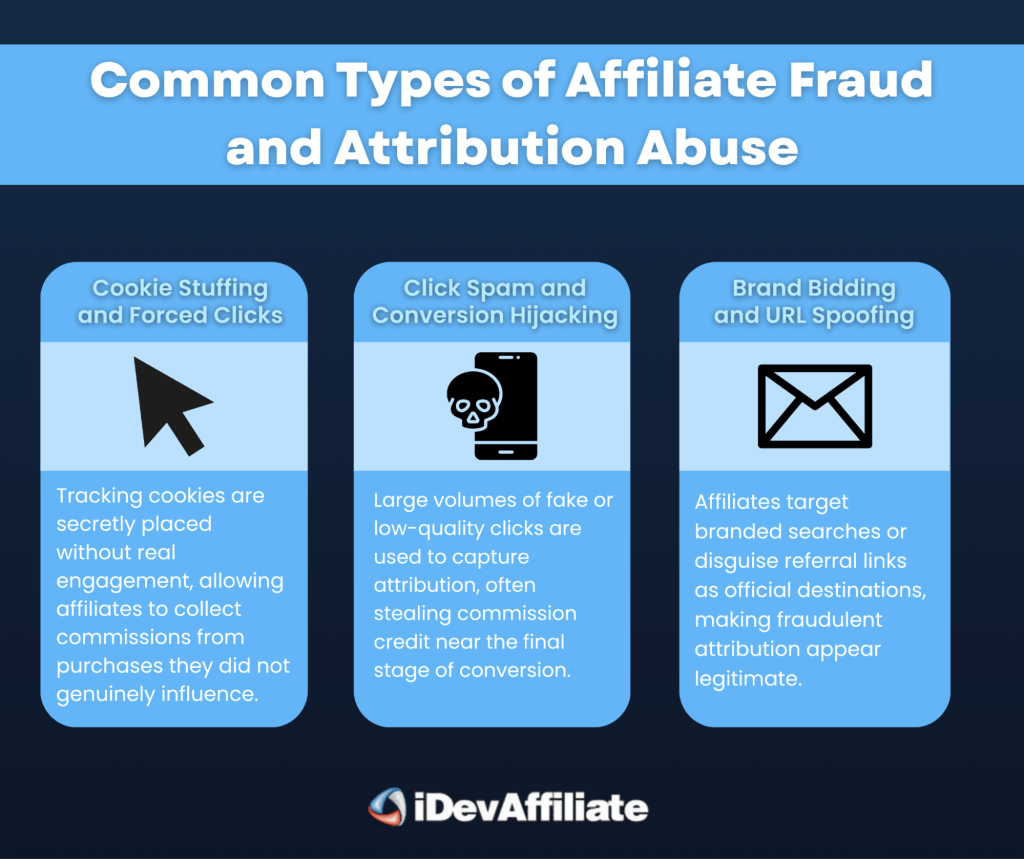
Most affiliate fraud follows repeatable attribution manipulation patterns designed to generate commissions without genuine customer influence or promotional value.
Fraudulent activity often hides inside normal-looking traffic, making weak attribution visibility one of the biggest risks for affiliate program accuracy.
Understanding common fraud tactics helps businesses detect suspicious reporting behavior before payout issues begin affecting profitability and affiliate trust.
1. Cookie Stuffing and Forced Clicks
Cookie stuffing places affiliate tracking cookies without legitimate user interaction or intentional affiliate link engagement occurring naturally.
Forced clicks work similarly by triggering hidden redirects that insert affiliate attribution into the customer journey invisibly afterward.
These tactics distort reporting accuracy by awarding commissions to affiliates without meaningful promotional influence over conversions.
2. Click Spam and Conversion Hijacking
Click spam floods affiliate programs with automated or low-quality clicks hoping legitimate buyers later fall inside attribution windows.
Conversion hijacking places affiliate tracking links close to checkout so fraudsters capture last-click attribution without creating original demand.
These attribution tactics weaken reporting accuracy while inflating commissions tied to low-value or manipulated referral activity.
3. Brand Bidding and URL Spoofing
Brand bidding happens when affiliates target branded search terms already likely to convert through existing customer demand organically.
URL spoofing disguises redirects as official brand destinations, making manipulated attribution appear legitimate inside affiliate reporting systems afterward.
Unchecked brand interception tactics slowly distort payout accuracy, affiliate trust, and long-term reporting reliability across programs.
4. Fake Leads and Form Fraud
Fake lead fraud generates commissions through fabricated signups, automated submissions, or low-quality customer information without real purchase intent.
These tactics commonly target pay-per-lead affiliate programs where conversions happen before deeper customer validation processes occur later.
Fraudulent lead activity increases payout risk while reducing confidence in affiliate conversion quality and reporting accuracy.
5. Duplicate Conversion Abuse
Duplicate conversion fraud happens when the same customer action triggers multiple affiliate commissions through repeated tracking signals accidentally.
Improper postback handling, duplicated pixels, or manipulated refresh activity can create inflated commission reporting across affiliate dashboards consistently.
Preventing duplicate conversions improves payout accuracy while reducing fraudulent commission leakage over longer reporting cycles.
6. Unauthorized Coupon Code Abuse
Coupon abuse happens when affiliates distribute unauthorized discounts through channels outside approved promotional agreements or intended audiences.
These tactics often intercept customers already planning to purchase, creating commissions without genuine affiliate-driven customer acquisition activity afterward.
Unauthorized coupon usage weakens attribution quality while increasing unnecessary payout and discount-related revenue loss significantly.
7. Toolbar and Adware Injection
Adware fraud injects affiliate tracking links through browser extensions, popups, or background software without customer awareness during browsing.
These tools overwrite existing attribution data and redirect commissions toward affiliates who did not influence the original purchase.
Adware-based attribution manipulation creates unreliable reporting visibility and damages trust across legitimate affiliate partnerships over time.
8. Domain Mimicking
Domain mimicking happens when affiliates use lookalike domains, misleading landing pages, or brand-style URLs to intercept customer traffic unfairly.
These tactics confuse buyers while making manipulated referrals appear legitimate inside affiliate tracking and reporting systems.
Domain mimicking damages brand trust while distorting attribution accuracy and commission validation across affiliate programs.
9. Attribution Overwriting and Session Theft
Attribution overwriting happens when affiliates insert themselves late into the customer journey before conversion activity finalizes successfully.
Session theft tactics redirect attribution credit away from affiliates who originally influenced the purchase or customer research process earlier.
These manipulations weaken affiliate trust while making commission reporting less reliable and harder to validate consistently.
How Affiliate Fraud Damages Program Performance
Affiliate fraud rarely stays isolated to one bad commission payout.
Once attribution data becomes unreliable, the financial impact spreads into reporting, budgeting, partner relationships, and long-term program trust.
The damage compounds because fraudulent activity often looks legitimate inside affiliate dashboards until patterns are investigated more closely.
Over time, even small attribution gaps caused by affiliate abuse can distort how the entire program operates.
1. Commission Leakage
Affiliate fraud increases commission costs without generating equivalent business growth.
Fraudulent clicks, leads, or attributed sales create payouts that appear valid in reporting, even when the affiliate did not genuinely influence the customer conversion or purchasing decision.
2. Distorted Performance Data
Once attribution data becomes unreliable, decision-making starts drifting in the wrong direction.
Inflated conversion numbers can push brands to increase commissions, reward low-quality affiliates, or shift budget away from partners actually driving profitable customer acquisition.
Many affiliate marketing scams continue scaling because manipulated attribution initially appears profitable inside affiliate reporting systems.
3. Refund and Chargeback Exposure
Fraudulent affiliate activity often creates downstream operational costs beyond the original commission payout.
Refunds, canceled orders, and chargebacks can leave businesses paying commissions on transactions that later disappear from recognized revenue entirely.
4. Lower Affiliate Trust
Strong affiliates notice when manipulated attribution consistently receives commission credit.
If trustworthy partners feel the program rewards loopholes instead of genuine promotion, engagement drops, recruitment becomes harder, and long-term affiliate retention weakens over time.
Repeated attribution manipulation can eventually create broader concerns around overall affiliate program violation enforcement and payout fairness.
5. Slower Internal Growth Decisions
When reporting accuracy becomes questionable, leadership teams become more cautious about scaling affiliate programs.
Finance, operations, and marketing teams spend more time validating numbers, reviewing disputes, and investigating anomalies instead of focusing on program expansion.
Most affiliate fraud becomes visible through reporting inconsistencies long before it appears as a confirmed payout dispute.
Recognizing those early attribution and traffic anomalies helps prevent fraudulent activity from quietly scaling inside your affiliate program.
Warning Signs of Affiliate Fraud
Instant account set up. All features unlocked in base plan. Professional onboarding included.
Create Your Affiliate Program
Fraudulent affiliate activity usually creates patterns that look strong in isolation but weak in business context.
The goal is not to question every traffic spike, but to identify activity that does not align with normal customer behavior, campaign timing, or legitimate promotion methods.
- Traffic Spikes Without Campaign Activity: Sudden click surges without promotions, launches, or seasonal demand often signal artificial or manipulated affiliate traffic.
- One Affiliate Driving Unusual Volume: Large traffic increases from a single affiliate while all other channels remain stable deserve closer attribution review.
- Clicks Without Revenue Growth: High click counts paired with weak revenue, tiny baskets, or excessive discount usage often indicate low-quality traffic.
- Unnatural Conversion Timing: Instant conversions or repeated purchase timing patterns can suggest forced clicks, click injection, or attribution manipulation.
- Missing Referrer Concentration: High volumes of “N/A” or hidden referring URLs isolated to one affiliate may indicate obscured traffic sources.
- Irrelevant Referral Sources: Traffic appearing from unrelated domains, redirects, or shortened URLs can hide the true origin of affiliate clicks.
- Late-Stage Attribution Patterns: Affiliates consistently appearing right before checkout may be intercepting commissions instead of generating original demand.
The strongest fraud signals usually come from repeated inconsistencies across attribution, conversion timing, and traffic quality rather than one isolated reporting anomaly.
The earlier suspicious activity gets identified, the easier it becomes to limit payout exposure and protect attribution accuracy.
That is why effective fraud prevention depends on combining visibility, validation rules, and controlled commission workflows inside one system.
Detecting and Preventing Affiliate Fraud
Affiliate fraud prevention works best when tracking visibility, attribution validation, and payout controls operate together across the affiliate workflow.
Most fraudulent activity becomes easier to identify once businesses standardize attribution rules, approval processes, and commission validation consistently.
When fraud controls remain structured and transparent, affiliate programs become easier to scale without creating unreliable reporting or payout disputes.
1. Manual Affiliate Approvals and Signup Controls
Affiliate fraud prevention should begin before affiliates receive tracking access or commission eligibility inside the platform.
Manual reviews, signup restriction rules, and affiliate verification controls help businesses identify suspicious applications before attribution becomes active.
Structured onboarding workflows reduce risks tied to fake affiliates, affiliate abuse, and manipulated referral activity long term.
2. Delayed Payouts and Commission Restrictions
Immediate payouts increase fraud exposure when fake leads, refunds, or invalid conversions appear after commissions are already released.
Delayed commission processing, amount restrictions, and commission blocking controls help businesses validate attribution quality before payouts move forward.
These controls reduce financial exposure while improving payout accuracy and affiliate reporting reliability consistently.
3. Controlled Attribution and Conversion Validation
Reliable affiliate tracking depends on validating clicks, conversions, referral signals, and attribution windows together throughout customer journeys.
Long attribution periods increase risks tied to cookie stuffing, overwritten sessions, duplicate referrals, and manipulated conversion activity later.
iDevAffiliate supports layered attribution validation and duplicate prevention controls for cleaner affiliate reporting visibility consistently.
4. Secure Access and Authentication Protection
Affiliate fraud risks increase when approval workflows, payout systems, and attribution controls lack strong internal security protections.
Two-step verification, secure authentication keys, and controlled access permissions help reduce unauthorized affiliate management activity significantly.
Stronger authentication workflows improve payout security while protecting attribution accuracy and commission reporting long term.
5. Traffic, Coupon, and Referral Monitoring
Fraudulent affiliate activity often hides inside abnormal traffic spikes, unauthorized coupon usage, and suspicious referral behavior patterns.
Traffic quality monitoring helps businesses identify click spam, low-quality referrals, manipulated discount activity, and artificial engagement faster.
Consistent referral monitoring improves attribution accuracy while reducing unreliable commission payouts across affiliate programs.
6. Attribution Auditing and Enforcement Rules
Affiliate fraud becomes harder to control when attribution changes and referral inconsistencies remain hidden inside reporting workflows.
Audit-ready reporting and consistent enforcement policies help businesses review conversion timing, attribution paths, and suspicious commission activity more accurately.
Clear enforcement discourages affiliate marketing scams while strengthening affiliate trust and long-term reporting transparency consistently.
Bottom Line: Affiliate Fraud Prevention Starts With Better Attribution
Instant account set up. All features unlocked in base plan. Professional onboarding included.
Create Your Affiliate Program
Affiliate fraud becomes much easier to control when your tracking, attribution, and payout workflows operate inside one reliable system.
The goal is not just to detect suspicious activity after commissions are paid, but to reduce the attribution gaps that fraud depends on in the first place.
When your affiliate platform clearly defines how clicks are tracked, how conversions are validated, and how commissions are approved, reporting becomes more trustworthy and enforcement becomes easier to manage:
- Identity-Based Tracking: Connect referrals to verified customer identities instead of relying only on browser sessions.
- Consistent Attribution Rules: Apply the same attribution logic across clicks, conversions, and affiliate touchpoints.
- Commission Blocking Controls: Prevent invalid payouts using amount restrictions, duplicate prevention, and suspicious activity filtering workflows.
- Secure Access Protection: Strengthen affiliate management using signup controls, two-step verification, and protected authentication access keys.
- Audit-Ready Reporting: Maintain a complete record of clicks, conversions, attribution changes, and commission activity.
Together, these controls help affiliate programs reduce fraudulent payouts while protecting legitimate partner relationships and reporting accuracy.
If you want to strengthen attribution reliability and reduce affiliate fraud risk, start a free trial with iDevAffiliate and test the platform against your real affiliate workflow.
Frequently Asked Questions (FAQS)
You may also like

How to Set Up an Affiliate Program on BigCommerce

How to Set Up an Affiliate Program on WooCommerce

How to Set Up an Affiliate Program on Shopify

First Steps: 6 FREE Marketing Ideas For Your New Affiliate Program
Create Your Affiliate Program
- Unlimited Affiliates
- Unlimited Commissions
- Built-In SEO Links
- Social Media Sharing
- Affiliate Program Directory
