
How to Prevent Duplicate Conversions in Affiliate Marketing

The best way to prevent duplicate conversions is to track each transaction with a unique identifier, fire conversion events only once, and use attribution rules that prevent overlapping commission credits.
Affiliate tracking accuracy depends on consistent event validation and a clear system for identifying each transaction only once. Without this structure, duplicate conversions can quietly inflate payouts, distort performance data, and weaken trust across your affiliate program.
Here’s what matters most:
- Single-event tracking tied to verified purchase completion
- Unique transaction IDs to block duplicate conversion signals
- Attribution rules that prevent overlap between tracking methods
- Identity-based tracking to unify customer activity across sessions
- Controlled integrations that eliminate parallel tracking conflicts
- Consistent reporting aligned with real transaction data
At iDevAffiliate, we’ve built our platform around these principles, including advanced email-based tracking that helps ensure conversions are attributed accurately even when customers switch devices, return later to purchase, or bypass traditional cookie-based tracking methods.
The sections below explore the most common causes of duplicate conversions, their impact on payouts and reporting accuracy, and the methods affiliate managers can use to maintain clean, reliable tracking.
What Causes Duplicate Conversions in Affiliate Tracking Systems
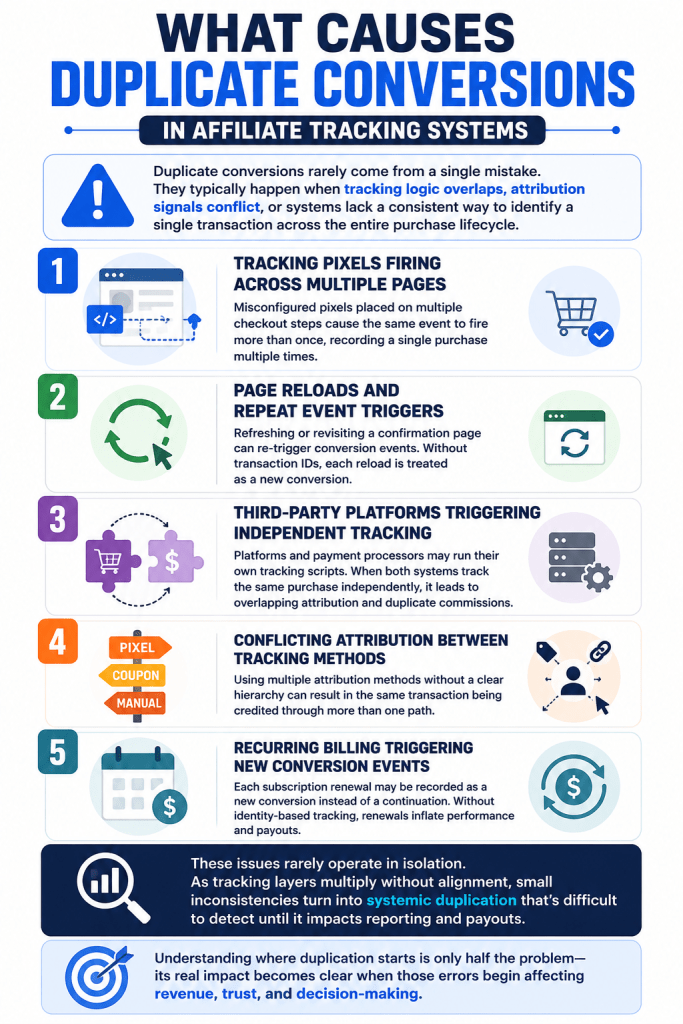
Duplicate conversions rarely come from a single mistake.
They typically happen when tracking logic overlaps, attribution signals conflict, or systems lack a consistent way to identify a single transaction across the entire purchase lifecycle.
1. Tracking Pixels Firing Across Multiple Pages
Duplicate conversions often begin with misconfigured tracking pixels placed across multiple steps in the checkout flow.
When the same event fires on both checkout and confirmation pages, a single purchase is recorded more than once.
2. Page Reloads and Repeat Event Triggers
Conversion tracking relies on page load events, which means simple user behavior like refreshing or revisiting a confirmation page can trigger duplicate conversions.
Without safeguards like transaction IDs, the system treats each reload as a new conversion event.
3. Third-Party Platforms Triggering Independent Tracking
Ecommerce platforms and payment processors often run their own tracking scripts, creating parallel conversion signals outside your affiliate system.
When both systems register the same purchase independently, attribution overlaps and results in multiple commission credits for a single order.
4. Conflicting Attribution Between Tracking Methods
Using multiple attribution methods simultaneously, such as pixels, coupons, and manual assignments, can create conflicts when systems do not reconcile ownership correctly.
Without a clear hierarchy, the same transaction may be credited through more than one attribution path.
5. Recurring Billing Triggering New Conversion Events
Subscription and recurring billing models introduce duplication when each renewal is treated as a new conversion instead of a continuation.
Without identity-based tracking, systems fail to link repeat charges to the original referral, inflating affiliate performance and payouts.
These issues rarely operate in isolation. As tracking layers multiply without alignment, small inconsistencies turn into systemic duplication that’s difficult to detect until it impacts reporting and payouts.
Understanding where duplication starts is only half the problem, its real impact becomes clear when those errors begin affecting revenue, trust, and decision-making.
How Duplicate Conversions Damage Affiliate Accuracy and Payouts
Duplicate conversions do more than inflate numbers. They distort performance data, misalign commissions, and create financial and operational pressure that compounds over time if not corrected early.
Inflated Payouts That Exceed Real Revenue
Duplicate conversions cause commission payouts to exceed actual revenue generated from a transaction.
When the same purchase is recorded multiple times, your affiliate costs increase without any corresponding business value being created.
Hidden Tracking Errors That Compound Over Time
Most duplicate conversion issues do not appear immediately and often go unnoticed during active campaigns.
Over time, small discrepancies accumulate into significant reporting gaps, making it harder to reconcile affiliate performance with actual business results.
Clawbacks That Disrupt Affiliate Relationships
Correcting duplicate payouts usually requires clawbacks, which introduce friction between you and your affiliates.
Even when justified, reversing commissions creates confusion and weakens trust if affiliates cannot clearly verify what went wrong.
Reputation Damage Across Affiliate Networks
Affiliates talk, especially when payout issues repeat.
Programs known for inconsistent tracking or frequent reversals quickly develop a negative reputation, making it harder to recruit and retain high-quality partners who expect reliable and transparent commission systems.
Performance Data That Loses Decision Value
When duplicate conversions distort reporting, your data becomes unreliable for decision-making.
Attribution insights, partner performance, and ROI calculations lose accuracy, leading to poor optimization decisions and misallocation of marketing resources
Left unaddressed, these issues compound into margin loss, reporting instability, and declining affiliate trust over time.
To deduplicate data, you need a structured system that prevents duplication at the source rather than correcting it after the fact.
9 Methods To Prevent Duplicate Conversion Tracking Errors
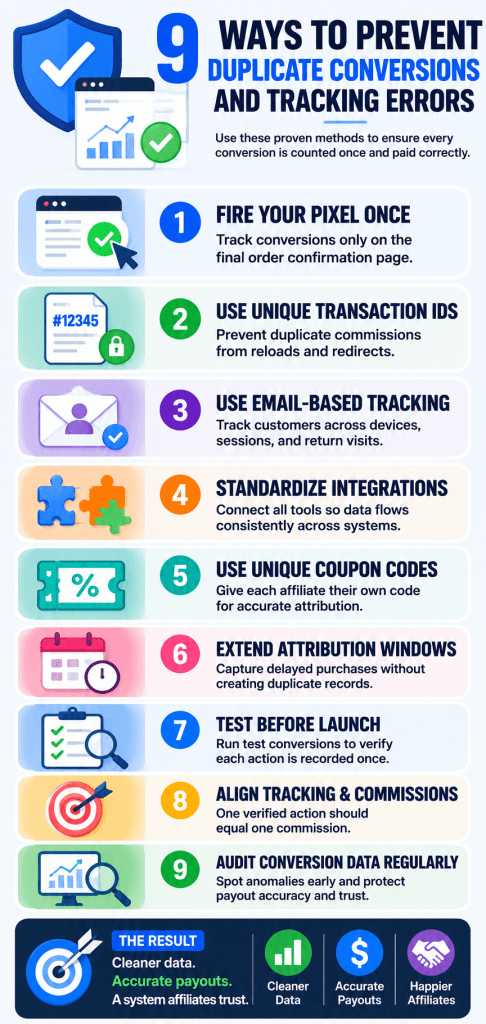
Preventing duplicate conversions requires more than one fix. You need a structured approach that combines pixel control, identity tracking, and attribution safeguards to ensure every conversion is counted once and tied to the correct affiliate.
Restrict Pixel Firing to a Single Verified Event
The most reliable way to prevent duplicates is ensuring your tracking pixel fires only once per confirmed order.
This means placing it exclusively on the final confirmation page and tying it to a unique transaction identifier.
Use Unique Transaction IDs for Validation
A transaction ID acts as a safeguard against repeated conversion signals from reloads or redirects.
When the same ID appears twice, the system recognizes it as a duplicate and blocks additional commission credit from being recorded.
Implement Identity-Based Tracking for Continuity
Email-based tracking connects each customer to a single affiliate using a verified identifier instead of session data.
This ensures conversions are not double-counted across devices, sessions, or delayed return visits.
Standardize Integrations Across All Systems
Tracking inconsistencies often come from disconnected tools and platforms firing independent events.
Automated integrations using webhooks, APIs, or plugins ensure data flows consistently across systems, reducing duplicate triggers and mismatched attribution signals.
Use Coupon Attribution as a Controlled Backup
Coupon codes provide a fallback attribution method when links or pixels fail, but only when managed correctly.
Assigning unique coupon codes to each affiliate ensures every redemption maps to one partner, preventing duplicate crediting across multiple sources.
Extend Attribution Windows Without Recounting Events
Longer attribution windows help capture delayed conversions without creating duplicate records.
Adjustable tracking duration ensures the same user remains linked to one affiliate over time, without re-triggering new conversions for repeat actions.
Validate Tracking with Pre-Launch and Ongoing Tests
Testing is critical to catch duplicate risks before they affect payouts.
Run controlled test conversions across devices and scenarios to confirm that each action is recorded once and attributed correctly.
Align Tracking Logic With Commission Rules
Even accurate tracking can fail if commission rules allow duplicate triggers.
Define clear payout conditions so that one verified action equals one commission, regardless of how many tracking signals are generated.
Monitor and Audit Conversion Data Integrity
Duplicate issues often surface gradually through reporting discrepancies.
Regular audits help identify anomalies early, allowing you to correct tracking behavior before it impacts affiliate trust or financial accuracy.
When these methods work together, duplicate conversions stop being a recurring issue and become a controlled edge case.
The result is cleaner data, accurate payouts, and a system affiliates can trust.
Maintaining Clean Conversion Data in Affiliate Tracking
Clean conversion data comes from consistent validation, not one-time fixes. Small gaps in tracking, attribution, or customer assignment can quietly distort payouts over time.
These practices help maintain accuracy, prevent duplication, and ensure every conversion remains verifiable.
- Audit Data Regularly: Compare traffic and conversion reports across platforms to detect discrepancies early before they compound into larger payout and reporting issues.
- Cross-Check Customer Identity: Match customer emails against affiliate records to prevent duplicate assignments and ensure each user remains linked to a single, verified affiliate source.
- Monitor Affiliate Feedback: Track complaints about missing or incorrect commissions as early indicators of tracking gaps or attribution inconsistencies within your system.
- Investigate Minor Discrepancies: Treat even small data mismatches as signals, because minor errors can scale quickly into significant financial and reporting inaccuracies.
- Enable Manual Attribution Control: Assign customers to affiliates when links are bypassed, ensuring attribution continuity without creating duplicate or conflicting commission records.
When these practices are applied consistently, conversion data remains clean, traceable, and aligned with actual customer behavior.
This creates a reliable foundation for accurate payouts, stronger affiliate trust, and scalable program performance.
Bottom Line: How to Prevent Duplicate Conversions Reliably
Preventing duplicate conversions is not just a technical fix, it is a structural decision in how your affiliate tracking operates.
When tracking logic, attribution rules, and validation methods are aligned, your system records each transaction once and ties it to the correct affiliate.
Conversion accuracy determines everything.
When your system validates each conversion instead of reacting to overlapping signals, affiliate programs operate with cleaner data, fewer disputes, and more reliable performance insights:
- Unique transaction IDs: ensure each purchase is recorded once, blocking duplicate conversion events.
- Identity-based tracking: connects conversions to verified customers, preventing duplication across devices and sessions.
- Controlled attribution logic: assigns each transaction to a single affiliate without conflicting signals.
- Automated integrations: synchronize tracking across platforms to eliminate duplicate triggers and reporting mismatches.
When these elements work together, your tracking system becomes consistent, auditable, and aligned with real business outcomes.
Affiliate programs perform better when conversion data is accurate and dependable.
Start a free trial of iDevAffiliate to see how structured tracking prevents duplicate conversions in real affiliate program environments.
Frequently Asked Questions (FAQS)
You may also like

How to Set Up an Affiliate Program on BigCommerce

How to Set Up an Affiliate Program on WooCommerce

How to Set Up an Affiliate Program on Shopify

First Steps: 6 FREE Marketing Ideas For Your New Affiliate Program
Create Your Affiliate Program
- Unlimited Affiliates
- Unlimited Commissions
- Built-In SEO Links
- Social Media Sharing
- Affiliate Program Directory
