Open Source Affiliate Tracking: What Are Your Options?

Open source affiliate tracking software gives businesses access to source code they can modify, but it typically requires developer resources to maintain. Self-hosted commercial affiliate software offers a practical middle ground — full data ownership, no monthly SaaS fees, and stable vendor support without the maintenance burden of a raw open source project.
If you are researching affiliate software options, you have likely come across two categories: open source tools available at no license cost, and commercial self-hosted software purchased once and installed on your own server. Both give you control over your data. Both let you avoid per-month SaaS pricing. But they are not the same thing, and the differences matter significantly once you are running a live program with real affiliates expecting accurate, timely commissions.
This post breaks down how open source affiliate tracking software works, what the real trade-offs are, and what to look for in any self-hosted solution before you commit.
Open Source vs Self-Hosted Commercial: Quick Comparison
| Factor | Open Source | Self-Hosted Commercial | SaaS / Cloud |
|---|---|---|---|
| License cost | Free | One-time purchase | Monthly subscription |
| Data ownership | Full | Full | Vendor-managed |
| Maintenance responsibility | You (or your developer) | Vendor | Vendor |
| Vendor support | Community only | Yes — dedicated support | Yes |
| Update cadence | Varies by project activity | Regular, vendor-managed | Regular, vendor-managed |
| Developer requirement | High | Low to moderate | None |
| Long-term cost (3–5 years) | Developer hours + hosting | One-time fee + hosting | Monthly × 36–60 months |
| Email-based tracking | Rare | Yes (mature platforms) | Rarely |
| Multi-tier commissions | Varies | Yes (up to 10 levels) | Limited (1–2 levels typical) |
| Data portability on exit | Full | Full | Varies by vendor |
What “Open Source” Actually Means for Affiliate Tracking
Open source software makes its source code publicly available. Anyone can inspect it, fork it, modify it, and — depending on the license — redistribute it. For affiliate tracking, that sounds appealing: no vendor lock-in, no subscription fees, full transparency into how commissions are calculated.
The catch is maintenance. Affiliate tracking is not a static problem. Payment processors update their APIs. Cookie policies shift. New shopping cart platforms emerge. Browser privacy changes — like Apple’s Safari Intelligent Tracking Prevention, which blocks third-party cookies by default — change what “working tracking” even means. When you run open source software, keeping up with those changes is your responsibility.
The total cost of open source affiliate software is not the license fee — it is the developer hours you spend keeping it running as platforms, browsers, and payment APIs change around it.
According to the Synopsys Open Source Security and Risk Analysis Report, 89% of codebases contain open source components that are more than four years out of date. For affiliate tracking software specifically — where commission accuracy and payment processor compatibility are business-critical — running on an unmaintained codebase is a material operational risk.
Many businesses adopt open source affiliate tools expecting to save money and end up spending far more on customization and maintenance than a commercial license would have cost. Before evaluating any open source option, be honest about your internal technical capacity. If you do not have a PHP developer on staff, an open source tracking system is a risk, not a savings.
Self-Hosted Commercial Software as a Practical Middle Ground
Self-hosted commercial affiliate software occupies a different position. You install it on your own server or hosting account, your data never touches a third-party SaaS provider’s systems, and you pay a one-time fee rather than a monthly subscription. Unlike raw open source tools, you also get ongoing vendor support, regular updates, and a tested codebase maintained by people whose business depends on it working correctly.
For businesses that want data ownership without dedicating a development team to maintaining tracking infrastructure, this is typically the more realistic path. You can review the full feature set of a mature self-hosted platform to understand what a complete affiliate tracking solution looks like — multi-tier recruiting, coupon code tracking, API access, and integration with 175+ shopping carts don’t happen by accident. They represent years of iteration in production environments.
Self-hosted does not mean unsupported — it means you control where your data lives while a dedicated vendor handles updates, security patches, and integration compatibility.
The distinction matters when explaining the setup to stakeholders. You own the installation. You own the database. You are not dependent on a SaaS vendor’s uptime or pricing decisions. But you also have a vendor relationship that includes support, documentation, and a development roadmap — which is what separates a commercial self-hosted platform from a community-maintained open source project.
How Affiliate Tracking Actually Works Under the Hood
Whether you choose open source or commercial software, understanding the tracking mechanics is essential. Most affiliate programs rely on cookie-based tracking: a visitor clicks an affiliate link, a cookie is set in their browser, and if they purchase within the tracking window, the affiliate receives credit. Cookie duration is configurable — anywhere from a single session to lifetime attribution.
Cookie-only tracking has a well-documented weakness. Cookies get cleared. Users switch devices. Apple’s Intelligent Tracking Prevention blocks third-party cookies in Safari by default — affecting the majority of mobile browser traffic in the United States. Any serious affiliate tracking system needs fallback methods.
Email-based tracking addresses this directly. Email-based tracking creates a permanent link between a customer and their referring affiliate — no cookie required. Attribution persists across devices, browsers, and years. When a referred customer places an order, their email address is matched against the referral record in the database. If that customer returns two years later and buys again, the original referring affiliate still receives credit automatically.
Beyond cookies and email matching, robust tracking platforms also support:
- Coupon code attribution — commissions tied to promo codes rather than tracking links
- Server-to-server (S2S) postback — conversion data passed directly between servers, no browser involved
- Custom JavaScript pixels — flexibility for non-standard checkout flows
- Full API access — for custom integrations with any platform not natively supported
When evaluating any affiliate tracking system — open source or commercial — verify that it handles all of these methods, not just the basics. Cookie-only systems leave commission revenue untracked. For a detailed breakdown of each method, see our guide to affiliate tracking methods.
What to Evaluate Before Choosing a Platform
iDevAffiliate has been in continuous development since 1999 — a useful benchmark for what a mature affiliate tracking platform looks like. That history means edge cases such as refunds, multi-currency payouts, affiliate tier structures, and fraud detection have been worked through in production environments, not just in a developer’s test environment.
When evaluating any affiliate software, start with technical requirements. Check the system requirements before committing — you need to confirm your hosting environment is compatible. Most PHP/MySQL-based affiliate platforms run on standard shared hosting, VPS, or dedicated servers, but there are version dependencies worth verifying before purchase.
Next, look at integration coverage. If your store runs on Shopify, WooCommerce, BigCommerce, ClickFunnels, HighLevel, or any of the hundreds of other cart platforms, you need a clear answer on whether a native integration exists or whether custom code is required. The difference between a plugin that installs in five minutes and a custom webhook integration that takes a developer two days is a meaningful operational difference.
Then examine the pricing model carefully. The self-hosted pricing for a commercial platform is a one-time investment. After purchase, your main costs are hosting — which you would have regardless — and optional support renewal. Compare that honestly against what open source maintenance would realistically cost in developer hours annually.
A one-time software license that runs for five years typically costs a fraction of what annual SaaS subscription fees accumulate to — and you own your data and your affiliate records the entire time.
According to Influencer Marketing Hub’s 2024 Affiliate Marketing Benchmark Report, the global affiliate marketing industry is valued at over $15 billion. For businesses running high-volume programs, the economics of self-hosted vs. SaaS shift decisively when modeled over three to five years — particularly on platforms that charge per-affiliate or per-transaction fees as your program scales.
Testing Before You Commit
No matter which direction you are leaning, do not skip hands-on evaluation. Documentation and feature lists only go so far. You need to see the actual admin interface, understand how affiliates log in and view their stats, and confirm that integration with your specific checkout flow works as expected.
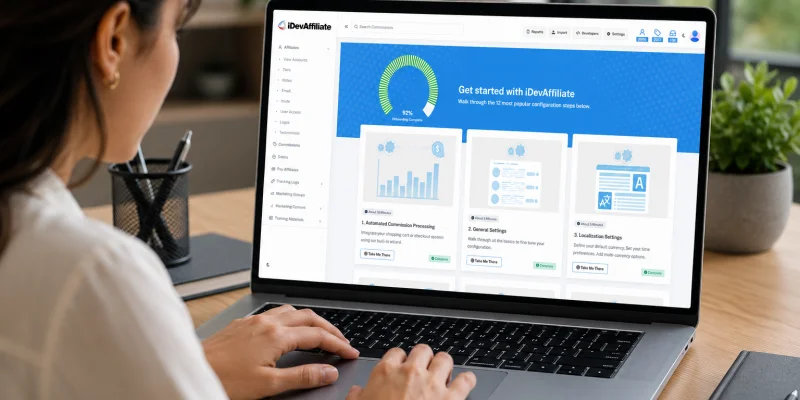
A live demo gives you access to the actual software environment rather than a marketing walkthrough. Look at the affiliate portal experience — your affiliates will spend time in it, and if it is confusing or outdated, recruitment and retention suffer. Look at how commission structures are configured. Look at the reporting tools. If something feels clunky in a demo, it will not feel better after you have signed up and migrated your affiliate records.
If you have questions about a specific setup scenario — unusual cart integrations, multi-tier structures, international currency handling — ask support before purchase, not after. Any vendor worth working with will answer pre-sales technical questions directly.
For a comprehensive overview before deciding, the detailed self-hosted affiliate software guide covers the full landscape from installation through ongoing program management, including a side-by-side comparison of cloud vs. self-hosted affiliate tracking.
Choosing between open source affiliate tracking software and a commercial self-hosted platform comes down to your internal technical resources, your tolerance for maintenance overhead, and the long-term economics of your program. If you have the development capacity to maintain an open source stack, it can work. If you want data ownership without becoming the de facto maintainer of your own tracking infrastructure, a mature commercial self-hosted option — one that has been in production since 1999 with installations worldwide — is typically the more practical choice.
Create Your Affiliate Program
Instant account set up. All features unlocked in base plan. Professional onboarding included.
Frequently Asked Questions
1. Is open source affiliate tracking software really free?
The license cost is typically zero, but implementation and ongoing maintenance are not. Most open source affiliate platforms require PHP development skills to install, configure, and update as payment processor APIs and browser cookie policies change. According to the Synopsys Open Source Security and Risk Analysis Report, 89% of open source codebases contain components that are more than four years out of date — meaning maintenance is a real, ongoing cost. Factor in developer time honestly before assuming free software saves money.
2. Can self-hosted affiliate software track across multiple devices?
Yes, when the platform supports email-based tracking. Email-based attribution ties a referral to a customer’s email address rather than a browser cookie, so it persists across devices, browsers, and sessions automatically. This is a key advantage over pure cookie-based tracking systems, which lose attribution when cookies are cleared or blocked. Apple’s Safari browser blocks third-party cookies by default, which affects the majority of mobile browser traffic in the US.
3. What happens to my affiliate data if I switch platforms later?
With self-hosted software, your affiliate data lives in your own database on your own server. You can export it, migrate it, or archive it without depending on a third-party vendor to release it. This is a meaningful advantage over SaaS platforms, where data portability terms vary widely by vendor and can create friction — or costs — when you want to leave.
4. How many affiliates can a self-hosted platform handle?
There is no fixed affiliate count limit tied to the software itself — capacity scales with your hosting environment. A properly configured VPS or dedicated server can handle thousands of active affiliates and high transaction volumes without hitting software-level constraints. Self-hosted platforms also avoid the per-affiliate or per-transaction pricing that some SaaS tools apply at scale.
5. Do I need technical expertise to install self-hosted affiliate software?
Basic server administration skills help, but many installations run on standard cPanel hosting environments where the setup is straightforward. Most commercial platforms provide detailed installation documentation, and some offer paid installation assistance for businesses that prefer not to handle setup themselves. Check the system requirements page to verify hosting compatibility before purchasing.
6. What is multi-tier affiliate tracking and do I need it?
Multi-tier tracking allows affiliates to recruit other affiliates and earn a commission on their recruits’ sales. Mature platforms support up to 10 levels deep. Not every program needs this — it is most useful for businesses building network-style referral structures or actively incentivizing affiliate recruitment rather than just direct sales. Single-tier tracking is sufficient for straightforward affiliate programs where affiliates promote directly to end customers.
Create Your Affiliate Program
Instant account set up. All features unlocked in base plan. Professional onboarding included.
You may also like

How to Set Up an Affiliate Program on BigCommerce

How to Set Up an Affiliate Program on WooCommerce

How to Set Up an Affiliate Program on Shopify

First Steps: 6 FREE Marketing Ideas For Your New Affiliate Program
Create Your Affiliate Program
- Unlimited Affiliates
- Unlimited Commissions
- Built-In SEO Links
- Social Media Sharing
- Affiliate Program Directory
