
Affiliate Marketing Tracking Methods

Affiliate tracking problems usually start long before commissions disappear.
When attribution breaks between the affiliate click, the customer conversion, and the final payout, reporting becomes inconsistent and affiliate trust starts weakening over time.
Affiliate tracking software helps solve that by connecting referral activity, attribution rules, conversion tracking, and affiliate analytics into one measurable system.
Instead of relying on assumptions, businesses can track which affiliate interactions actually influenced the conversion and maintain more reliable affiliate tracking systems across the customer journey.
Research from the Performance Marketing Association found U.S. affiliate marketing spend reached $13.62 billion in 2024, highlighting how important accurate attribution has become as affiliate programs continue scaling.
Here’s what matters most:
- Track clicks, conversions, and referral activity consistently
- Apply attribution windows across the full customer journey
- Validate conversions using cookies, postbacks, and identity-based tracking
- Reduce commission disputes caused by broken attribution paths
- Maintain audit-ready reporting for payouts and affiliate activity
Platforms like iDevAffiliate also support email address-based tracking, helping businesses maintain attribution continuity even when cookies expire or customers switch devices before purchasing.
Most affiliate programs do not fail because of poor traffic alone.
They fail when attribution becomes unreliable enough that affiliates stop trusting the numbers behind their commissions.
What Are Affiliate Marketing Tracking Methods and Why They Matter
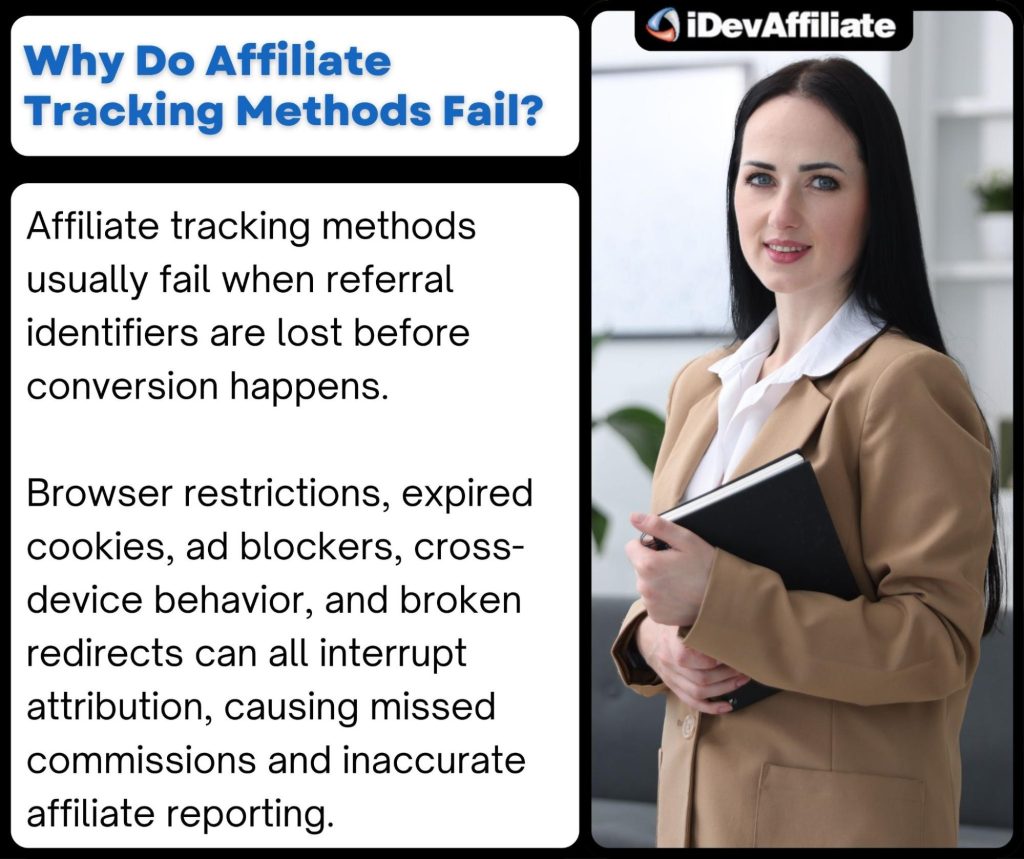
Affiliate marketing tracking methods connect an affiliate referral to a completed conversion so commissions can be attributed accurately. When tracking breaks, reporting becomes unreliable, commissions go missing, and affiliate trust starts weakening over time.
Affiliate software manages this through a click-to-commission process.
A visitor clicks a unique affiliate tracking link, referral data is stored, and the completed purchase or signup is matched back to the correct affiliate using attribution rules, conversion tracking, and affiliate analytics visibility.
More advanced platforms, like iDevAffiliate, also support email address-based tracking, helping maintain attribution even when cookies expire, browsers block tracking, or customers switch devices before converting.
Here’s what drives the tracking process:
- Click Tracking: Records the affiliate referral and visitor activity
- Attribution Windows: Define how long referrals remain eligible
- Conversion Tracking: Matches purchases or leads back to affiliates
- Commission Logic: Calculates payouts using attribution rules
Tracking problems usually happen when referral identifiers are lost or overwritten during the customer journey.
Cookie restrictions, ad blockers, broken redirects, cross-device browsing, inconsistent checkout flows, and weak affiliate agreement monitoring can all interrupt attribution before the conversion happens.
When tracking stays inconsistent, affiliates see clicks while businesses see sales, but neither side can fully connect the two. That gap is where reporting disputes, payout confusion, and attribution problems usually begin.
Different tracking methods solve different attribution gaps, which is why modern affiliate programs rarely rely on one tracking method alone.
3 Core Affiliate Marketing Tracking Methods
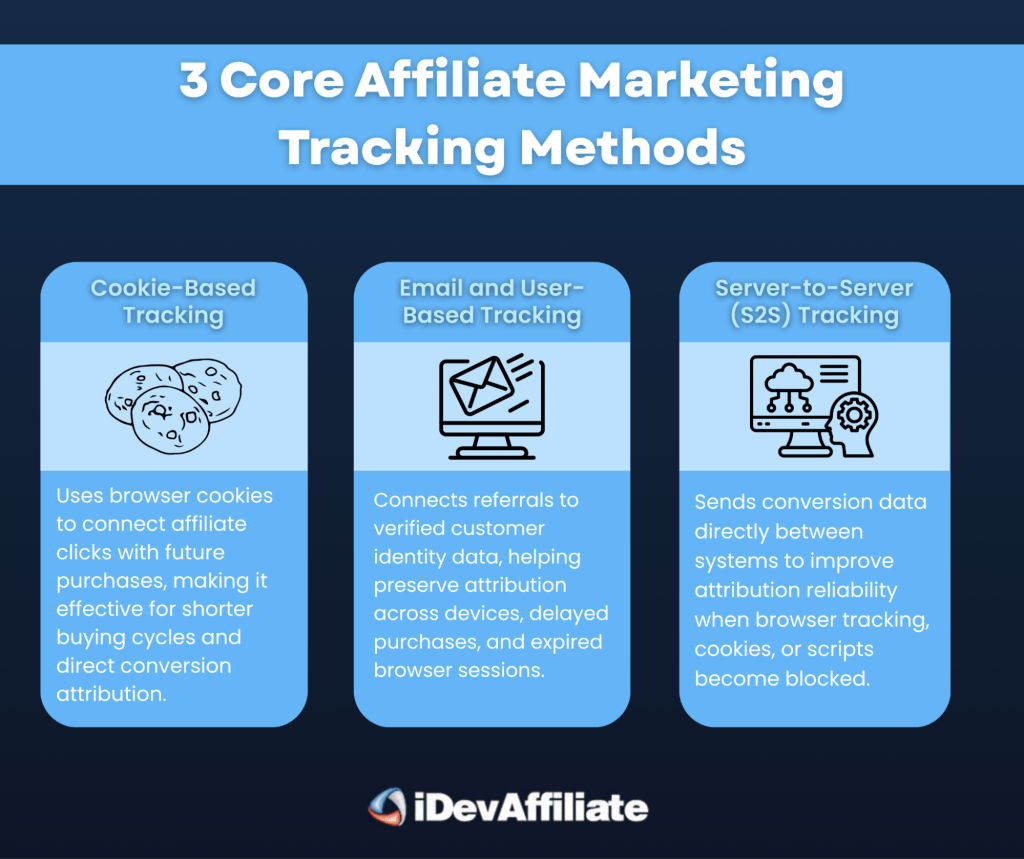
Affiliate tracking methods work best when they support real customer behavior instead of relying on one fragile attribution signal.
Different tracking methods solve different attribution problems, especially when cookies expire, users switch devices, or browsers block tracking scripts.
Most affiliate programs now combine multiple tracking methods together to improve attribution accuracy, reduce missed commissions, and maintain stronger affiliate trust across longer buying journeys.
1. Cookie-Based Tracking
Cookie tracking connects affiliate clicks to later purchases using browser-stored referral identifiers.
It remains one of the most widely used affiliate tracking systems across ecommerce and SaaS affiliate programs.
- Stores affiliate referral data inside browser sessions
- Attribution windows define commission eligibility duration
- First-party cookies survive better across modern browsers
- Third-party cookies face stronger browser restrictions today
Cookie-based tracking works well for shorter buying cycles and direct conversions.
iDevAffiliate helps businesses manage attribution windows and track affiliate sales more consistently across browser-based affiliate journeys.
2. Email and User-Based Tracking
Email-based tracking helps recover attribution when cookies expire or users return later on different devices.
Instead of relying only on browser sessions, attribution stays connected through verified customer identity data.
- Connects conversions across multiple devices and sessions
- Improves attribution for longer customer consideration cycles
- Reduces lost commissions from expired browser cookies
- Helps validate returning customer referral attribution accurately
iDevAffiliate supports email address-based tracking to maintain stronger attribution continuity across delayed purchases and cross-device customer behavior.
This creates more reliable commission tracking when traditional browser-based methods lose referral visibility.
3. Server-to-Server (S2S) Tracking
Server-to-server tracking validates conversions directly between systems without depending entirely on browser scripts.
This method improves attribution reliability when cookies, pixels, or JavaScript tracking become blocked or interrupted.
- Sends conversion events directly between connected systems
- Reduces attribution loss from blocked browser tracking
- Uses click IDs for deterministic conversion matching
- Creates cleaner audit trails for payout validation
S2S tracking also improves affiliate rules monitoring by validating conversions through more controlled attribution workflows consistently.
When combined with other tracking methods, it creates a more resilient and trustworthy affiliate reporting system.
Different tracking methods solve different attribution gaps across the customer journey.
Choosing the right setup depends on how customers browse, return, and complete conversions over time.
Choosing the Right Affiliate Tracking Setup
Affiliate tracking works best when the attribution method reflects how customers actually browse, return, and convert.
Different traffic sources create different attribution risks, which is why reliable affiliate programs usually combine multiple tracking methods together.
The goal is not just to track clicks.
Strong affiliate tracking protects attribution accuracy, reduces commission disputes, and creates reporting affiliates can consistently trust over longer customer journeys.
Sales Cycle Alignment
Short buying journeys and longer research-heavy purchases need different attribution setups to maintain reliable commission tracking.
The longer customers take to convert, the more durable your attribution method needs to become.
Short sales cycles usually rely heavily on affiliate tracking links alone.
Longer cycles often perform better with email-based tracking or server-side attribution methods that help businesses track affiliate sales more reliably over time.
Attribution Rule Consistency
Affiliate attribution becomes unreliable when commission rules change across traffic sources, devices, or conversion paths.
Consistent attribution logic helps affiliates understand how commissions are credited and why conversions qualify for payouts.
Programs using iDevAffiliate can apply the same attribution rules across clicks, conversions, and referral activity.
That consistency reduces disputes and helps reporting stay more transparent as affiliate programs scale over time.
Hybrid Tracking Reliability
Most affiliate programs now combine multiple attribution methods instead of depending entirely on browser cookies alone.
Layered tracking creates stronger attribution continuity when devices change or browser restrictions interrupt referral visibility.
Hybrid setups often combine affiliate links, coupon tracking, email-based attribution, and server-to-server postbacks together.
iDevAffiliate supports these layered affiliate tracking systems while improving affiliate analytics visibility and long-term attribution reliability.
Tracking Transparency and Compliance
Affiliate tracking becomes easier to trust when attribution activity remains transparent across commissions, clicks, and conversions consistently.
Clear tracking visibility also helps businesses maintain stronger affiliate relationships and operational reporting accuracy over time.
Reliable reporting supports better affiliate agreement monitoring by helping businesses validate referral activity and commission qualification rules consistently.
Transparent attribution workflows also reduce payout disputes while strengthening long-term affiliate trust significantly.
Bottom Line: Reliable Affiliate Tracking Starts With Better Attribution
Instant account set up. All features unlocked in base plan. Professional onboarding included.
Create Your Affiliate Program
Affiliate tracking works when clicks, conversions, attribution rules, and commission workflows stay connected inside one reliable system.
The goal is not just to record affiliate traffic, but to maintain attribution accuracy across the full customer journey without creating reporting gaps or payout confusion.
When your affiliate platform clearly defines how referrals are tracked, how conversions are validated, and how commissions are approved, affiliate reporting becomes easier to trust and scale:
- Identity-Based Tracking: Keep referrals connected to verified customer identities instead of relying only on browser sessions.
- Consistent Attribution Rules: Apply the same attribution logic across clicks, conversions, and affiliate touchpoints.
- Layered Tracking Methods: Combine cookies, email tracking, coupon attribution, and server-to-server tracking for stronger reliability.
- Audit-Ready Reporting: Maintain complete visibility into clicks, conversions, attribution activity, and commission payouts.
Together, these systems help affiliate programs reduce attribution loss, improve commission accuracy, and create stronger long-term affiliate trust.
If you want to improve affiliate attribution and commission visibility, start a free trial with iDevAffiliate and test the platform against your real affiliate workflow.
Frequently Asked Questions (FAQS)
You may also like

How to Set Up an Affiliate Program on BigCommerce

How to Set Up an Affiliate Program on WooCommerce

How to Set Up an Affiliate Program on Shopify

First Steps: 6 FREE Marketing Ideas For Your New Affiliate Program
Create Your Affiliate Program
- Unlimited Affiliates
- Unlimited Commissions
- Built-In SEO Links
- Social Media Sharing
- Affiliate Program Directory
