
How Much Should You Pay Finance Affiliates?

Finance affiliates are typically paid through CPA (cost per acquisition), revenue share, hybrid, or tiered commission models. In most financial affiliate programs, payouts range from $5 to $100+ per lead or roughly 5% to 30% per sale, depending on the product, approval requirements, customer value, and risk profile.
The right affiliate payout isn’t determined by industry averages alone. Successful finance companies calculate commissions based on customer lifetime value (CLV), profit margins, approval rates, compliance requirements, and long-term profitability. A payout that attracts affiliates but erodes margins is just as problematic as one that’s too low to drive partner participation.
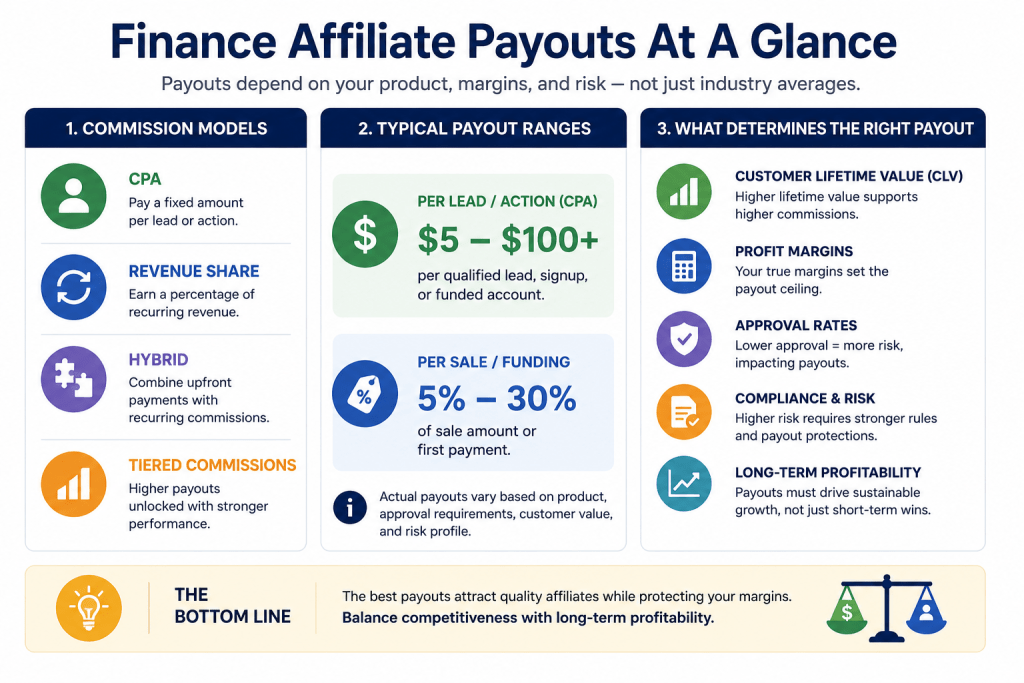
Affiliate payouts in financial programs require more than a commission percentage. They depend on structured commission logic, accurate attribution, and clear validation rules from the start. Without alignment between margins, tracking, and risk controls, payouts can quickly become inconsistent, unprofitable, and difficult to defend across different affiliate types and conversion scenarios.
Here’s what matters most when structuring finance affiliate payouts:
- Margin-based payout limits that protect long-term profitability
- Attribution accuracy that connects conversions to the right affiliate
- Commission models that balance risk between business and partners
- Tiered incentives that reward performance without overpaying
- Validation rules that prevent fraud, reversals, and duplicate payouts
- Consistent reporting aligned with verified customer outcomes
At iDevAffiliate, we’ve built our platform to support the flexibility finance affiliate programs need, from standard commission structures to recurring, tiered, and custom commission models. Combined with accurate attribution and configurable payout rules, businesses can reward affiliates fairly while maintaining control over acquisition costs and profitability.
The sections below break down what determines finance affiliate payouts, how different commission models distribute risk, and how to structure incentives that attract partners without eroding margins.
What Determines Affiliate Payouts in Financial Programs
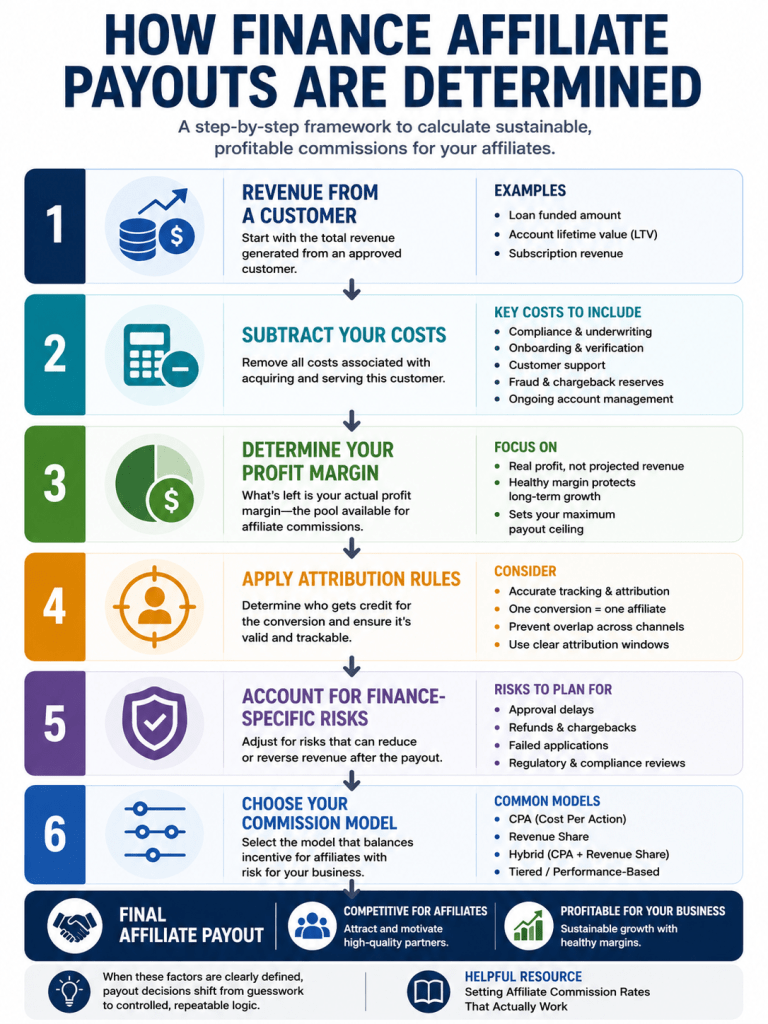
Finance affiliate payouts look attractive on the surface, but what you can sustainably pay depends on margin, attribution accuracy, and risk exposure.
Without aligning these factors early, payouts quickly become unpredictable and difficult to maintain.
Your Real Margin Sets the Payout Ceiling
Affiliate payouts must come from actual profit, not projected revenue, especially in finance where servicing costs are significant.
Ignoring costs like support, underwriting, and fraud leads to overpaying for customers. Sustainable payouts start with what remains after all variable costs are accounted for.
Servicing Costs Reduce Available Commission Pool
Post-conversion costs often exceed expectations in financial products, directly impacting what you can afford to pay affiliates.
These include onboarding, compliance checks, customer support, and ongoing account management. Every additional cost reduces the margin available for commissions.
Conversion Lag Impacts Payout Confidence
Financial conversions rarely happen instantly, often taking days or weeks between initial click and final action. This delay increases uncertainty in attribution and raises the risk of miscrediting conversions.
Longer lag requires stronger validation before confidently assigning payouts.
Attribution Accuracy Determines Payout Stability
Affiliate payouts rely on how accurately you can connect a conversion back to the correct referral source.
Weak attribution systems create overlap between channels and inflate commission costs. Stronger attribution ensures payouts reflect real contribution rather than tracking gaps.
Multi-Channel Journeys Increase Attribution Complexity
Customers often interact with multiple touchpoints before converting, including ads, emails, and direct visits.
Without clear attribution rules, credit shifts unpredictably between channels. Defined attribution logic ensures one conversion maps to one affiliate consistently.
Trust, Compliance, and Refund Risk Shape Payout Rules
Financial products carry higher compliance and refund risks, directly affecting commission reliability and timing. Misleading promotions or failed approvals often lead to reversals and clawbacks.
Clear validation rules and payout delays help align commissions with verified outcomes.
When these factors are clearly defined, payout decisions shift from guesswork to controlled, repeatable logic.
The next step is choosing a commission model that aligns this logic with how risk and rewards are shared between you and your affiliates.
Common Commission Models Used in Finance Affiliate Marketing
The commission model you choose defines who carries risk and how payouts behave over time.
In finance, delayed conversions, churn, and compliance exposure make this decision more strategic than simply offering competitive rates.
CPA Payouts for Leads and Signups
CPA models focus on paying affiliates for a single, clearly defined action. This works best when you can validate conversions quickly and want predictable acquisition costs.
- Fixed payout for each verified lead or signup
- Clear action definitions reduce disputes and fraud risk
- Predictable costs regardless of long-term customer value
- Higher risk of low-quality or unverified conversions
CPA shifts most post-conversion risk to you while rewarding affiliates upfront. It works best when your validation process is strict and conversion quality is controlled.
Revenue Share for Recurring Value Products
Revenue share aligns affiliate earnings with actual revenue collected over time. This model is most effective when your product generates consistent, ongoing value.
- Pays percentage of revenue collected over time
- Reduces upfront payout risk for the business
- Requires strong retention and reliable attribution tracking
- Affiliates wait longer to realize full earnings
Revenue share creates long-term alignment between you and your affiliates. It works best when your product has predictable retention and low refund rates.
Hybrid Models to Balance Risk and Incentives
Hybrid structures combine upfront payouts with ongoing revenue sharing. This approach balances immediate rewards with long-term performance incentives.
- Combines CPA payouts with revenue share components
- Reduces risk imbalance between business and affiliates
- Encourages both acquisition and customer quality
- Supports more flexible and competitive payout structures
Hybrid models are often the most practical for finance programs. They allow you to reward early effort while still tying payouts to real value.
Tiered Commission Structures for Performance Growth
Tiered commissions increase payouts based on affiliate performance thresholds. This structure motivates affiliates to scale while keeping base payouts controlled.
- Higher payouts triggered after performance thresholds met
- Encourages consistent and scalable affiliate activity
- Keeps entry-level payouts manageable for new affiliates
- Rewards high-performing partners without raising base rates
Tiering helps you grow without overpaying every conversion. It creates clear incentives for affiliates to improve performance over time.
Risk Allocation Across Commission Models
Each commission model distributes risk differently between you and affiliates. Understanding this balance helps you choose a structure you can sustain long-term.
- CPA shifts post-conversion risk to the business
- Revenue share shifts performance risk to affiliates
- Hybrid models distribute risk across both parties
- Tiered structures reward performance without fixed increases
The best model is the one your margins and tracking can support. Clear risk allocation keeps payouts predictable and reduces future disputes.
Safeguards to Protect Commission Integrity
No model works without safeguards that control payouts and prevent abuse. Clear rules ensure commissions reflect verified, legitimate customer actions.
- Define strict validation criteria for commissionable actions
- Set clawback rules for refunds and invalid conversions
- Limit bonuses to trackable and auditable performance events
- Document payout terms to avoid retroactive disputes
Safeguards turn commission structures into reliable systems, not assumptions. When rules are clear and enforced, both payouts and relationships remain stable.
When commission models are clearly defined, payouts become structured instead of reactive.
The next step is refining these structures based on partner type, market positioning, and how your offer fits the audience you are trying to reach.
Factors That Influence How Much You Should Pay Affiliates
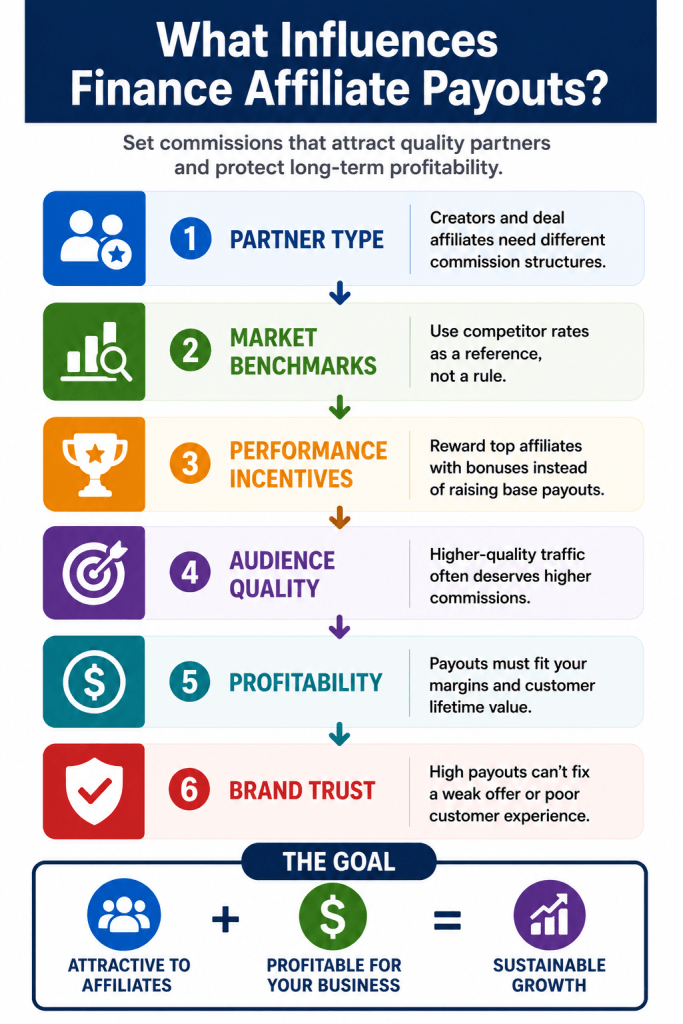
Affiliate payouts in finance are shaped by partner type, market benchmarks, and audience fit.
The goal is not just to attract affiliates, but to set payouts that drive quality conversions without creating long-term risk or credibility issues.
- Differentiate Partner Types: Creators build long-term trust and intent, while deal partners focus on immediate conversions and predictable payout structures.
- Structure Creator Incentives: Stable base commissions with achievable bonus tiers help creators stay consistent while scaling content and audience engagement.
- Align Deal Partner Expectations: Clear payout rules, short attribution windows, and defined action criteria help deal partners forecast earnings accurately.
- Use Benchmarks as Reference Points: Market rates guide positioning, but your payout must align with margins, conversion lag, and approval rates.
- Layer Incentives Instead of Overpaying: Tiered bonuses and performance rewards attract top affiliates without increasing base payouts across all conversions.
- Protect Audience and Offer Credibility: High payouts on weak offers damage trust, leading to lower-quality traffic and long-term brand impact.
When payouts reflect partner type, economics, and audience fit, affiliate programs scale with consistency instead of volatility.
Once these factors are aligned, payouts become intentional rather than reactive, tailored to who you partner with and how they drive value.
The next step is defining clear payout boundaries so you stay competitive while protecting profitability as volume scales.
How to Balance Competitive Payouts With Profitability
Balancing affiliate payouts with profitability requires clear boundaries, not guesswork.
You need defined ceilings, realistic floors, and structured review cycles to keep acquisition scalable without eroding margins.
Set a Maximum CPA Based on Real Economics
Your maximum CPA defines the highest payout you can sustain while maintaining profitability. This should be calculated before negotiating with affiliates, using actual revenue and cost data.
A clear ceiling prevents overpaying and keeps customer acquisition costs predictable.
Build Payouts on Conservative Performance Assumptions
Affiliate payouts should be based on realistic conversion and approval rates, not best-case scenarios.
Ignoring reversals, chargebacks, or drop-offs creates inflated expectations and unstable payouts. Conservative estimates protect margins and reduce the need for frequent payout corrections.
Find the Minimum Payout That Attracts Quality Partners
Your payout floor is the lowest commission that still attracts and retains the right affiliates. Setting it too low limits growth, while setting it too high reduces profitability.
The goal is a balanced rate that drives participation without overpaying every conversion.
Use Tiered Structures to Scale Without Overpaying
Tiered commissions allow you to reward higher performance without increasing base payouts. This creates a path for affiliates to earn more while keeping entry-level costs controlled.
Well-structured tiers align incentives with quality and volume instead of flat payouts.
Keep Commission Thresholds Achievable and Transparent
Affiliate motivation depends on clear, realistic performance thresholds they can actually reach.
Unattainable tiers discourage participation and make the program feel unfair or inconsistent. Transparent thresholds improve engagement and create predictable scaling behavior.
Stabilize Payouts With Structured Review Cycles
Regular review windows help you adjust payouts without creating confusion or distrust. Frequent changes disrupt affiliate planning and weaken long-term relationships.
Scheduled reviews keep payouts aligned with performance while maintaining program stability.
Once payout limits and structures are clearly defined, your program becomes easier to scale without constant adjustments.
The next step is designing those payouts in a way that keeps top affiliates engaged, motivated, and consistently performing over time.
How to Structure Payouts to Attract and Retain Top Affiliates
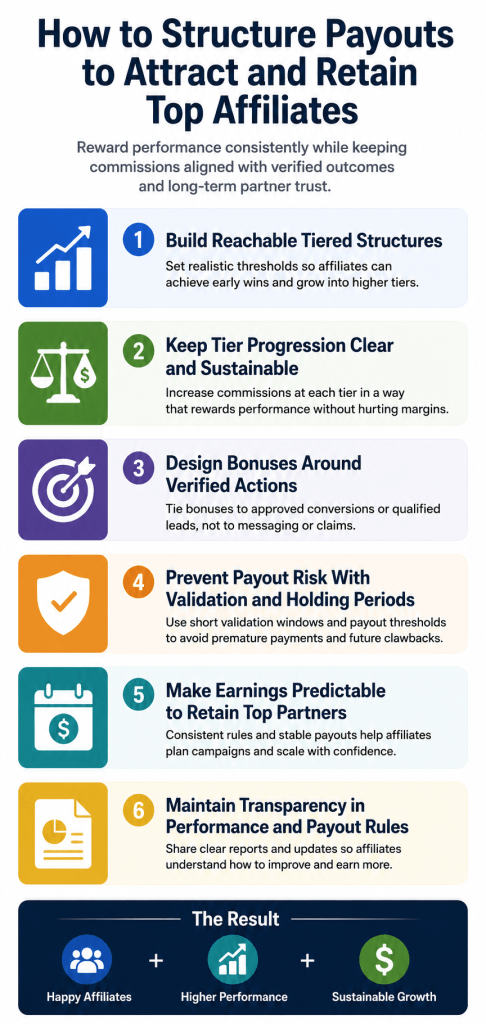
Attracting top affiliates requires more than competitive payouts, it requires predictable structure and clear incentives.
The goal is to reward performance consistently while keeping commissions aligned with verified outcomes and long-term partner trust.
Build Tiered Structures Affiliates Can Actually Reach
Tiered commissions work best when thresholds are realistic for both new and high-performing affiliates. If early tiers feel unattainable, most partners disengage before reaching higher levels.
For example, setting Tier 2 at 10–15 approved conversions per month gives active affiliates a reachable goal instead of pushing thresholds only top performers can hit.
Keep Tier Progression Clear and Financially Sustainable
Each commission tier should reflect measurable performance improvements without creating margin pressure. Aggressive increases may attract volume but often lead to lower-quality traffic and higher reversal risk.
Balanced tier growth maintains profitability while still rewarding top-performing affiliates.
Design Bonus Structures Around Verified Actions
Bonuses should be tied to clear, trackable outcomes like approved conversions or qualified leads. Avoid incentives that depend on messaging style or claims, which increase compliance and refund risks.
For example, rewarding affiliates for “approved accounts” instead of signups ensures bonuses align with verified revenue-generating activity, not inflated or low-quality leads.
Prevent Payout Risk With Validation and Holding Periods
Short validation windows and payout thresholds help reduce premature payments and future clawbacks. This ensures commissions are only released after conversions are confirmed and stable.
For example, holding payouts for 30 days after approval helps account for refunds, chargebacks, or failed verifications before commissions are finalized.
Make Earnings Predictable to Retain Top Partners
Top affiliates prioritize programs where earnings are stable and easy to forecast over time. Frequent rule changes or unclear payout logic reduce trust and lead to silent churn.
Consistency in structure helps affiliates plan campaigns and scale confidently.
Maintain Transparency in Performance and Payout Rules
Clear communication around commissions, reversals, and payout timing builds long-term partner confidence.
Providing regular performance visibility helps affiliates understand how to improve earnings.
For example, sharing monthly reports with conversion rates, approval status, and tier progress helps affiliates forecast earnings and optimize their promotional strategy.
Bottom Line: How Much Should You Pay Finance Affiliates?
Instant account set up. All features unlocked in base plan. Professional onboarding included.
Create Your Affiliate Program
Setting affiliate payouts in finance is not about matching competitor rates, it is about aligning margins, attribution accuracy, and risk controls into one consistent system.
When commission structures are built on real economics and verified tracking, payouts become predictable, scalable, and easier to defend.
Payout structure determines everything.
When affiliate programs are built on clear commission logic and validated conversion tracking, they operate with fewer disputes, stronger partner trust, and more reliable performance visibility:
- Margin-based payouts: ensure commissions stay aligned with real profitability after servicing costs.
- Accurate attribution tracking: connects every conversion to the correct affiliate across devices and sessions.
- Tiered commission structures: reward performance without increasing base payout risk.
- Validated conversion rules: tie commissions to approved, verified customer actions only.
Structured payout systems bring these elements together into one framework, where commissions, tracking, and profitability remain aligned across every affiliate interaction.
Affiliate programs scale faster when payouts are consistent and defensible.
Start a free trial to see how structured tracking and commission management perform in real financial affiliate programs.
Frequently Asked Questions (FAQS)
You may also like

How to Set Up an Affiliate Program on BigCommerce

How to Set Up an Affiliate Program on WooCommerce

How to Set Up an Affiliate Program on Shopify

First Steps: 6 FREE Marketing Ideas For Your New Affiliate Program
Create Your Affiliate Program
- Unlimited Affiliates
- Unlimited Commissions
- Built-In SEO Links
- Social Media Sharing
- Affiliate Program Directory
