
Affiliate Marketing Minimum Payout Threshold Best Practices

Minimum payout threshold best practices help businesses balance payout efficiency, affiliate trust, and predictable cash flow across affiliate programs.
The right payout threshold reduces micro-payment overhead while still allowing affiliates to reach payouts within realistic earning cycles consistently.
When payout rules become difficult to understand or impossible to reach, affiliate motivation, retention, and payout transparency usually start declining over time.
This blog breaks down how payout thresholds actually work, why businesses use them, and how structured payout policies improve long-term affiliate program stability.
Here’s what matters most:
- Payout thresholds control eligibility, not commission calculation
- Visible pending balances improve affiliate payout transparency significantly
- Realistic payout minimums reduce affiliate churn over time
- Consistent payout rules simplify approval and reconciliation workflows
- Structured payout timing improves merchant cash flow predictability
- Clear payout communication reduces affiliate support disputes significantly
iDevAffiliate helps businesses manage affiliate payout thresholds, pending balances, and commission approvals through structured affiliate reporting and payout visibility tools.
The strongest affiliate programs treat payout thresholds as trust-building systems instead of hidden operational controls.
When payout structures remain transparent and achievable, affiliate programs become easier to scale without creating unnecessary payout friction or reporting confusion.
The rest of this guide breaks down how to build payout threshold policies that stay fair for affiliates while remaining operationally sustainable as affiliate programs continue scaling.
Minimum Payout Thresholds and Why They Exist
Minimum payout thresholds help businesses control payout timing without changing how affiliate commissions are actually earned.
They create a structured payout workflow that balances operational efficiency, predictable cash flow, and affiliate payment visibility across the program.
When payout rules remain transparent and consistent, affiliate programs become easier to manage without creating unnecessary payout confusion or trust issues.
Payout Eligibility and Commission Earnings
Affiliate commissions are earned when approved transactions are successfully tracked inside the affiliate program.
Minimum payout thresholds only control when accumulated earnings become eligible for release during the payout cycle.
- Approved sales generate commissions automatically after validation
- Payout thresholds control release timing, not earnings calculation
- Pending balances continue accumulating across payout periods consistently
- Threshold eligibility determines when payouts enter approval queues
Affiliates can earn commissions daily while receiving payouts less frequently.
Clear payout eligibility rules help businesses reduce confusion around pending balances and payout timing expectations.
Commission Approval and Pending Balances
Most affiliate programs separate commission approvals from actual payout processing for operational consistency.
This allows businesses to validate transactions before commissions move into the final payout approval workflow.
- Pending commissions remain visible before payout qualification occurs
- Approved balances continue accumulating toward payout eligibility thresholds
- Refund validation protects businesses from premature commission payouts
- Consistent approval workflows improve affiliate reporting transparency significantly
Affiliates trust payout systems more when balances remain easy to track.
Clear pending balance visibility reduces payout disputes and unnecessary support requests over time.
Operational Costs and Payout Efficiency
Affiliate payouts create operational costs beyond the commission amount being paid to partners directly.
Processor fees, reconciliation work, fraud checks, and support overhead all affect payout efficiency across affiliate programs.
- Small payouts increase transaction processing costs unnecessarily
- Batch payout schedules improve finance workflow predictability significantly
- Thresholds reduce repetitive micro-payout approval cycles internally
- Structured payout timing simplifies reconciliation across affiliate programs
Minimum payout thresholds help businesses maintain cleaner payout operations consistently.
Well-structured payout rules reduce administrative overhead without negatively affecting serious affiliate partners long-term.
Predictable Payout Scheduling
Consistent payout schedules help affiliates understand exactly when commissions are expected to become payable.
This improves affiliate confidence while helping businesses maintain cleaner financial planning across payout cycles consistently.
- Fixed payout cycles improve affiliate payout predictability significantly
- Threshold rules simplify batch approval processing across affiliates
- Standardized payout timing reduces avoidable payout confusion internally
- Predictable schedules strengthen affiliate trust and reporting consistency
Affiliates care heavily about payout timing transparency across affiliate programs.
Predictable payout workflows help businesses maintain stronger long-term affiliate relationships more consistently.
Transparent Payout Tracking
Affiliate trust improves when payout progress stays visible throughout the commission approval and payout process.
Businesses that clearly display payout eligibility reduce confusion around pending earnings and payout qualification requirements significantly.
- Visible pending balances improve affiliate payout transparency consistently
- Threshold progress indicators reduce affiliate support requests significantly
- Clear payout status improves commission reporting visibility internally
- Consistent payout tracking strengthens affiliate relationship confidence long-term
Transparent payout systems make affiliate programs easier to trust and scale.
Businesses reduce payout-related disputes when affiliates clearly understand how payout thresholds actually work.
Transparent payout systems make affiliate programs easier to trust and scale consistently.
The next section explains how payout minimums directly influence affiliate motivation, retention, and long-term cash flow predictability.
How Payout Minimums Affect Affiliate Trust and Cash Flow
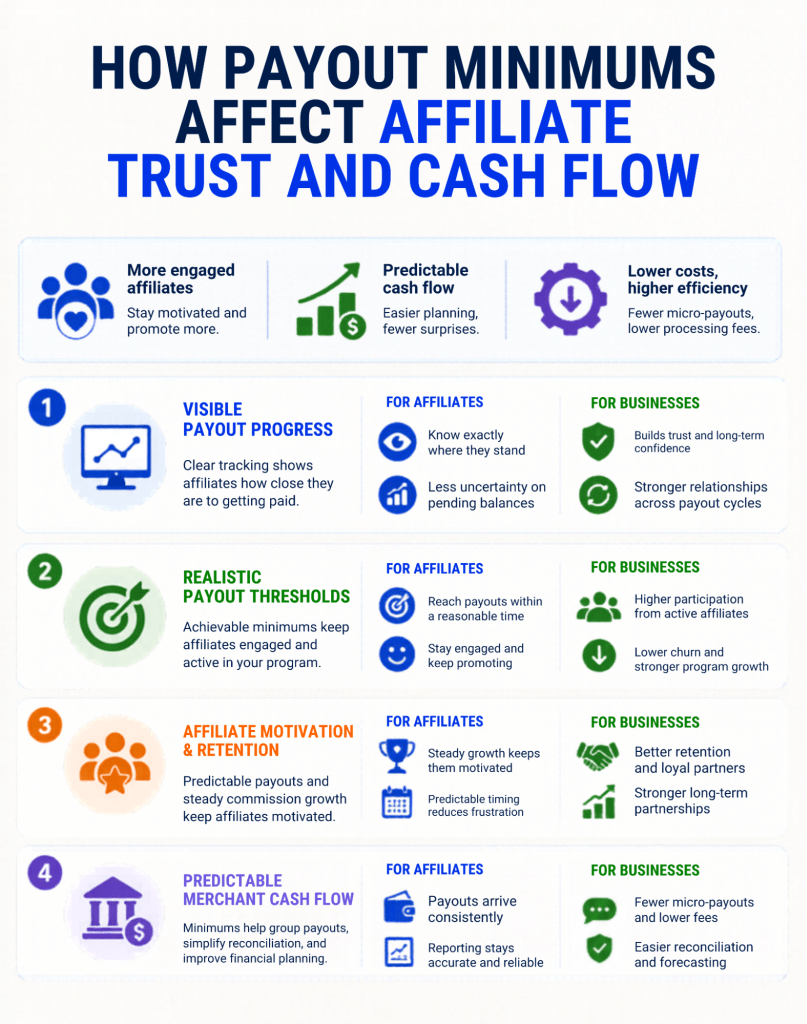
Minimum payout thresholds influence both affiliate motivation and merchant payout stability across affiliate programs.
When payout progress feels visible and achievable, affiliates stay engaged and continue promoting consistently over longer periods.
Businesses also gain cleaner payout forecasting, lower transaction costs, and more predictable commission management across payout cycles.
Visible Payout Progress
Affiliates stay motivated when payout progress remains visible throughout the commission accumulation process clearly.
Clear payout tracking reduces uncertainty around pending balances and helps affiliates understand exactly when payouts become eligible.
Consistent progress visibility also strengthens trust across longer affiliate relationships and recurring payout cycles.
Realistic Payout Thresholds
Payout minimums should feel achievable within a reasonable timeframe for active affiliate partners consistently.
Thresholds that appear too difficult to reach often reduce affiliate engagement and long-term promotional activity significantly.
Reasonable payout structures help businesses maintain stronger affiliate participation and lower partner churn rates over time.
Affiliate Motivation and Retention
Affiliates respond better when commission growth feels steady and payout timing remains predictable consistently.
Long payout delays often create frustration, especially for smaller affiliates building momentum inside newer affiliate programs.
Reliable payout expectations help businesses maintain stronger affiliate retention and healthier long-term partner relationships overall.
Predictable Merchant Cash Flow
Minimum payout thresholds help businesses reduce micro-payouts and maintain cleaner financial planning across payout cycles.
Larger grouped payouts simplify reconciliation while reducing transaction fees and operational payout processing overhead significantly.
Predictable payout schedules also improve coordination between affiliate reporting, finance operations, and commission approval workflows internally.
Transparent Payout Communication
Affiliate trust improves when payout rules, balances, and eligibility requirements remain easy to understand consistently.
Businesses should clearly display pending balances, payout thresholds, and expected payout timing inside affiliate reporting systems.
Transparent payout communication reduces confusion while improving affiliate confidence across growing payout operations long-term.
The way payout thresholds are structured directly affects affiliate expectations, payout efficiency, and long-term program scalability.
Now let’s see the most common payout threshold structures businesses use to balance affiliate trust with operational consistency.
Common Minimum Payout Threshold Structures
Affiliate programs usually apply payout minimums using a few standardized structures across different partner groups.
The right structure depends on affiliate earning patterns, payout frequency, and operational payout management requirements.
When payout thresholds match affiliate behavior properly, businesses reduce support friction while improving payout predictability consistently.
1. Flat Program-Wide Thresholds
Flat payout thresholds apply the same minimum payout requirement across every affiliate inside the program.
This structure simplifies payout communication, reporting workflows, and commission approval processes significantly across larger affiliate programs.
Uniform payout rules also reduce administrative overhead and simplify long-term affiliate payout management consistently.
2. Tiered Affiliate Thresholds
Tiered payout thresholds assign different minimum payout amounts based on affiliate performance or relationship category.
Higher-performing affiliates often receive lower payout minimums to improve payout consistency and partner retention significantly.
Tiered structures help businesses balance payout efficiency while supporting different affiliate earning behaviors more effectively.
3. Payout Cycle Alignment
Payout cadence directly affects how reachable minimum payout thresholds feel for affiliate partners consistently over time.
A moderate payout threshold may feel reasonable during weekly payouts but restrictive during longer monthly cycles instead.
Aligning payout timing with affiliate earnings improves payout predictability and reduces affiliate frustration significantly.
4. Low-Volume Affiliate Handling
Affiliate programs with many smaller partners usually require payout structures that prevent excessive micro-payment processing overhead.
Higher thresholds help businesses reduce unnecessary payout transactions while keeping reporting workflows easier to manage consistently.
Balanced payout rules prevent operational inefficiencies without discouraging smaller affiliates from continued program participation.
5. Predictable Threshold Communication
Affiliate payout structures work best when payout eligibility requirements remain simple and consistently communicated throughout reporting workflows.
Affiliates should easily understand payout thresholds, payout timing, and progress toward becoming payout eligible each cycle.
Clear payout communication strengthens affiliate trust while reducing avoidable payout disputes and support requests long-term.
Key Factors Behind Defensible Payout Thresholds
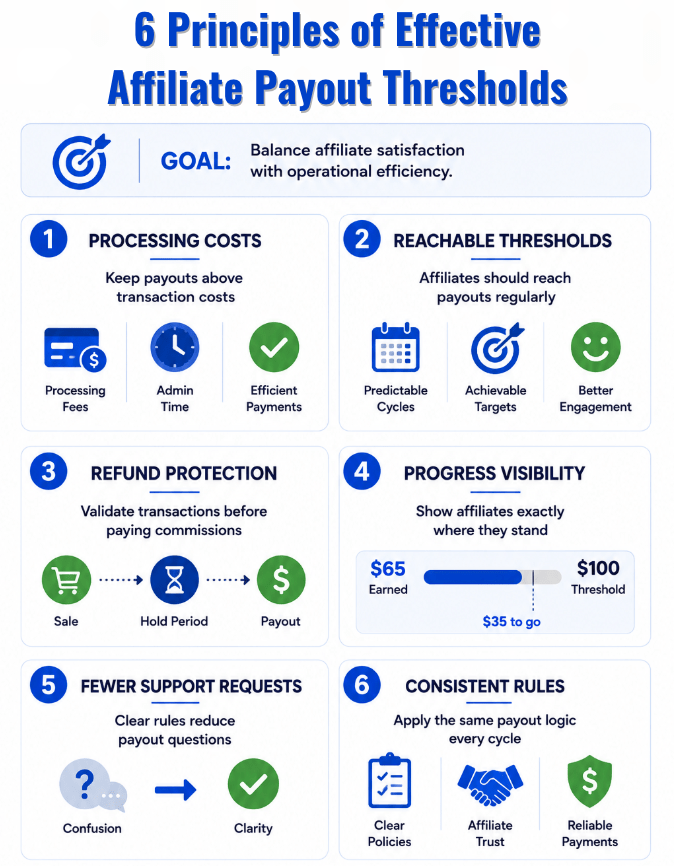
Minimum payout thresholds work best when affiliates understand the logic behind them and businesses apply rules consistently.
The goal is balancing payout efficiency, predictable cash flow, and realistic payout accessibility across different affiliate earning patterns.
Well-structured payout thresholds reduce confusion, improve forecasting, and strengthen affiliate trust over longer payout cycles.
- Processing Cost Visibility: Payout minimums should comfortably exceed processing fees, reconciliation effort, and payout administration costs across every affiliate payment cycle.
- Realistic Affiliate Reachability: Active affiliates should realistically reach payout thresholds within predictable payout cycles without extended pending balance accumulation periods.
- Refund Window Protection: Standard payout holding periods help businesses validate refunds, reversals, and transaction disputes before commissions become payable.
- Pending Balance Transparency: Visible payout progress reduces confusion by showing affiliates exactly how much remains before payout eligibility activates successfully.
- Support Ticket Reduction: Clear payout rules and threshold visibility reduce repetitive “when will I get paid” affiliate support requests significantly.
- Consistent Threshold Enforcement: Stable payout policies prevent confusion and help affiliate programs maintain cleaner payout operations across larger partner networks.
When payout thresholds stay transparent and achievable, affiliates remain more engaged and payout operations become easier to manage consistently.
Defensible payout structures protect operational efficiency without creating unnecessary payout frustration or long-term affiliate disengagement.
Bottom Line: Do Minimum Payout Threshold Best Practices Actually Matter?
Instant account set up. All features unlocked in base plan. Professional onboarding included.
Create Your Affiliate Program
Minimum payout thresholds are not just payout settings, they directly shape affiliate trust, payout predictability, and long-term program stability.
When payout rules feel inconsistent or difficult to reach, affiliate engagement, reporting clarity, and payout confidence all start weakening over time.
Payout transparency determines affiliate trust.
When your payout system is built around clear eligibility rules and visible commission progress, affiliate programs become easier to manage and scale consistently:
- Payout eligibility tracking: shows affiliates exactly when commissions become payable across every payout cycle.
- Pending balance visibility: keeps affiliate earnings transparent while reducing payout confusion and support disputes.
- Structured payout workflows: standardize approvals, payout timing, and reconciliation processes consistently.
- Scalable payout management: supports affiliate growth without increasing operational payout complexity significantly.
Platforms like iDevAffiliate strengthen this further through flexible payout threshold controls, transparent pending balance reporting, and structured commission approval workflows.
Affiliate programs scale more effectively when payout systems remain transparent and predictable.
Start a free trial of iDevAffiliate to see how structured payout workflows improve affiliate trust, reporting visibility, and payout management consistency in real affiliate environments.
You may also like

How to Set Up an Affiliate Program on BigCommerce

How to Set Up an Affiliate Program on WooCommerce

How to Set Up an Affiliate Program on Shopify

First Steps: 6 FREE Marketing Ideas For Your New Affiliate Program
Create Your Affiliate Program
- Unlimited Affiliates
- Unlimited Commissions
- Built-In SEO Links
- Social Media Sharing
- Affiliate Program Directory
