
Affiliate Marketing Checklist for a Quick and Easy Start

An affiliate marketing checklist helps business owners launch an affiliate program without missing critical setup steps. From choosing affiliate software and commission structures to recruiting affiliates and tracking referrals, this checklist covers everything you need to get your program up and running.
Launching an affiliate program can feel overwhelming when you’re not sure where to start. That’s why we’ve broken the process down into a simple, step-by-step checklist you can follow from setup to launch.
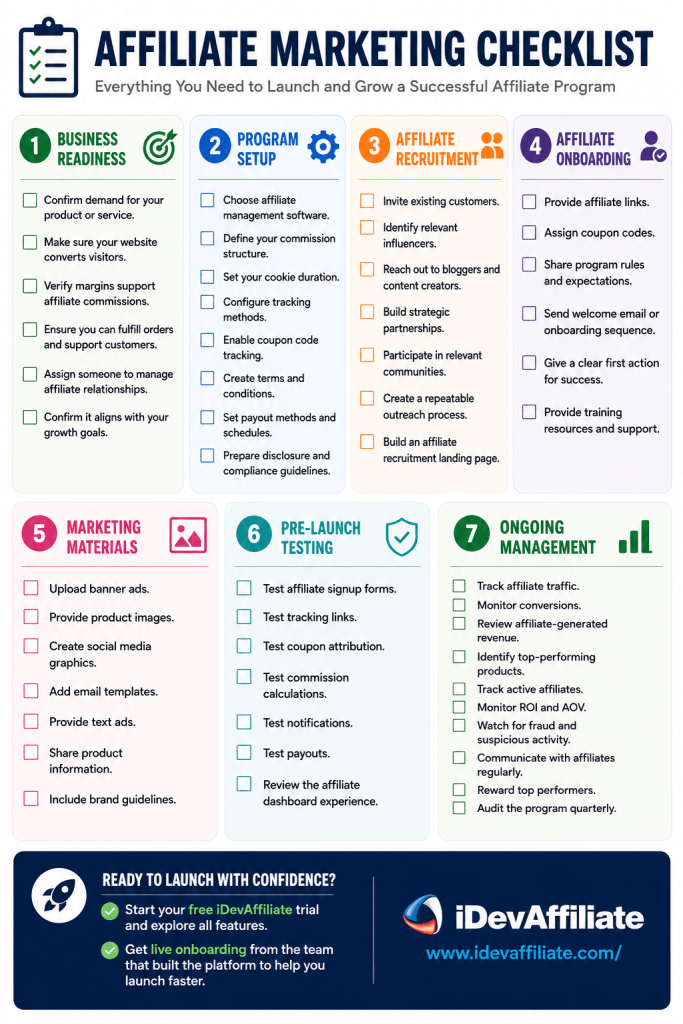
For more than 20 years, we’ve helped businesses launch, manage, and grow successful affiliate programs with iDevAffiliate. Our platform simplifies affiliate tracking, onboarding, commissions, and payouts, while advanced email attribution helps ensure affiliates receive credit for the customers they refer.
Keep reading for a closer look at each checklist item and practical tips for building a successful affiliate program.
1. Business Readiness Checklist
Before launching your affiliate program, make sure you can check off the following:
- There is proven demand for your product or service.
- Your website consistently converts visitors into customers.
- Your profit margins can support affiliate commissions.
- You can fulfill orders and support customers reliably.
- Someone on your team can manage affiliate relationships.
- Affiliate marketing aligns with your broader business and marketing goals.
- Your target audience is likely to respond to affiliate recommendations and referrals.
Affiliate marketing is one of the most effective growth channels available because you only pay for results. However, it’s important to remember that affiliate marketing amplifies what’s already working. It does not fix underlying business problems. If your offer isn’t converting, your margins are too thin, or your customer experience needs work, adding affiliates will simply send more traffic into an existing bottleneck.
Many businesses also delay launching because they assume affiliate marketing is overly complicated. In reality, the technology is often the easiest part. Modern affiliate software handles tracking, commissions, reporting, and payouts automatically. The bigger challenge is building a program that attracts quality affiliates and gives them the support they need to succeed.
If you can confidently check off the items above, you’re in a strong position to move forward with launching your affiliate program.
2. Affiliate Program Setup Checklist
Before recruiting affiliates, make sure you’ve completed the following setup tasks:
- Choose affiliate management software.
- Define your commission structure.
- Set your cookie duration.
- Configure your tracking methods.
- Enable coupon code tracking.
- Create affiliate terms and conditions.
- Establish payout methods and schedules.
- Prepare disclosure and compliance guidelines.
The decisions you make during setup will impact both affiliate satisfaction and long-term profitability. One of the biggest mistakes businesses make is offering commissions that look attractive on paper but aren’t sustainable as the program grows. Your commission structure should align with your profit margins, customer lifetime value, and business goals.
If you sell multiple products with different margins, consider product-level commissions rather than a one-size-fits-all commission rate. This allows you to reward affiliates fairly while protecting profitability across your product catalog.
Accurate tracking is equally important. Affiliates need confidence that every referral will be properly attributed, whether a customer purchases immediately or returns later to complete their order. This is why many businesses prioritize tracking capabilities when selecting affiliate software.
iDevAffiliate simplifies the setup process by combining affiliate tracking, onboarding, payment management, reporting, and nearly 200 integrations into a single platform. In addition to traditional tracking methods, iDevAffiliate’s email attribution technology helps connect customers with the affiliates who referred them, providing a more reliable way to track referrals when cookie-based tracking alone may not be enough.
3. Affiliate Recruitment Checklist
To find your first affiliates, make sure you’ve completed the following:
- Reach out to existing customers.
- Identify industry influencers.
- Connect with bloggers and content creators.
- Build strategic partnerships.
- Participate in relevant communities.
- Create a repeatable outreach process.
A common mistake is focusing on affiliates with the largest audiences. In most cases, audience fit matters more than audience size. The best affiliates are people who already have the trust of your ideal customers and can authentically recommend your products or services.
Start with the lowest-hanging fruit. Existing customers, business partners, industry experts, and niche content creators are often more effective than large influencers because their audiences are highly targeted and engaged.
As your program grows, develop a repeatable recruitment process that includes outreach templates, follow-up sequences, and a dedicated affiliate landing page. This will make it easier to consistently attract new affiliates without starting from scratch each time.
It’s also worth remembering that recruiting affiliates is often easier than keeping them engaged. The most successful affiliate programs don’t just focus on adding new partners. They focus on supporting, communicating with, and rewarding the affiliates they already have.
4. Affiliate Onboarding Checklist
After an affiliate is approved, make sure you’ve completed the following:
- Provide affiliate links.
- Assign coupon codes.
- Share program rules.
- Deliver marketing assets.
- Provide support resources.
- Send a welcome email or onboarding sequence.
- Give affiliates a clear first action.
- Provide training resources such as videos, tutorials, or setup guides.
Many affiliate programs lose momentum during onboarding. An affiliate signs up, receives login credentials, and then has no idea what to do next. Without guidance, even motivated affiliates can become inactive before they ever make their first referral.
A strong onboarding process removes that uncertainty. Every new affiliate should know how to access their links, where to find marketing materials, how commissions work, and what steps they should take first. Whether it’s sharing a referral link, posting on social media, or sending an email to their audience, providing a clear first action helps affiliates start generating results faster.
Automation can also reduce affiliate drop-off. Welcome emails, onboarding sequences, resource libraries, and automated notifications help ensure every affiliate receives the information they need without creating additional work for your team.
5. Affiliate Marketing Materials Checklist
Make sure affiliates have access to the following:
- Banner ads.
- Product images.
- Social media graphics.
- Email templates.
- Text ads.
- Product information.
- Brand guidelines.
One of the biggest mistakes businesses make is assuming affiliates only need a referral link. In reality, affiliates are far more likely to promote your products when they have ready-to-use marketing materials that save them time and effort.
At a minimum, provide product images, banners, social graphics, email copy, product descriptions, and key selling points. The easier it is for affiliates to start promoting, the more likely they are to remain active.
Many businesses also struggle with how much creative freedom to give affiliates. Should you provide finished graphics or editable templates? The answer is usually both. Finished assets make it easy for affiliates to launch quickly, while editable templates allow experienced affiliates to customize promotions for their audience.
It’s important to strike a balance between creativity and consistency. Affiliates should have enough flexibility to communicate in their own voice, but clear brand guidelines help prevent inaccurate claims, inconsistent messaging, and off-brand promotions. By providing both marketing assets and clear expectations, you can empower affiliates to create effective campaigns while protecting your brand.
6. Pre-Launch Testing Checklist
Before launching your affiliate program publicly, confirm you’ve tested the following:
- Test affiliate signup forms.
- Test tracking links.
- Test coupon attribution.
- Test commission calculations.
- Test notifications.
- Test payouts.
- Review the affiliate dashboard experience.
It’s tempting to start recruiting affiliates as soon as your program is configured, but taking time to test everything first can prevent major problems later. Nothing damages affiliate trust faster than missed commissions, broken tracking links, or inaccurate payouts.
Walk through the entire affiliate experience from start to finish. Submit a test application, click a referral link, complete a purchase, verify the commission was recorded correctly, and confirm that notifications and reporting are working as expected. If you’re using coupon code tracking, test that as well.
Pre-launch testing often uncovers issues that would otherwise go unnoticed, such as incorrect commission settings, broken integrations, confusing dashboard navigation, or attribution errors. Finding and fixing these problems before affiliates begin promoting your business creates a smoother experience for everyone involved and helps build confidence in your program from day one.
7. Affiliate Management Checklist
After your affiliate program is live, make sure you’re consistently doing the following:
- Track affiliate traffic.
- Monitor conversions.
- Review affiliate-generated revenue.
- Identify which products generate the most affiliate-driven revenue.
- Track active affiliates.
- Monitor ROI and AOV.
- Watch for fraud and suspicious activity.
- Communicate with affiliates regularly.
- Reward top performers.
- Conduct quarterly program audits.
Launching your affiliate program is only the beginning. Long-term success comes from actively managing and improving the program over time. Many businesses focus heavily on recruiting new affiliates, but retention is often more valuable than acquisition. In most programs, a small group of top-performing affiliates generates a significant portion of total revenue.
Regular communication helps keep affiliates engaged and motivated. Share product updates, promotional opportunities, seasonal campaigns, and performance insights. The more connected affiliates feel to your business, the more likely they are to continue promoting your products.
As your program grows, consider creating a dedicated community space where affiliates can ask questions, share ideas, and stay informed about new opportunities.
Performance bonuses, contests, tiered commissions, exclusive offers, and early access to new products can also encourage affiliates to stay active and increase their promotional efforts. These incentives often deliver stronger results than simply increasing commission rates across the board.
It’s equally important to establish ownership internally. Whether it’s a dedicated affiliate manager or a team member responsible for the program, someone should be accountable for recruitment, communication, reporting, and optimization. Without clear ownership, affiliate programs often lose momentum and become an afterthought.
Finally, schedule regular program audits to review performance, identify inactive affiliates, evaluate commission costs, update marketing materials, and monitor for fraudulent activity. Small improvements made consistently can have a significant impact on long-term affiliate revenue.
Launch With Confidence
Instant account set up. All features unlocked in base plan. Professional onboarding included.
Create Your Affiliate Program
Follow this affiliate marketing checklist, focus on building strong affiliate relationships, and you’ll be well on your way to creating a scalable new revenue channel for your business.
Ready to launch? Start your free iDevAffiliate trial and get live onboarding from the team that built the platform. We’ll help you get your affiliate program up and running with confidence.
Frequently Asked Questions (FAQS)
You may also like

How to Set Up an Affiliate Program on BigCommerce

How to Set Up an Affiliate Program on WooCommerce

How to Set Up an Affiliate Program on Shopify

First Steps: 6 FREE Marketing Ideas For Your New Affiliate Program
Create Your Affiliate Program
- Unlimited Affiliates
- Unlimited Commissions
- Built-In SEO Links
- Social Media Sharing
- Affiliate Program Directory
