
Why Affiliate Links Break (& What to do About it)

Why affiliate links break usually comes down to one thing: attribution fails somewhere between the click and the conversion. Missing pixels, browser restrictions, broken integrations, and short attribution windows quietly disconnect affiliate referrals from commissions long before anyone notices the reporting gap.
Affiliate tracking failures rarely look dramatic at first.
Clicks still appear inside dashboards. Orders still come through normally. Revenue still looks stable on the surface. The real problem is that attribution slowly stops connecting those events together correctly.
That is where affiliate programs start losing commission accuracy, partner trust, and long-term growth visibility.
Here’s where affiliate tracking usually breaks:
- Conversion pixels stop firing after checkout or landing page updates
- Browser privacy settings block cookies before attribution completes
- Cross-device customer journeys disconnect referrals from purchases
- Integrations drift out of sync without triggering visible warnings
- Attribution windows expire before delayed purchases happen
- Reporting gaps make affiliates lose confidence in payouts
Affiliate tracking software works best when attribution stays connected across the full customer journey, not just inside one browser session.
Features like email address tracking, flexible attribution durations, automated integrations, and coupon code attribution help reduce the silent tracking gaps most programs struggle to detect early.
If your affiliate reporting cannot clearly explain where commissions disappeared, the problem is usually deeper than the dashboard itself.
The rest of this guide breaks down exactly why affiliate tracking fails, how those attribution gaps damage affiliate trust, and which systems help prevent silent commission loss before it compounds into larger reporting problems.
Why Affiliate Links Break and What Causes Tracking Failures
Affiliate link breaking happens when the connection between the affiliate click, customer conversion, and commission payout becomes interrupted.
Once attribution fails, clicks and sales stop matching correctly, creating missing commissions, reporting gaps, and weaker affiliate trust over time.
Most affiliate tracking failures usually come from a small number of predictable technical and attribution-related problems.
Missing Conversion Pixels
Affiliate tracking breaks when the conversion pixel is missing from the final purchase or confirmation page.
Clicks still record correctly, but conversions never connect back to the affiliate referral inside the tracking system.
Even small checkout or landing page updates can accidentally remove conversion tracking without creating obvious warning signs.
Broken Platform Integrations
Affiliate software depends on stable integrations between your storefront, checkout system, and tracking platform.
API changes, expired credentials, or plugin updates can interrupt conversion reporting without immediately triggering visible errors.
iDevAffiliate helps businesses monitor integration activity more consistently before silent attribution gaps affect commission reporting long term.
Short Attribution Windows
Attribution windows determine how long affiliate referrals remain eligible after the original click happens
Short attribution windows often disconnect legitimate conversions from affiliates when customers take longer to purchase or compare options.
Longer buying cycles usually require more durable attribution settings to maintain accurate commission visibility over time.
Redirect and Parameter Failures
Affiliate links rely on tracking parameters staying consistent across redirects, landing pages, and checkout flows.
If tracking IDs are removed, rewritten, or interrupted, attribution can break before the conversion is fully recorded.
These failures often create reporting gaps where affiliates generate traffic but commissions never appear inside reporting dashboards.
Cross-Device Attribution Gaps
Customers regularly browse products on one device before purchasing later from another browser or session.
Cookie-only tracking struggles to maintain attribution continuity when users switch devices or browsers during the customer journey.
iDevAffiliate supports email address-based tracking to help businesses maintain stronger attribution continuity across delayed and cross-device conversions.
These technical attribution failures usually become harder to detect once browsers and devices start interrupting tracking independently of your setup.
Modern privacy controls now break affiliate attribution silently, even when integrations, pixels, and tracking links appear to be working correctly.
How Browsers and Devices Quietly Break Affiliate Tracking
Not every affiliate tracking failure comes from broken integrations or missing pixels.
Modern browsers, privacy controls, and cross-device customer behavior now interrupt attribution long before conversion reporting shows obvious problems.
These silent attribution gaps are one reason many affiliate programs lose commission accuracy without realizing it immediately.
Third-Party Cookie Restrictions
Many affiliate tracking systems still rely heavily on third-party browser cookies for attribution continuity.
Modern browsers like Safari and Firefox now block many third-party tracking cookies by default across customer sessions.
This reduces attribution visibility and disconnects affiliate referrals from conversions that happen later in the buying journey.
Ad Blocker Interference
Ad blockers often prevent affiliate tracking scripts, pixels, and redirects from loading during customer sessions.
Clicks may still appear inside affiliate reporting while conversion tracking silently fails before the purchase gets recorded.
Built-in webhook integrations and JavaScript tracking pixels help reduce attribution loss when browser-side tracking becomes unreliable.
Cross-Device Attribution Loss
Customers frequently browse products on mobile devices before completing purchases later from desktop sessions or tablets.
Cookie-based tracking struggles to connect those separate browsing sessions back to the same customer identity consistently.
Email address-based tracking helps maintain attribution continuity across delayed purchases and cross-device customer journeys.
Private Browsing Limitations
Private browsing sessions automatically remove cookies and tracking identifiers once the browser session closes completely.
Affiliate clicks recorded inside private browsing windows often disappear before the customer later completes the purchase process.
This creates attribution blind spots where legitimate affiliate influence never connects back to the final conversion event.
Cookie-Only Tracking Limitations
Cookie-only attribution creates growing reliability problems as browsers continue restricting long-term tracking storage behavior.
Modern affiliate programs usually combine cookies with server-side and identity-based attribution methods for stronger tracking continuity.
Layered attribution setups create more reliable commission tracking across different customer journeys, devices, and browsing environments.
How Broken Tracking Hurts Revenue and Affiliate Trust
Instant account set up. All features unlocked in base plan. Professional onboarding included.
Create Your Affiliate Program
Affiliate tracking failures rarely stay isolated to one missing commission or reporting inconsistency.
Once attribution becomes unreliable, the damage spreads into payouts, affiliate relationships, revenue forecasting, and long-term partner retention.
Most affiliate programs notice the business impact only after trust and conversion consistency have already started declining.
Missing Commission Attribution
Untracked conversions create revenue gaps where affiliates influence purchases but never receive commission credit correctly.
Broken pixels, blocked cookies, and interrupted attribution paths silently disconnect legitimate sales from affiliate referral activity.
Industry research suggests tracking issues can reduce affiliate earnings by 20% to 40% across affected affiliate programs.
Declining Affiliate Trust
Affiliates usually notice payout inconsistencies before businesses recognize attribution problems inside reporting dashboards.
When commissions disappear without explanation, affiliates often reduce promotions instead of reporting every missing conversion manually.
Trust weakens quickly once affiliates stop believing conversion tracking reflects their actual contribution to sales.
Reduced Partner Promotion
Affiliate partners naturally shift traffic toward programs with more reliable attribution and payout consistency over time.
Even strong affiliates reduce campaign visibility when conversion reporting no longer matches the traffic they generate consistently.
This creates long-term revenue loss beyond the commissions initially missed from broken affiliate tracking systems.
Reporting and Revenue Gaps
Broken attribution creates reporting gaps where clicks, conversions, and payouts stop aligning across affiliate performance data.
Businesses may continue seeing sales growth while affiliate dashboards show declining commissions and inconsistent attribution visibility.
These mismatches make affiliate forecasting, commission planning, and partner management significantly harder to scale accurately.
Delayed Problem Detection
Most affiliate tracking failures compound quietly before creating visible complaints or obvious conversion reporting anomalies.
Affiliates often reduce activity gradually, making attribution problems look like normal traffic fluctuations at first glance.
Early visibility into conversion inconsistencies helps businesses resolve attribution gaps before affiliate relationships weaken further.
Most affiliate tracking problems become manageable once businesses can detect attribution gaps before affiliates start questioning payouts.
That is why reliable affiliate programs focus heavily on testing, monitoring, and layered attribution systems that surface tracking failures early.
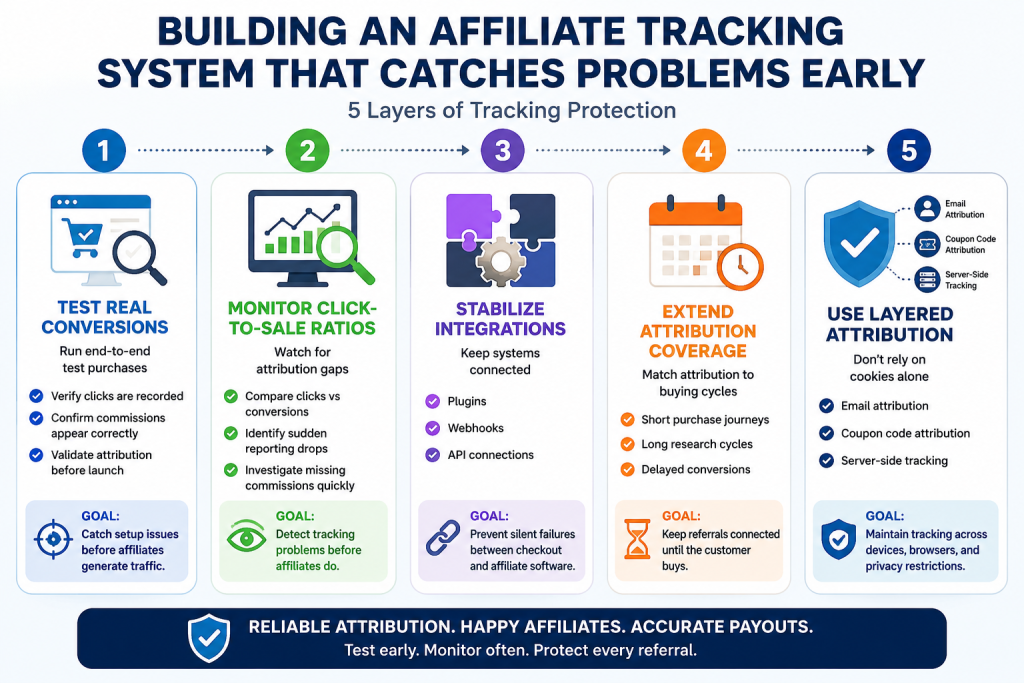
Building an Affiliate Tracking System That Catches Problems Early
Affiliate tracking becomes more reliable when validation happens before attribution gaps start affecting commissions and reporting.
Most silent tracking failures can be identified early through testing, reporting comparisons, and stronger integration visibility.
The goal is not just to record clicks, but to maintain attribution accuracy before affiliates notice payout inconsistencies.
1. Real Conversion Testing
Test conversions confirm affiliate tracking works correctly across clicks, attribution, and completed customer purchases.
A full end-to-end transaction helps verify whether conversions appear correctly inside affiliate reporting and connected systems.
Platforms with built-in setup wizards and tracking validation tools make it easier to catch attribution gaps before launch.
2. Click and Conversion Monitoring
Tracking failures usually appear first as growing gaps between affiliate clicks and recorded conversion activity.
Regular reporting comparisons help businesses identify attribution problems before affiliates start questioning missing commission payouts.
Monitoring conversion baselines consistently makes sudden attribution drops easier to detect and investigate quickly.
3. Automated Integration Stability
Affiliate tracking depends on stable integrations between checkout systems, affiliate software, and conversion reporting tools.
Automated integrations using plugins, webhooks, and API connections help reduce silent attribution failures caused by manual setup errors.
iDevAffiliate supports nearly 200 cart and checkout integrations to help businesses maintain cleaner conversion tracking continuity.
4. Flexible Attribution Coverage
Different customer journeys require different attribution durations depending on how long buyers take to convert.
Adjustable attribution durations help affiliate referrals remain connected across shorter purchases and longer research-driven buying cycles.
Programs using narrow attribution windows often lose commission visibility before the customer finally completes the purchase process.
5. Layered Attribution Protection
Modern affiliate programs rarely rely entirely on browser cookies for conversion attribution and commission tracking anymore.
Email address tracking and coupon code attribution help preserve referral visibility when browsers block traditional tracking methods.
Layered attribution setups create more reliable reporting across cross-device behavior, delayed purchases, and privacy-focused browsing sessions.
Bottom Line: Reliable Affiliate Tracking Starts With Strong Attribution
Instant account set up. All features unlocked in base plan. Professional onboarding included.
Create Your Affiliate Program
Affiliate tracking works best when clicks, conversions, and commission workflows stay connected inside one reliable attribution system.
The goal is not just to record affiliate traffic, but to maintain accurate conversion tracking across the full customer journey without creating payout disputes or reporting confusion.
Clarity in attribution determines everything.
When your affiliate system clearly defines how clicks are recorded, how conversions are validated, and how commissions are approved, affiliate reporting becomes easier to trust and scale:
- Identity-Based Tracking: Connect referrals to verified customer identities instead of relying only on browser sessions.
- Consistent Attribution Rules: Apply the same attribution logic across clicks, conversions, and affiliate touchpoints.
- Layered Tracking Methods: Combine cookies, server-side tracking, and identity-based attribution for stronger reporting continuity.
- Audit-Ready Reporting: Maintain complete visibility into affiliate clicks, conversions, commissions, and payout activity.
Together, these systems help businesses reduce attribution loss, improve commission visibility, and build stronger long-term affiliate trust.
If you want to improve affiliate tracking reliability and commission accuracy, start a free trial with iDevAffiliate and test the platform against your real affiliate workflow.
Frequently Asked Questions (FAQS)
You may also like

How to Set Up an Affiliate Program on BigCommerce

How to Set Up an Affiliate Program on WooCommerce

How to Set Up an Affiliate Program on Shopify

First Steps: 6 FREE Marketing Ideas For Your New Affiliate Program
Create Your Affiliate Program
- Unlimited Affiliates
- Unlimited Commissions
- Built-In SEO Links
- Social Media Sharing
- Affiliate Program Directory
