
How Often Should You Pay Affiliates?

Most affiliate programs should pay affiliates once per month, typically 30–60 days after a sale is made. This gives businesses time to verify transactions, process refunds, and protect cash flow while providing affiliates with a predictable payment schedule they can trust.
But choosing a payout schedule is only part of the equation.
Most affiliate programs don’t struggle because affiliates stop promoting. They struggle because payout systems become difficult to manage as the program grows. When payout timing is inconsistent, commissions get delayed, refund disputes increase, and affiliate trust starts weakening over time.
A structured affiliate payout system solves this by creating predictable commission workflows tied to verified sales activity.
Here’s what actually matters:
- Cash flow alignment: payouts follow confirmed customer revenue
- Refund protection windows: commissions release after refund periods close
- Predictable payment schedules: affiliates know exactly when payouts arrive
- Minimum payout thresholds: reduce unnecessary small transaction processing
- Automated commission tracking: eliminate spreadsheet-based payout calculations
- Centralized payout controls: manage commissions from one structured system
Automated systems handle commission tracking, payout rules, and payments in one place, keeping everything consistent as you scale.
If your affiliate program feels harder to manage as affiliate volume increases, the issue is usually not growth itself, it’s operational structure.
Understanding how payout systems work at a process level changes how you manage commissions, protect cash flow, and scale affiliate operations without creating unnecessary administrative overhead.
Core Factors That Shape Your Affiliate Payout Schedule
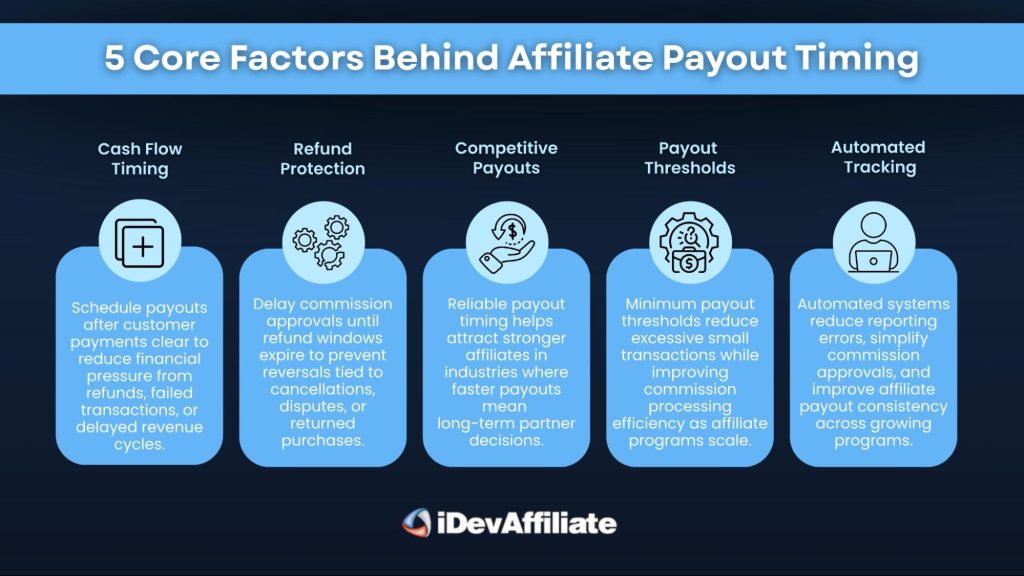
Affiliate payout timing directly impacts affiliate trust, cash flow stability, refund protection, and how competitive your program feels to potential partners. The goal is not simply paying affiliates faster.
The goal is creating a payout structure that remains sustainable as your affiliate program grows.
The strongest payout systems balance financial protection for the business while still giving affiliates predictable and reliable payment expectations.
1. Cash Flow Alignment
Affiliate payouts should always follow confirmed revenue collection rather than estimated incoming payments. If commissions are paid before subscription charges clear or invoices settle, businesses can create avoidable cash flow pressure during growth periods or seasonal fluctuations.
2. Refund Protection Windows
Refund periods directly affect when affiliate commissions should become payable. A commission locking period gives businesses time to verify completed sales before releasing payouts, helping prevent losses tied to refunded orders or canceled subscriptions.
This protection matters because the National Retail Federation estimated that retail returns reached $890 billion in 2024, making refund-related commission reversals a major operational concern for online businesses.
3. Competitive Payment Expectations
Affiliates often compare payout timing before deciding which programs deserve long-term promotion. Reliable monthly payouts remain the standard, but some competitive industries now use faster schedules to attract experienced affiliates away from competing programs.
Businesses should evaluate competitor payout timing, locking periods, and payout thresholds together rather than focusing only on commission percentages or bonus incentives.
4. Minimum Payout Thresholds
Minimum payout thresholds reduce administrative overhead by preventing constant processing of extremely small commission balances. They also help businesses batch transactions more efficiently while giving affiliates a clear earnings target before payouts are released.
Many established affiliate networks use thresholds between $50 and $100 depending on payout method, transaction costs, and overall program structure.
5. Automated Payment Management
Manual payout management becomes difficult very quickly as affiliate programs scale.
Tracking commissions, validating refunds, and calculating payout eligibility manually increases the risk of reporting mistakes and delayed affiliate payments over time.
iDevAffiliate automates commission tracking, payout scheduling, locking periods, and affiliate reporting, helping businesses maintain consistent payment operations without relying on spreadsheets or manual reconciliation processes.
Comparing Affiliate Payout Schedules
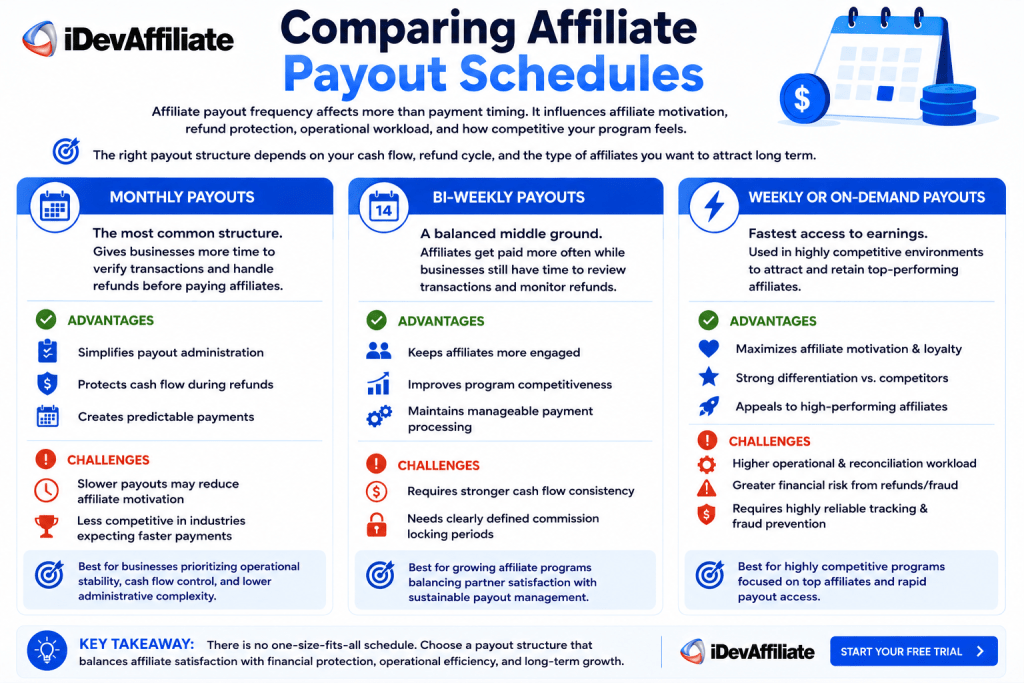
Affiliate payout frequency affects more than payment timing. It influences affiliate motivation, refund protection, operational workload, and how competitive your program feels compared to other affiliate opportunities.
The right payout structure depends on your cash flow, customer refund cycle, and the type of affiliates you want to attract long term.
Monthly Payouts
Monthly payouts remain the most common structure across affiliate programs because they align well with accounting cycles, refund windows, and commission validation processes.
This schedule gives businesses more time to verify transactions before releasing affiliate payments.
Advantages:
- Simplifies payout administration and reconciliation workflows
- Protects cash flow during refunds or chargeback periods
- Creates predictable monthly payment operations
Challenges:
- Slower payouts may reduce affiliate motivation
- Less competitive in industries expecting faster payments
Monthly schedules work best for businesses prioritizing operational stability, controlled cash flow management, and lower administrative complexity.
Bi-Weekly Payouts
Bi-weekly payouts create a middle ground between affiliate motivation and manageable operational workload.
Affiliates receive commissions more consistently while businesses still maintain enough time to review transactions and monitor refund activity properly.
Advantages:
- Keeps affiliates more engaged through faster payouts
- Improves program competitiveness without excessive complexity
- Maintains manageable payment processing frequency
Challenges:
- Requires stronger cash flow consistency
- Needs clearly defined commission locking periods
This structure works well for growing affiliate programs looking to balance partner satisfaction with sustainable payout management.
Weekly or On-Demand Payouts
Weekly or on-demand payouts are typically used in highly competitive affiliate environments where faster access to earnings helps attract experienced affiliates.
This approach prioritizes affiliate retention and rapid payout accessibility above administrative simplicity.
Advantages:
- Maximizes affiliate motivation and loyalty
- Creates strong differentiation against competing programs
- Appeals to high-performing affiliates expecting faster access to commissions
Challenges:
- Increases operational and reconciliation workload significantly
- Raises financial risk from refunds or fraudulent conversions
- Requires highly reliable tracking and fraud prevention systems
iDevAffiliate helps businesses manage faster payout structures through automated commission tracking, configurable locking periods, and centralized payout management tools that reduce manual processing work.
While maintaining accurate affiliate reporting.
How to Choose a Payout Schedule That Scales
A scalable affiliate payout structure should reduce manual work without making payment processes harder for affiliates to understand.
As programs grow, consistency and automation become more important than simply increasing payout frequency.
- Set Minimum Thresholds: Prevent excessive small transactions while keeping payout processing manageable as affiliate participation increases.
- Match Refund Windows: Delay commission payouts until refund periods expire to avoid reversing already released payments.
- Protect Cash Flow Timing: Schedule affiliate payments after customer revenue successfully clears and settles into business accounts.
- Automate Commission Tracking: Eliminate spreadsheet-based calculations that create reporting errors and inconsistent affiliate payment processing workflows.
- Centralize Payout Management: Manage thresholds, locking periods, commissions, and affiliate balances from one structured system dashboard.
- Reduce Manual Reconciliation: Automated payout systems minimize repetitive administrative work as affiliate transaction volume increases over time.
- Maintain Payment Consistency: Reliable payout timing strengthens affiliate trust and improves long-term partner retention across growing programs.
iDevAffiliate helps businesses scale affiliate payouts through automated commission tracking, configurable payout rules, and centralized payment management designed to reduce operational complexity as affiliate programs expand.
Bottom Line: Does Your Affiliate Payout Structure Actually Matter?
Instant account set up. All features unlocked in base plan. Professional onboarding included.
Create Your Affiliate Program
Affiliate payout systems are not just administrative workflows, they directly shape affiliate trust, operational stability, and long-term program scalability.
When payout processes become inconsistent, everything downstream becomes harder to manage: commissions, refund handling, reporting accuracy, and affiliate relationships.
Reliable payout management affects everything.
When your payout structure is built around verified sales activity and clear commission rules, affiliate programs become easier to operate and scale:
- Automated commission tracking: iDevAffiliate tracks affiliate commissions without manual spreadsheet calculations.
- Configurable commission settings: iDevAffiliate allows businesses to define payout structures and commission rules.
- Affiliate reporting visibility: iDevAffiliate keeps commission activity organized and easier to review.
iDevAffiliate helps businesses simplify affiliate payout management through structured commission tracking and flexible affiliate program configuration tools.
Affiliate programs scale more efficiently when payout systems remain consistent.
Start a free trial of iDevAffiliate to see how automated commission tracking and structured affiliate management perform in real operating conditions.
Frequently Asked Questions (FAQS)
You may also like

How to Set Up an Affiliate Program on BigCommerce

How to Set Up an Affiliate Program on WooCommerce

How to Set Up an Affiliate Program on Shopify

First Steps: 6 FREE Marketing Ideas For Your New Affiliate Program
Create Your Affiliate Program
- Unlimited Affiliates
- Unlimited Commissions
- Built-In SEO Links
- Social Media Sharing
- Affiliate Program Directory
