How Long Do Affiliate Links Last in Real Scenarios

Affiliate links don’t really expire, your commission credit does. That’s why you can see clicks, working links, and still earn nothing.
If you’re trying to understand how long affiliate links last, here’s what actually determines it:
- Attribution only works if the full click-to-sale chain holds
- Cookie duration and link behavior operate on separate timelines
- Program rules can override tracking even when everything “works”
- Last-click attribution can replace your credit before checkout
- Device switching and privacy tools frequently break attribution
If you want more reliable attribution, iDevAffiliate uses email-based tracking to maintain the connection beyond cookies and sessions.
Most explanations stop at cookie duration.
The real answer lies in how attribution behaves across devices, sessions, and competing touchpoints, and that’s where most commissions are actually lost.
What Determines How Long Affiliate Links Last
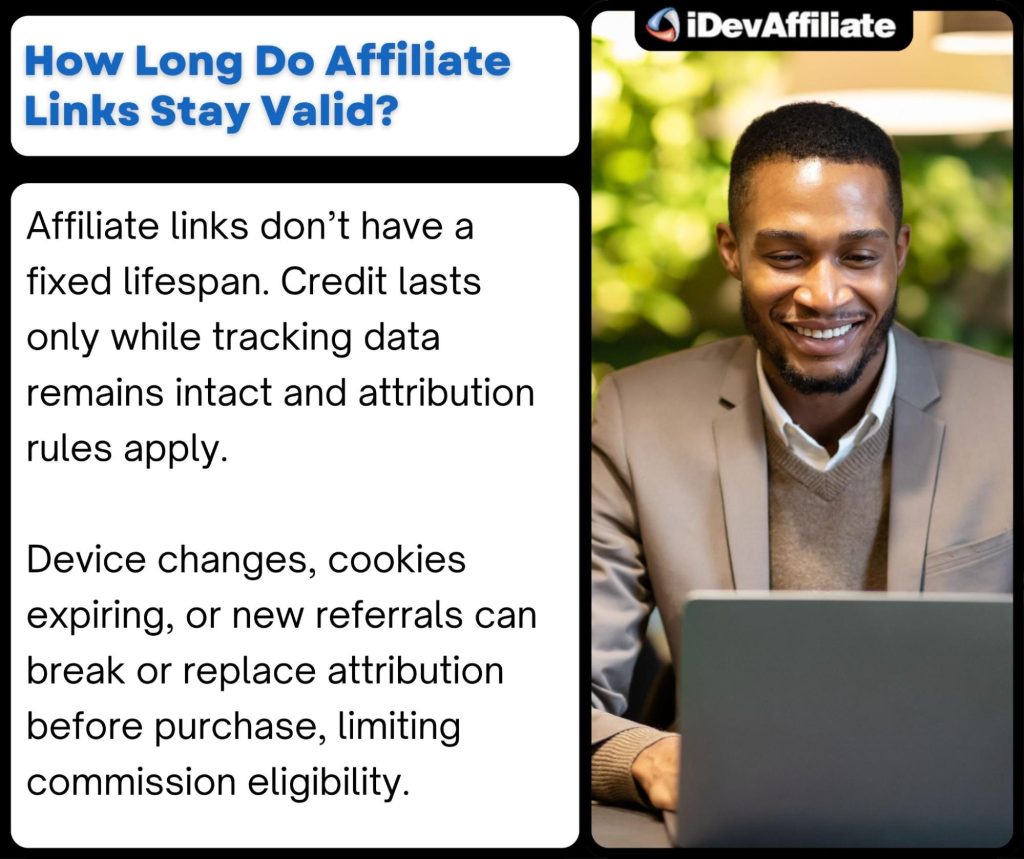
Affiliate links don’t “expire” in the way most people think. What actually expires is your ability to receive credit for a conversion.
That depends on how tracking is stored, how attribution rules are defined, and whether that connection survives until purchase.
The Click-to-Sale Attribution Chain
Affiliate software assigns each partner a unique tracking link or identifier, connecting the initial click to a potential conversion.
That connection only holds if tracking data is stored, maintained, and successfully matched at checkout without being interrupted.
Tracking Breakpoints in Real Browsing
Attribution often breaks in ways that are not immediately visible, such as device switching, browser changes, or privacy restrictions.
Even when intent is strong, missing or unreadable tracking data can prevent the system from connecting the original click to the final purchase.
Program Rules Override Tracking
Even when tracking works perfectly, program rules determine whether a commission is actually credited.
Exclusions, refund policies, coupon restrictions, and approval delays can override attribution, meaning a tracked conversion may still not result in a payable commission.
Attribution Switching Between Affiliates
Affiliate attribution can shift when another qualifying interaction happens before purchase.
In many programs, the most recent valid referral takes priority, which means earlier influence can be replaced by later clicks, especially through coupon or deal-based interactions.
Once you understand how attribution holds or breaks, the next question becomes how long that credit realistically lasts across different programs.
Because in practice, link lifespan isn’t fixed, it varies based on the type of offer and how people actually buy.
Helpful Resource → Best Affiliate Tool Stack for Scalable Growth
Common Affiliate Programs and Typical Link Lifespans
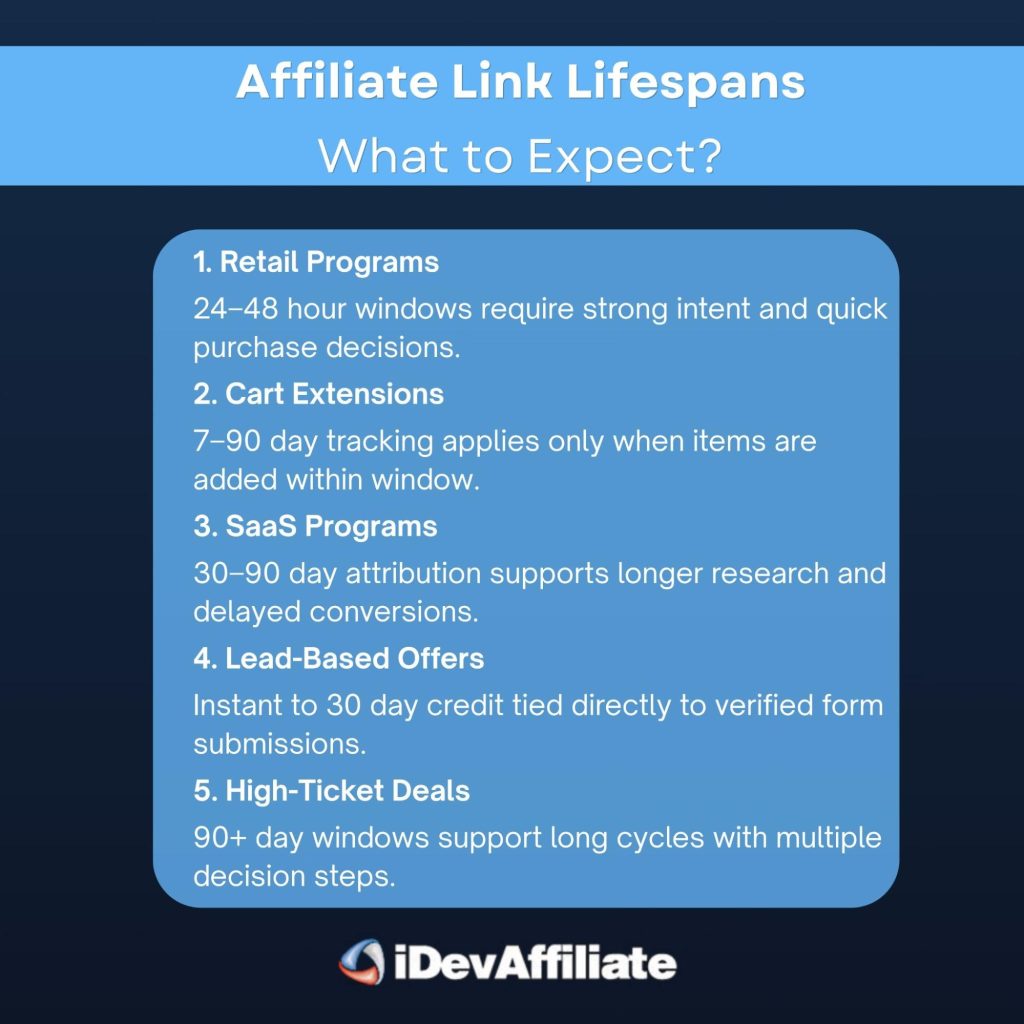
Affiliate link duration varies significantly depending on the type of program you promote.
The actual lifespan is shaped by how long customers take to decide and complete a purchase. Knowing these averages helps you match your content and traffic strategy to realistic earning windows.
Retail Marketplaces: 24 to 48 Hour Windows
Retail affiliate programs typically offer short tracking windows, often between 24 to 48 hours.
For example, Amazon uses a 24-hour cookie, making fast purchase intent critical to earning commissions from these programs.
Cart-Based Extensions: Up to 7 to 90 Days (Conditional)
Some retail programs extend attribution if items are added to the cart within the initial window.
In these cases, commissions can still apply for 7 to 90 days, but only if the cart action meets specific program rules.
SaaS Programs: 30 to 90 Day Attribution
SaaS affiliate programs commonly provide longer tracking windows ranging from 30 to 90 days.
This reflects longer buying cycles where users research, compare options, and return later to complete the purchase.
Lead-Based Programs: Instant to 30 Day Credit
Lead-based programs assign attribution when a form is submitted, often within the same session or up to 30 days.
The key event is the lead capture itself, not the final sale, making tracking dependent on accurate form submission.
High-Ticket or Enterprise Offers: 90+ Day Windows
Higher-value offers often include extended attribution windows of 90 days or more.
These longer periods support complex buying journeys where multiple stakeholders, approvals, and follow-ups delay the final decision.
These ranges give you a realistic expectation of how long affiliate links last across different program types.
But lifespan alone doesn’t explain lost commissions, the real difference comes from how tracking windows and link behavior operate separately.
Cookie Duration vs Link Behavior vs Email Tracking
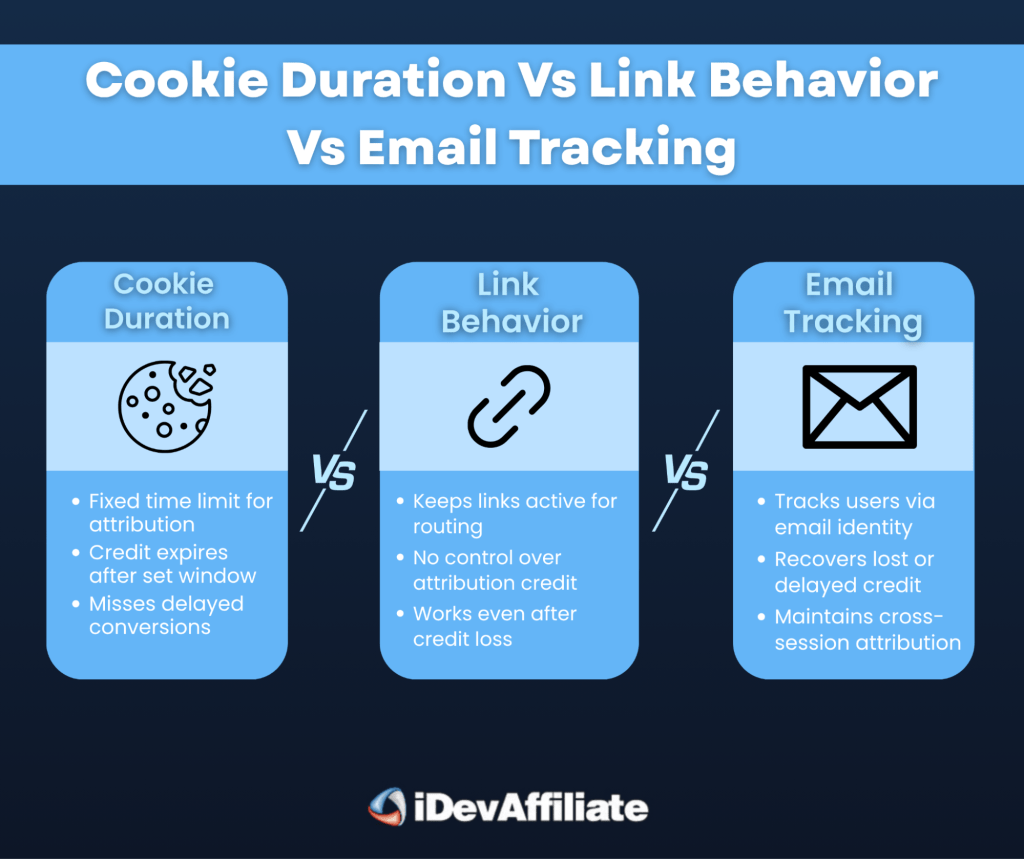
One of the biggest misunderstandings in affiliate marketing is assuming links and attribution expire together.
In reality, a referral link can continue working while your commission eligibility has already ended. Understanding how cookie-based and email-based tracking differ is key to diagnosing lost conversions.
Working Links vs Attribution Credit
A referral link can remain active even when attribution is no longer valid. The real difference lies in how each method handles attribution beyond the initial click.
- Cookie Duration: Limits how long referral data persists before attribution eligibility expires.
- Link Behavior: Ensures routing works, but has no role in preserving attribution credit.
- Email Tracking: Connects referrals to verified user identity, preserving attribution beyond session limits.
When attribution needs to hold under real conditions, identity-based tracking provides the most reliable foundation.
Cookie Windows and Session Limits
Each tracking method defines how long a referral remains eligible for commission credit. These limits determine whether delayed or multi-session conversions are properly captured.
- Cookie Duration: Fixed expiration window, often misaligned with longer customer decision timelines.
- Link Behavior: Operates independently of attribution windows, offering no control over commission validity.
- Email Tracking: Extends attribution by reconnecting returning users through persistent identity matching.
For longer buying cycles, email-based tracking aligns better with how customers actually convert.
Attribution Loss in Real Behavior
Real-world browsing behavior introduces gaps that traditional tracking methods struggle to handle. Understanding these breakdowns explains why valid referrals often go uncredited.
- Cookie Duration: Breaks with device switching, data clearing, or expired tracking windows.
- Link Behavior: Continues functioning but cannot recover attribution once tracking is lost.
- Email Tracking: Reconnects fragmented sessions by matching activity to a single verified user identity.
When journeys span devices and time, identity tracking significantly reduces attribution loss.
Email-Based Tracking Extends Attribution
Email tracking introduces a more stable attribution layer by focusing on user identity. This approach adapts better to modern, non-linear customer journeys.
- Cookie Duration: Restricted to browser context, making it unreliable across devices and time gaps.
- Link Behavior: Supports access but does not influence attribution persistence or accuracy.
- Email Tracking: Uses captured email identity to maintain attribution across sessions, devices, and delays.
This shift from sessions to identity is what makes attribution consistently hold in real-world conditions.
Why Links Appear to Expire
Many assume links stop working when commissions are not credited after a conversion. In reality, attribution is usually lost or replaced before the purchase occurs.
- Cookie Duration: Expires or gets overwritten by newer interactions before conversion happens.
- Link Behavior: Remains active but does not indicate whether attribution is still valid.
- Email Tracking: Maintains attribution continuity by tying conversions back to verified user identity.
Links rarely fail, attribution does, and identity-based tracking is what prevents that breakdown.
Understanding these differences makes it easier to diagnose attribution gaps instead of guessing.
It also highlights why identity-based tracking, like email tracking, is becoming the standard for accurate, scalable affiliate attribution.
What Reduces How Long Affiliate Links Actually Last
Even when programs offer long tracking windows, real-world behavior often shortens how long you actually receive credit.
The gap between “expected” and “actual” attribution usually comes down to a few predictable breaks in the tracking chain.
Understanding these helps you protect commissions before they disappear.
Privacy Blocking and Consent Loss
Tracking can fail entirely when users block cookies or decline consent, reducing your effective window to zero.
Even with long attribution periods, no tracking means no credit, making privacy tools a primary cause of untracked conversions.
Device Switching and Session Breaks
Affiliate tracking is often limited to a single browser or device, so switching environments breaks attribution.
A user clicking on mobile and purchasing on desktop can lose the original referral connection, even within the valid tracking window.
Last-Click Attribution Overrides
Many programs credit the most recent qualifying interaction, not the first.
If a shopper clicks another affiliate link before purchasing, your attribution can be replaced, even if you influenced the original decision.
Coupon Leakage and Deal Interruption
Coupon searches often introduce a new affiliate touchpoint just before checkout.
This late-stage interaction can override your referral, shifting credit to coupon or deal platforms despite your earlier influence in the buying process.
Conversion Tracking Failures
Even when clicks and intent are present, commissions can be lost if conversion tracking fails to record properly.
Integration gaps, incorrect event triggers, or checkout issues can prevent the system from matching the purchase to the original referral.
These breakdowns are not random.
They follow consistent patterns, and once you recognize them, you can adjust your strategy to protect attribution instead of losing it silently.
Bottom Line: How Long Do Affiliate Links Really Last?
Instant account set up. All features unlocked in base plan. Professional onboarding included.
Create Your Affiliate Program
Affiliate links can last indefinitely, but attribution does not.
Your ability to earn depends on whether the system can still connect the original click to the final purchase.
Attribution determines everything.
For affiliate links to “last” in a meaningful way, the tracking chain must remain intact from click to conversion:
- Stored tracking data that survives sessions, devices, and delays
- Clear attribution rules that define who gets credited and when
- Protection against overrides from coupon sites or later clicks
- Reliable conversion tracking that records completed purchases
- Systems that reduce tracking loss from privacy or device changes
iDevAffiliate strengthens this process by using email-based tracking alongside traditional methods, helping maintain attribution even when cookies fail or sessions reset.
Affiliate tracking works best when it’s built on clarity, not assumptions.
And once you understand where attribution breaks, you can design your strategy to protect it and scale with confidence.
Something you can experience firsthand by starting a free trial of iDevAffiliate and seeing how stable attribution holds up in real conditions.
Frequently Asked Questions (FAQS)
You may also like

How to Set Up an Affiliate Program on BigCommerce

How to Set Up an Affiliate Program on WooCommerce

How to Set Up an Affiliate Program on Shopify

First Steps: 6 FREE Marketing Ideas For Your New Affiliate Program
Create Your Affiliate Program
- Unlimited Affiliates
- Unlimited Commissions
- Built-In SEO Links
- Social Media Sharing
- Affiliate Program Directory
