
First-Click vs Last-Click Attribution in Affiliate Tracking

First-click attribution rewards the affiliate who introduces the customer first, while last-click attribution rewards the affiliate responsible for the final conversion before purchase. The attribution model you choose directly impacts affiliate payouts, partner behavior, and how accurately your affiliate tracking reflects the customer journey.
Here’s what actually changes between the two:
- Awareness-focused attribution vs conversion-focused commission credit
- Content creators and influencers vs coupon and deal affiliates
- Top-of-funnel discovery vs final purchase conversion activity
- Long-term customer journey visibility vs simplified tracking
- Affiliate trust and partner incentives vs aggressive last-click competition
- Extended sales cycles vs short sales cycle conversion behavior
- Cookie-based tracking vs identity-based affiliate attribution continuity
iDevAffiliate helps businesses manage affiliate attribution more accurately through flexible attribution models, email-based tracking, and identity-based affiliate tracking designed to preserve referral relationships across devices, sessions, and longer customer journeys.
By combining traditional affiliate tracking with first-party data and email attribution, iDevAffiliate helps businesses maintain cleaner commission reporting even when cookies expire or users return later through different marketing channels.
The sections below explain how first-click and last-click attribution models work, how they influence affiliate behavior, and how to choose the right attribution structure for your affiliate program.
What Are First-Click and Last-Click Attribution Models?
Attribution models are simply the rules you use to decide which affiliate gets credit for a sale.
Understanding the two most fundamental models, first-click and last-click, is the starting point for building a fair and effective affiliate program.
This decision matters more than ever as affiliate marketing continues growing rapidly.
According to the Performance Marketing Association, U.S. affiliate marketing spend reached $13.6 billion in 2024, making accurate attribution increasingly important for both brands and affiliates.
Each model tells a different story about your customer’s journey and rewards different types of affiliate contributions.
First-Click: Rewarding the Initial Introduction
First-click attribution gives 100% of the commission credit to the very first affiliate link a customer clicks.
This model operates on a ‘first-in, first-out’ principle, rewarding the partner who introduced the customer to your brand, regardless of any other affiliate interactions that happen before the final purchase.
The core philosophy here is to value awareness and discovery.
This model answers the question, “Which affiliate started this customer’s journey?”
It’s designed to reward affiliates who are excellent at generating initial interest and bringing new potential customers into your sales funnel.
Last-Click: Crediting the Final Conversion Touchpoint
Last-click attribution assigns 100% of the commission to the final affiliate link a customer clicked before converting.
This is the most common and traditionally the default model in affiliate marketing due to its simplicity. It ignores all previous touchpoints and focuses exclusively on the interaction that immediately preceded the sale.
This model answers the question, “Which affiliate closed the deal?” It prioritizes the partner who successfully persuaded the customer to make a purchase at the critical moment.
Affiliates who specialize in deal-closing content, such as coupon sites or final review comparisons, tend to benefit most from this structure.
A Real-World Payout Scenario
To see how these models work in practice, imagine a customer’s path to buying a new software subscription. The journey involves three different affiliates over the course of a week.
On Monday, the customer reads a detailed blog post from Affiliate A and clicks their link to visit the software’s website for the first time.
On Wednesday, they watch a video review from Affiliate B and click their link to re-examine the features.
Finally, on Friday, they find a 10% discount code on a coupon site run by Affiliate C, click that link, and complete the purchase.
- With First-Click Attribution: Affiliate A receives 100% of the commission. Their blog post was the first touchpoint that introduced the customer to the product.
- With Last-Click Attribution: Affiliate C receives 100% of the commission. Their coupon code link was the final click before the sale was made.
- In Both Scenarios: Affiliate B, who provided a mid-journey video review, receives no commission for their contribution.
This example shows how your choice of attribution model directly determines which partner gets paid. It highlights the importance of aligning your model with the affiliate behaviors you want to reward.
Key Differences: How Each Model Impacts Your Program
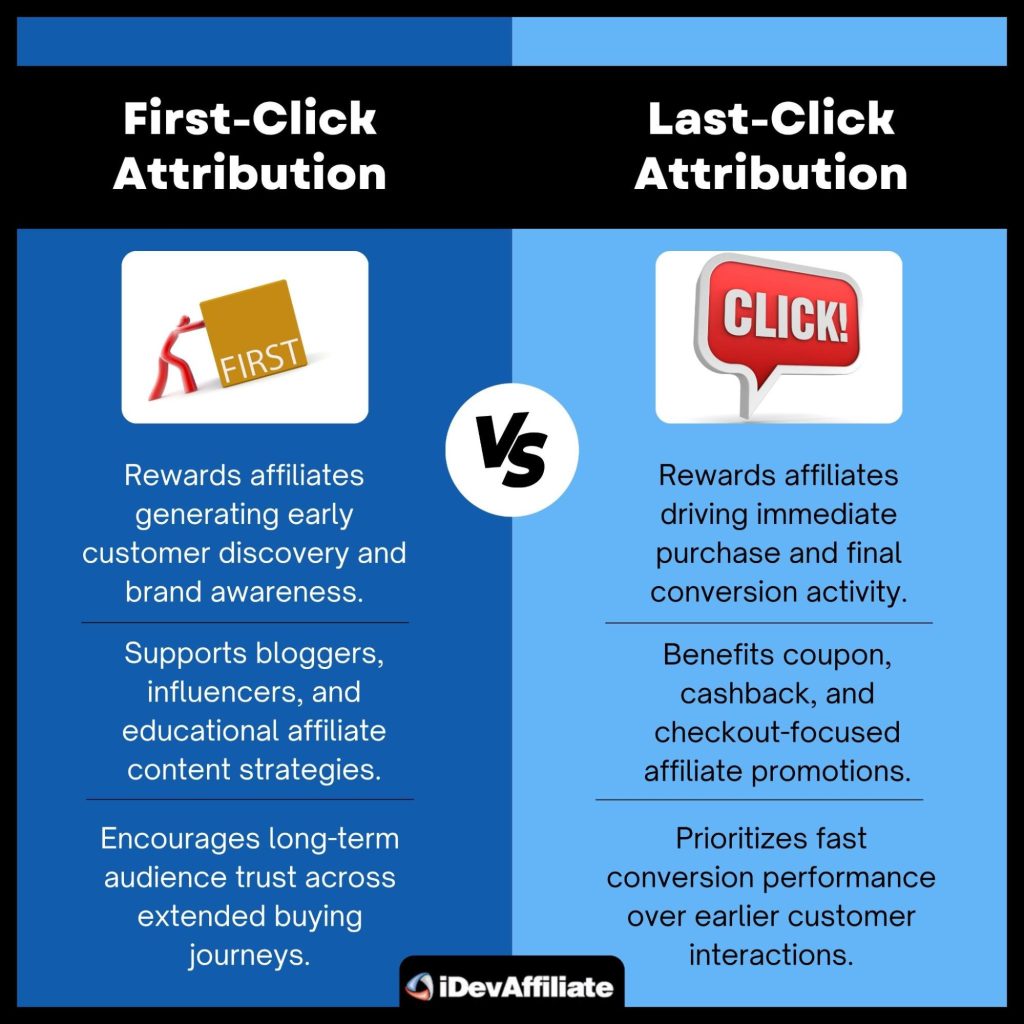
Choosing between first-click and last-click attribution affects more than commission payouts.
It influences how affiliates promote your brand, which partners stay motivated, and how accurately your tracking reflects the customer journey.
The attribution model you choose ultimately determines which affiliate behaviors your program encourages over time.
Rewarding Brand Discovery vs. Rewarding Final Conversion
Affiliate programs often need to decide whether they value customer introduction or purchase completion more heavily.
This distinction directly impacts which affiliates feel incentivized to promote your products consistently.
- First-Click Attribution: Rewards affiliates responsible for introducing new customers and generating early-stage brand awareness.
- Last-Click Attribution: Rewards affiliates responsible for driving the final action immediately before completed purchase conversion.
First-click attribution tends to favor discovery-focused partners, while last-click prioritizes affiliates skilled at closing sales.
The right choice depends on whether your program emphasizes customer acquisition or immediate conversions.
Supporting Content Creators vs. Supporting Coupon Affiliates
Different affiliate types contribute at different stages of the buying process. Some educate and build trust over time, while others help convert buyers already close to purchasing.
- First-Click Attribution: Benefits bloggers, educators, influencers, and review publishers creating awareness-driven evergreen marketing content.
- Last-Click Attribution: Benefits coupon sites, deal platforms, and affiliates targeting customers near final checkout stages.
Programs relying heavily on content partnerships often lean toward first-click attribution. Programs focused on rapid conversion activity frequently prefer last-click structures for simplicity and speed.
Long-Term Relationship Building vs. Short-Term Conversion Focus
Attribution models also shape how affiliates approach promotion strategies over time. The commission structure influences whether affiliates prioritize long-term trust or immediate transactional tactics.
- First-Click Attribution: Encourages affiliates to educate audiences and nurture customer trust throughout extended buying journeys.
- Last-Click Attribution: Encourages affiliates to capture purchase-ready traffic using discounts, urgency, and closing-focused promotions.
This distinction becomes especially important for SaaS businesses or higher-consideration purchases where customers research products across multiple sessions before converting.
Customer Journey Visibility vs. Simplified Tracking
Tracking complexity varies significantly between attribution models. Some businesses prefer operational simplicity, while others prioritize deeper visibility into how customers actually convert.
- First-Click Attribution: Highlights which affiliates consistently generate initial customer interest and new visitor acquisition activity.
- Last-Click Attribution: Simplifies commission assignment by crediting only the final verified affiliate referral interaction.
While last-click attribution is easier to manage, both models still simplify a much larger customer journey.
More advanced affiliate tracking systems can preserve referral relationships beyond a single browser session using identity-based tracking methods.
Protecting Affiliate Trust vs. Creating Commission Competition
The attribution structure inside your platform directly impacts affiliate confidence in your program. Affiliates want assurance that their marketing efforts will be rewarded fairly and consistently.
- First-Click Attribution: Protects affiliates investing significant effort into early-stage education and audience-building campaigns.
- Last-Click Attribution: Creates stronger competition among affiliates attempting to secure the final conversion interaction.
This shift toward creator and partner relationships is accelerating.
When affiliates repeatedly lose commissions despite influencing the customer journey, frustration builds quickly.
Clear attribution rules combined with accurate tracking help maintain healthier affiliate relationships and reduce payout disputes over time.
How to Choose the Right Model for Your Business
The best attribution model is the one that supports your growth strategy, affiliate relationships, and customer buying behavior.
Instead of treating attribution as just a tracking setting, it helps to view it as a decision that shapes how affiliates promote your business over time.
iDevAffiliate allows businesses to configure attribution rules around their actual customer journey, giving program managers more control over how commissions are assigned and tracked.
- Prioritize Customer Acquisition: First-click attribution rewards affiliates responsible for introducing entirely new customers to your brand.
- Focus on Final Conversions: Last-click attribution rewards affiliates who successfully drive customers to complete purchases immediately.
- Support Content Partnerships: Educational content creators often perform better when early-stage referral activity receives commission protection.
- Reward Closing-Focused Affiliates: Coupon, loyalty, and deal-based affiliates typically benefit more from final-click commission structures.
- Match Longer Buying Cycles: SaaS and research-heavy purchases often involve multiple touchpoints before customers finally convert.
- Define Tracking Rules Clearly: Transparent attribution terms reduce confusion, prevent disputes, and strengthen long-term affiliate trust significantly.
- Extend Attribution Reliability: Email address-based tracking helps preserve affiliate relationships beyond cookies, browser sessions, or device changes.
Choosing the right attribution model ultimately comes down to what behaviors you want your affiliate program to encourage.
When your tracking structure aligns with your business goals, affiliates understand exactly how to promote your brand effectively.
iDevAffiliate helps support that process with flexible attribution controls, reliable tracking accuracy, and identity-based referral tracking designed for longer and more complex customer journeys.
Building a Stronger Affiliate Program With Better Attribution Tracking
Instant account set up. All features unlocked in base plan. Professional onboarding included.
Create Your Affiliate Program
First-click and last-click attribution are not just commission settings, they define how your affiliate program rewards value.
When attribution models fail to reflect the actual customer journey, partner trust weakens, content creators disengage, and commission disputes become harder to manage.
Attribution accuracy shapes affiliate behavior.
When your tracking system is built around clear attribution rules and verified referral activity, affiliate programs become easier to scale and optimize:
- Customer introduction tracking: rewards affiliates responsible for generating early-stage brand discovery.
- Conversion attribution logic: connects commissions to the affiliate interaction your business values most.
- Reliable referral tracking: preserves attribution across longer buying cycles, devices, and browser sessions.
- Transparent commission structure: reduces payout disputes and creates clearer affiliate expectations.
iDevAffiliate strengthens this further by combining traditional tracking methods with email-based attribution, helping referrals stay connected even when cookies expire or browser limitations interfere with tracking.
Affiliate programs perform better when attribution is consistent.
Start a free trial of iDevAffiliate to see how flexible attribution tracking and verified commission reporting perform in real affiliate programs.
Frequently Asked Questions (FAQS)
You may also like

How to Set Up an Affiliate Program on BigCommerce

How to Set Up an Affiliate Program on WooCommerce

How to Set Up an Affiliate Program on Shopify

First Steps: 6 FREE Marketing Ideas For Your New Affiliate Program
Create Your Affiliate Program
- Unlimited Affiliates
- Unlimited Commissions
- Built-In SEO Links
- Social Media Sharing
- Affiliate Program Directory
