
Finance Affiliate Program Setup Checklist for Fast Growth

If you’re setting up an affiliate program for your finance business, you’ll need a checklist to launch a compliant, trackable, and scalable affiliate program from day one.
Affiliate marketing in financial services works best when partner activity is controlled, attribution is accurate, and compliance is built into every step of the process. This ensures promotions stay aligned with regulations, conversions are tracked correctly, and commissions reflect verified customer actions across complex buying journeys.
Finance Affiliate Program Setup Checklist
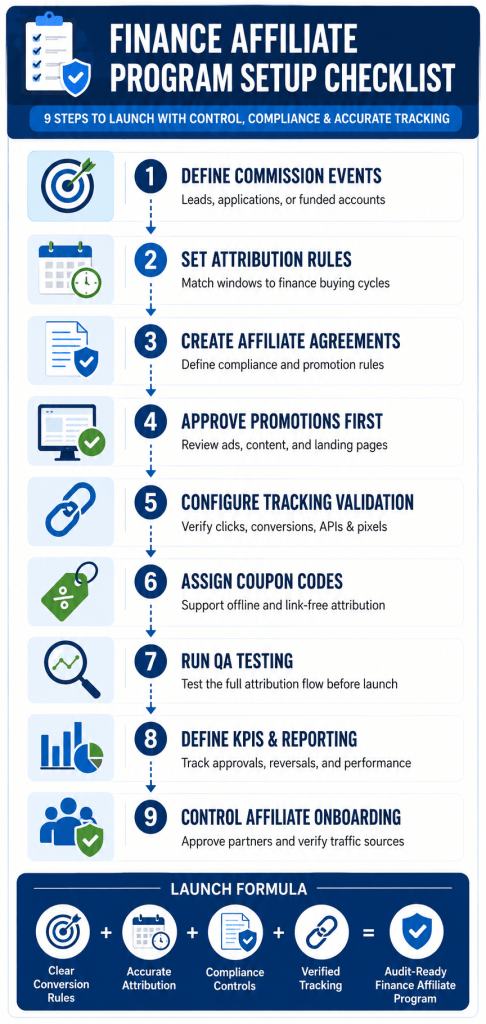
A finance affiliate program only works when setup decisions are made before traffic begins. Each element, from compliance to tracking, must connect clearly to attribution and payouts.
This checklist ensures your program launches with control, accuracy, and audit-ready structure.
1. Define Commissionable Conversion Events
Start by deciding which actions actually earn a commission in your program.
This could include leads, approved applications, or funded accounts, supported by lead tracking and flexible commission triggers.
Clear definitions prevent disputes and ensure payouts reflect real, verified business outcomes.
2. Set Attribution Rules and Windows
Attribution rules determine which affiliate receives credit when multiple touchpoints exist. Use adjustable tracking duration and define attribution windows that match finance buying cycles.
Longer windows preserve early influence and reduce payout conflicts across partners.
3. Create Compliance-Ready Affiliate Agreements
Your agreement defines what affiliates can and cannot do when promoting your offer. Include claim restrictions, disclosure requirements, and enforcement terms.
Strong agreements protect your brand and give you authority to act when violations occur.
4. Build Pre-Approval Workflows for Promotions
Require approval before any affiliate content goes live across channels. This includes landing pages, ads, and videos with final URLs.
Using controlled landing page routing ensures affiliates only send traffic to approved, compliant destinations.
5. Configure Tracking Links and Conversion Validation
Tracking must connect every click to a verified conversion without gaps. Use tracking links alongside pixels, APIs, or webhooks to validate actions.
Integrated systems ensure every conversion is captured accurately across complex, multi-step finance funnels.
6. Implement Coupon Attribution with Guardrails
Coupon codes should support tracking, not create attribution conflicts. Assign unique coupon codes to affiliates for link-free and offline tracking.
Clear rules prevent duplicate crediting and ensure fair commission allocation across partners.
7. Run Pre-Launch Tracking and QA Tests
Before launch, validate your entire tracking and attribution flow end to end. Test clicks, conversions, and reporting consistency across devices and sessions.
Automated integrations make it easier to identify gaps before they impact real affiliate traffic.
8. Define KPIs and Reporting Structure
Set measurable KPIs that reflect both performance and data quality. Track approved conversions, reversal rates, and attribution timelines.
Flexible reporting ensures you can monitor performance accurately and detect anomalies early.
9. Structure Onboarding and Partner Controls
Onboarding is your first layer of fraud prevention and compliance control. Approve partners based on traffic sources and promotion methods, and assign clear tracking identifiers.
Structured onboarding ensures only qualified affiliates promote your offer under defined rules.
When these elements are set up correctly, your program operates with clarity instead of constant adjustments.
The next step is understanding where even well-structured setups fail, and how small gaps turn into larger operational problems.
Why Finance Affiliate Programs Require More Control

Finance affiliate programs look similar to standard performance marketing, but stricter messaging control and longer decision cycles change how they operate.
Without structured approvals and attribution rules, small gaps quickly turn into compliance risks and payout disputes.
Understanding these differences helps you design systems that stay accurate, auditable, and scalable.
Limited Claim Flexibility Increases Risk
Finance affiliates operate under strict messaging boundaries, where even small claim variations can create compliance exposure.
Unlike other niches, affiliates cannot freely test messaging angles. This makes pre-approved content and controlled communication essential for safe, consistent promotion.
Approval Workflows Replace Open Publishing
Affiliate promotion in finance requires structured approval before anything goes live.
You cannot rely on post-publication fixes because risk occurs at the moment of exposure. Controlled workflows ensure every page, claim, and creative is reviewed before reaching customers.
Marketing Assets Become Compliance Surfaces
In finance, every asset an affiliate publishes represents your brand and regulatory responsibility.
This includes landing pages, videos, and comparison content. Without strict control, messaging drift creates inconsistencies between affiliate claims and actual product terms.
Attribution Windows Must Reflect Real Journeys
Finance buyers rarely convert on the first interaction, making short attribution windows unreliable.
Longer windows preserve credit for early-stage affiliates who influenced the decision. This reduces disputes and aligns payouts with actual customer consideration behavior.
Auditability Is a Core Program Requirement
Finance affiliate programs must be able to prove what was promoted, when, and by whom.
Scattered approvals and missing records create risk during disputes or reviews. A structured audit trail ensures every action is traceable and defensible at any time.
When control, messaging, and attribution are tightly managed, finance affiliate programs become predictable instead of reactive.
The next step is translating these principles into a structured setup that connects compliance, tracking, and payouts from day one.
Common Mistakes That Break Finance Affiliate Programs
Small setup mistakes in finance affiliate programs often create long-term payout and compliance issues.
These problems usually start with unclear rules or misaligned attribution logic that looks correct at launch. The pointers below highlight where most programs fail and how those gaps show up in real operations.
- Unclear Commission Rules: Vague definitions of commissionable actions create confusion, disputes, and inconsistent payouts across affiliates and internal teams.
- Undefined Attribution Logic: Missing or unclear attribution rules lead to conflicts when multiple affiliates influence the same conversion journey.
- Last-Click Overdependence: Relying only on last-click attribution shifts credit to final interactions instead of true demand-driving partners.
- Unclear Coupon Attribution: Allowing coupon commissions without defined rules creates duplicate crediting and payout inconsistencies across partners.
- Weak Violation Enforcement: Lack of defined consequences for policy violations leads to inconsistent handling and increased compliance risk over time.
- Mismatch Between Rules and Reporting: When platform logic differs from documented rules, affiliates lose trust due to inconsistent commission outcomes.
- No Predefined Edge Case Handling: Missing rules for refunds, duplicates, and self-referrals creates confusion when exceptions occur during payouts.
- Inconsistent Partner Expectations: Affiliates operate differently when program rules are unclear, leading to unpredictable promotion and performance patterns.
When these gaps are not addressed early, disputes and misattribution become part of daily operations.
Clear rules, aligned tracking, and consistent enforcement turn affiliate programs into predictable, scalable systems.
When these mistakes go unchecked, they compound into trust issues, reporting gaps, and stalled program growth.
Fixing them early ensures your affiliate program scales with clarity, consistency, and defensible performance data.
Bottom Line: How Affiliate Marketing Works for Financial Services
Instant account set up. All features unlocked in base plan. Professional onboarding included.
Create Your Affiliate Program
Affiliate marketing in financial services is not just about performance, it is about control, compliance, and accurate attribution working together.
By structuring partner activity and tracking systems correctly, it creates a reliable connection between promotions and verified customer outcomes.
Control and attribution determine everything.
When affiliate programs are built on clear rules and validated tracking, they operate with fewer disputes, stronger compliance, and more reliable performance visibility:
- Controlled partner access: ensures only approved affiliates promote regulated financial offers.
- Pre-approved messaging: keeps promotions compliant across all channels and placements.
- Accurate attribution tracking: connects every click to verified conversions across devices.
- Outcome-based commission rules: align payouts with approved, validated customer actions.
Structured tracking systems bring these elements together into one consistent framework, where attribution, compliance, and payouts remain aligned across every partner interaction.
Affiliate programs scale faster when every action is controlled and measurable.
Start a free trial to see how structured tracking and compliant workflows perform in real financial campaigns.
Frequently Asked Questions (FAQS)
You may also like

How to Set Up an Affiliate Program on BigCommerce

How to Set Up an Affiliate Program on WooCommerce

How to Set Up an Affiliate Program on Shopify

First Steps: 6 FREE Marketing Ideas For Your New Affiliate Program
Create Your Affiliate Program
- Unlimited Affiliates
- Unlimited Commissions
- Built-In SEO Links
- Social Media Sharing
- Affiliate Program Directory
