
Fix Coupon Attribution Problems in Affiliate Payouts

Coupon attribution problems occur when promo codes, attribution rules, and checkout behavior combine in ways that shift commission credit away from true demand drivers. These breakdowns often reward the final action instead of the full customer journey, distorting payouts and partner performance visibility.
Affiliate program performance depends on attribution accuracy, clear commission rules, and how well coupon usage aligns with real customer behavior.
When coupon codes override earlier influence or tracking gaps appear, affiliate trust declines and payout disputes increase over time.
Affiliate tracking software helps create consistency by connecting coupon redemption, attribution logic, commission calculations, and partner activity into one controlled system.
Instead of relying on last-touch signals alone, businesses can track which interactions actually influenced conversions and customer intent.
Here’s what matters most:
- Assign unique coupon codes to maintain clear ownership
- Define attribution rules that reflect full customer journeys
- Use tracking systems that validate coupon and click data together
- Align commission logic with actual partner contribution
- Maintain consistent reporting across all attribution touchpoints
iDevAffiliate also supports email address-based tracking, helping businesses maintain reliable attribution even when sessions break or coupon usage overrides browser-based tracking.
Keep reading to understand how coupon attribution problems occur, how they impact payouts, and how structured tracking systems can restore accurate, dispute-free commission attribution.
What Causes Coupon Attribution Problems in Affiliate Tracking
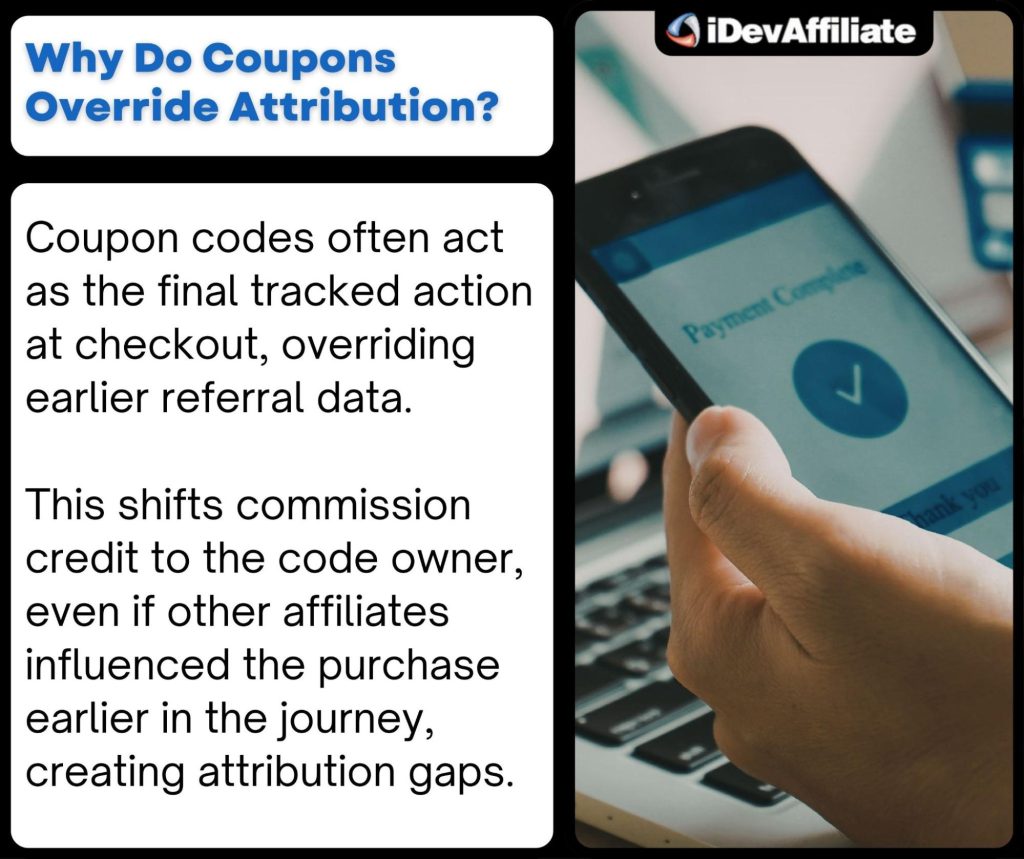
Coupon attribution problems usually come from how attribution rules, checkout behavior, and coupon usage interact during the buying journey.
When these systems prioritize the final action over the full journey, payouts shift toward whoever appears at checkout.
Understanding these patterns helps you identify where attribution breaks before disputes start affecting partner trust.
Last-Touch Attribution Skews Commission Credit
Last-touch attribution gives full credit to the final interaction, even when earlier partners created the demand.
This shifts payouts toward coupon partners who appear at checkout. Over time, it undervalues content and influencer partners who drive initial engagement.
Checkout Coupon Entry Overrides Prior Attribution
When a coupon code is entered at checkout, many systems treat it as the primary commission trigger.
This can override earlier referral data captured during the journey. As a result, attribution shifts to the code owner regardless of who influenced the purchase.
Shared Coupon Codes Create Attribution Conflicts
When multiple affiliates use the same coupon code, attribution becomes unclear and difficult to defend.
A single code can represent multiple touchpoints across different channels. This creates disputes because more than one partner may claim the same conversion.
Coupon Code Leakage Breaks Attribution Control
Assigned coupon codes often spread beyond their intended audience through sharing or reposting.
Once a code behaves like a public discount, it attracts conversions from unrelated traffic sources. This disconnects commissions from the original affiliate who promoted it.
Multi-Touch Journeys Collapse into One Signal
Customer journeys often include multiple interactions before conversion, but coupon redemption reduces attribution to one event.
This removes visibility into earlier influence across channels. As a result, commission decisions rely on incomplete data rather than full journey context.
When attribution rules favor the final action instead of the full journey, coupon-based signals start to dominate commission decisions.
To correct this, you need to understand exactly how coupon redemption overrides earlier influence and shifts payouts in subtle but consistent ways.
This is where most attribution issues move from theory to real payout misalignment at checkout.
How Coupon Codes Override or Misattribute Conversions
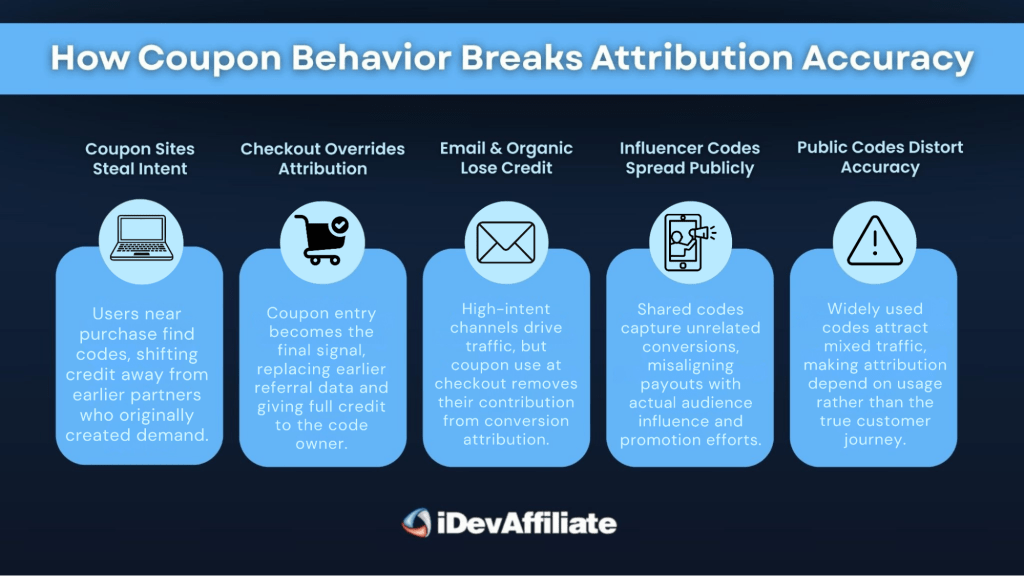
Coupon attribution issues often appear invisible because tracking still records conversions correctly. The problem is not missing data, but how coupon redemption overrides earlier influence at checkout.
This creates payout shifts toward code owners, even when other channels drove the original demand.
1. Coupon Sites Capture Branded Purchase Intent
Coupon sites often intercept users who already intend to buy, especially during branded searches.
The shopper finds a discount code just before checkout, and that redemption becomes the commission trigger. This shifts credit away from earlier partners who created the initial interest.
2. Checkout Prioritizes Coupon Redemption Signals
At checkout, coupon redemption acts as a clear and final attribution signal.
Systems often prioritize this event over previous referral data. As a result, earlier interactions are ignored, and the affiliate tied to the code receives full commission credit.
3. Email and Organic Channels Lose Final Credit
Email campaigns and organic content often drive the initial visit and engagement. However, when a coupon code is introduced at checkout, that signal replaces earlier attribution.
This causes high-performing channels to appear weaker in conversion reporting despite driving demand.
4. Influencer Codes Spread Beyond Intended Audiences
Influencer coupon codes are easy to remember and frequently shared outside their original audience. Once reused across different channels, they begin capturing unrelated conversions.
This leads to misattribution, where commissions are assigned without reflecting the true source of influence.
5. Public Coupon Behavior Distorts Attribution Accuracy
When coupon codes behave like public discounts, they attract conversions from multiple sources.
Attribution becomes tied to whichever code is used, not how the customer arrived. This simplifies tracking but reduces accuracy in understanding true performance drivers.
When coupon redemption becomes the dominant signal, attribution shifts from influence to convenience at checkout.
To fix this, you need to identify the tracking gaps that allow these overrides to happen in the first place.
Common Tracking Gaps That Break Coupon Attribution
Common tracking gaps often look small at setup, but they create compounding attribution issues at scale.
When coupon codes are not tightly linked to affiliates or sessions break, payouts become harder to validate and defend.
- Unassigned Codes: Coupon discounts apply without linking redemption to a specific affiliate, creating disputes or missing commission ownership.
- Mismatch Errors: Inconsistent coupon code formatting between systems breaks attribution mapping and disconnects redemption from commission tracking.
- Shared Code Conflicts: Multiple affiliates promoting the same code remove clear ownership, making it impossible to validate who earned the payout.
- Session Breakpoints: Privacy controls and device switching interrupt tracking continuity, disconnecting referral data before conversion is recorded.
- Mobile Tracking Gaps: Inconsistent session handling on mobile devices increases unattributed or misattributed conversions during checkout.
When these gaps go unaddressed, coupon attribution becomes difficult to audit and explain. Closing these gaps ensures every redemption maps to a clear, defensible commission decision.
How to Fix Coupon Attribution with Accurate Tracking Systems
Fixing coupon attribution starts with making every redemption traceable, consistent, and easy to validate.
The goal is not more tracking layers, but clearer rules that connect coupon usage to a single, defensible commission outcome.
Audit Coupon Redemptions Against Commission Data
Before changing rules, you need visibility into where attribution is breaking.
A structured audit reveals mismatches between what your cart records and what your affiliate system pays.
- Compare cart coupon data with affiliate reports
- Identify codes missing from commission tracking systems
- Flag multi-affiliate or shared coupon code usage
- Validate exact code matching across integrated systems
When audits align coupon usage with commission triggers, attribution becomes measurable. This step creates a clean baseline before introducing any rule changes.
Assign One Coupon Code Per Affiliate
Clear ownership is the foundation of reliable coupon attribution. Assigning one code per affiliate removes ambiguity and simplifies commission decisions at checkout.
- Create codes in cart before affiliate assignment
- Mirror exact codes inside coupon tracking system
- Use coupon/promo codes for link-free attribution
- Enable easy sharing across offline channels
This approach ensures every redemption maps to a single partner. It also supports channels like podcasts, influencers, and word-of-mouth promotions.
Standardize Coupon Tracking Across Systems
Attribution often fails when systems do not communicate consistently. Aligning your cart, tracking platform, and integrations prevents silent attribution gaps.
- Use APIs, webhooks, and plugin-based integrations
- Validate conversions with tracking pixels and events
- Sync coupon data across checkout and tracking systems
- Test integrations across devices and sessions
With automated integrations and built-in setup tools, tracking becomes easier to maintain. This reduces dependency on manual fixes and prevents hidden attribution errors.
Define Payout Levels Based on Partner Value
Not all coupon-driven conversions deliver equal value to your business. Setting payout levels ensures commissions reflect contribution, not just redemption events.
- Create tiered commissions for different partner types
- Adjust payouts based on acquisition versus closing role
- Apply rules across products, subscriptions, and offers
- Align commission logic with actual revenue impact
Consistent payout logic prevents overpaying low-value interactions. It also reinforces the type of partner behavior you want to scale.
Publish Rules and Strengthen Attribution Continuity
Attribution only works when rules are clear, enforced, and visible to partners. Automation and identity tracking ensure those rules persist beyond sessions and devices.
- Define attribution duration based on buying cycles
- Use email address tracking for persistent attribution
- Assign and notify affiliates with dedicated coupon codes
- Provide dashboards for real-time performance visibility
With email-based tracking and adjustable attribution duration, attribution stays intact longer. This ensures coupon commissions remain tied to verified users, not fragile sessions.
Bottom Line: Fix Coupon Attribution with Clear Tracking Systems
Instant account set up. All features unlocked in base plan. Professional onboarding included.
Create Your Affiliate Program
Coupon attribution works best when tracking accuracy, coupon ownership, and commission rules stay aligned inside one consistent system.
The goal is not just to track coupon redemptions, but to ensure every commission reflects the partner who actually influenced the purchase.
When your affiliate platform clearly defines how coupon codes are assigned, how attribution is applied, and how commissions are triggered at checkout, payout accuracy becomes easier to maintain without creating disputes or misaligned incentives:
- Assigned Coupon Codes: Tie each coupon redemption to a single affiliate for clear ownership and accountability.
- Consistent Attribution Rules: Ensure coupon usage does not override earlier influence without defined logic.
- Flexible Commission Structures: Set payout levels that reflect real partner contribution across different roles.
- Reliable Tracking Systems: Maintain visibility into coupon usage, conversions, and commission attribution across channels.
Together, these systems turn coupon attribution into a controlled process instead of a source of confusion or payout disputes.
If you want to manage coupon tracking, attribution, and commissions more reliably, start a free trial with iDevAffiliate and test the platform against your real affiliate workflow.
Frequently Asked Questions (FAQS)
You may also like

How to Set Up an Affiliate Program on BigCommerce

How to Set Up an Affiliate Program on WooCommerce

How to Set Up an Affiliate Program on Shopify

First Steps: 6 FREE Marketing Ideas For Your New Affiliate Program
Create Your Affiliate Program
- Unlimited Affiliates
- Unlimited Commissions
- Built-In SEO Links
- Social Media Sharing
- Affiliate Program Directory
