
Benefits of Email Tracking in Affiliate Marketing

Email tracking improves affiliate marketing by connecting referrals to verified customer identities instead of temporary browser sessions. This creates more accurate affiliate attribution, preserves commissions across devices, reduces tracking gaps, and improves long-term reporting reliability throughout the customer journey.
Here’s why email-based attribution matters:
- Email-based attribution that preserves affiliate relationships across sessions and devices
- Cross-device tracking that reconnects users when they return later to purchase
- More accurate commissions tied to verified customer activity instead of browser assumptions
- Reduced attribution loss caused by expired cookies or interrupted sessions
- Better reporting visibility across longer buying cycles and delayed conversions
- Stronger affiliate trust through consistent, identity-based commission tracking
iDevAffiliate helps businesses solve affiliate attribution problems through email address-based tracking designed to preserve referral relationships even when traditional browser tracking fails.
By connecting affiliate activity directly to verified customer identity, iDevAffiliate creates more reliable attribution continuity across repeat visits, delayed purchases, subscription renewals, and multi-device customer journeys.
The sections below explain how email-based tracking works, why traditional tracking methods fail, and how identity-based attribution improves affiliate reporting, commission accuracy, and long-term program performance.
What Email Tracking Actually Means In Affiliate Systems

Email tracking in affiliate systems connects referred customers to an affiliate using a persistent identifier that does not break across sessions, devices, or browser limitations.
1. Tracking Identifiers And Affiliate Attribution
Affiliate software assigns each partner a unique tracking link that captures referral data when a visitor arrives.
This creates the initial connection between the visitor and the affiliate who drove that traffic.
2. Cookie And Session-Based Tracking Limitations
Traditional tracking relies on cookies, IP addresses, or browser sessions to maintain attribution.
These methods can fail when users switch devices, clear cookies, or interact across different environments before completing a purchase.
3. Email Address As A Persistent Identifier
Email address-based tracking connects referral data directly to the customer’s verified identity.
Instead of relying on temporary browser data, the system ties the referral to the user’s email, creating a stable and long-term attribution link.
4. Cross-Device And Cross-Session Attribution
Once the email address is captured, the system can recognize the same user across multiple devices, browsers, or sessions.
This ensures the original affiliate relationship remains intact regardless of how the customer returns to complete the purchase.
5. Structuring Verified Attribution Into The System
Advanced platforms like iDevAffiliate store this identity-based relationship as a persistent record.
This allows commissions to be accurately assigned based on verified customer activity rather than assumptions tied to fragile tracking methods.
By shifting attribution from temporary browser data to verified identity, email-based tracking creates a more stable and accurate foundation for affiliate programs.
That foundation directly impacts how commissions are preserved, how affiliates are rewarded, and how reliably your program scales, which is where the real benefits start to show.
Helpful Resource → Setting a Fair Cookie Duration for Your Affiliate Program
Key Benefits Of Email Address-Based Tracking In Affiliate Programs
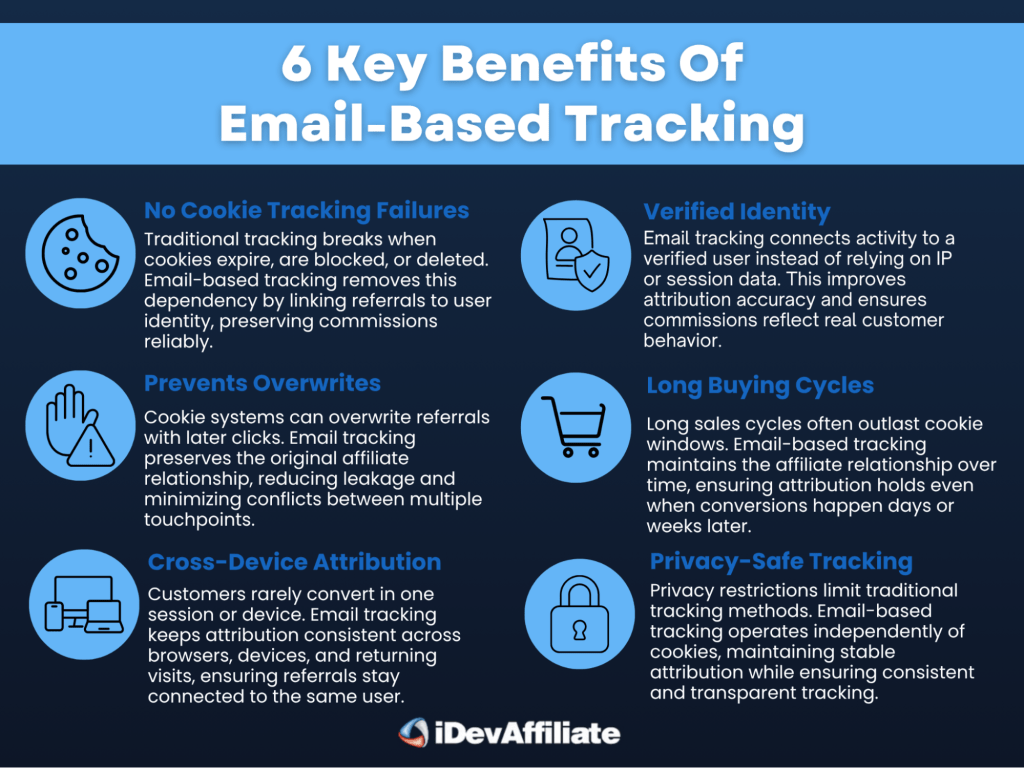
Email address-based tracking changes how affiliate attribution works by replacing temporary identifiers with a persistent, identity-driven system.
Instead of relying on fragile browser data, it ensures every referral stays connected to the correct affiliate across the entire customer journey.
1. Eliminating Cookie-Based Tracking Failures
Traditional tracking breaks when cookies expire, are blocked, or deleted.
Email-based tracking removes this dependency by linking referrals directly to user identity, preserving commissions even when browser-level tracking fails.
Helpful Resource → How Affiliate Tracking and Management Software Works
2. Maintaining Cross-Device Attribution
Customers rarely convert in a single session or on one device.
By tying referrals to an email address, attribution remains consistent across devices, browsers, and returning sessions.
3. Supporting Long Buying Cycles
In longer sales cycles, cookie windows often expire before conversion.
Email-based tracking keeps the affiliate relationship intact, ensuring attribution remains accurate over extended decision timelines.
4. Preventing Attribution Loss And Overwrites
Cookie-based systems can overwrite referrals with later clicks.
Email tracking preserves the original relationship, reducing commission leakage and minimizing attribution conflicts between affiliates.
5. Improving Accuracy With Verified Identity
Instead of relying on indirect signals like IP or session data, email tracking connects activity to a verified user.
This ensures commissions are tied to real customer behavior with far less ambiguity.
6. Enabling Reliable Tracking In Privacy-First Environments
Modern privacy restrictions limit traditional tracking methods.
Email-based tracking operates independently of these constraints, maintaining stable attribution while strengthening trust through consistent, transparent tracking.
When attribution becomes consistent and identity-based, the benefits move beyond fixing tracking gaps and start influencing how the entire affiliate program performs.
That shift is what turns accurate tracking into measurable growth, where better attribution directly improves revenue visibility, partner trust, and overall program efficiency.
Helpful Resource → What Affiliate Tracking Software Really Does
How Email-Based Tracking Improves Affiliate Program Performance
Affiliate programs perform best when attribution is accurate, consistent, and resistant to tracking gaps.
Email address-based tracking strengthens this foundation by ensuring every referral is connected to a verified customer identity, not a temporary session.
1. Preserving Attribution Across The Full Customer Journey
Email-based tracking ensures that affiliate referrals remain intact from first click to final purchase.
Even if users return later or switch environments, the original affiliate relationship is preserved without relying on fragile session data.
2. Reducing Revenue Loss From Tracking Breakdowns
When tracking depends on cookies or IP addresses, conversions can go unattributed.
Email-based tracking removes these gaps by maintaining a persistent connection, ensuring that every completed purchase is correctly linked to the referring affiliate.
3. Supporting Multi-Touch And Delayed Conversions
Customers often interact with multiple touchpoints before converting.
By tying attribution to a verified identity, email tracking allows affiliate programs to handle longer journeys without losing the original referral source.
4. Preventing Commission Disputes And Attribution Conflicts
Inconsistent tracking creates disputes when multiple affiliates appear to drive the same customer.
Email-based tracking maintains a clear, verified relationship, reducing ambiguity and ensuring commissions are assigned based on accurate data.
5. Strengthening Affiliate Trust And Program Retention
Affiliates rely on accurate tracking to trust a program.
When attribution is consistent and verifiable, partners are more confident that their efforts will be rewarded, leading to stronger engagement and long-term participation.
6. Improving Reporting Accuracy And Decision-Making
Reliable tracking data leads to cleaner reporting, allowing businesses to evaluate which affiliates, campaigns, and channels drive real revenue.
This improves budgeting, optimization, and overall program strategy.
7. Enabling Scalable And Consistent Program Growth
As affiliate programs grow, tracking complexity increases.
Email-based tracking provides a stable foundation that scales with volume, ensuring attribution remains accurate without requiring constant adjustments or manual corrections.
When attribution is built on verified identity instead of temporary data, affiliate tracking becomes a reliable growth system.
One that protects revenue, strengthens partnerships, and scales without breaking.
How iDevAffiliate Structures Email-Based Tracking For Reliable Attribution
Affiliate tracking only works when attribution is consistent, verifiable, and resistant to common failure points.
iDevAffiliate structures email-based tracking around customer identity, ensuring every referral remains connected to the correct affiliate across the entire journey.
- Centralized Attribution Flow: iDevAffiliate captures and stores every referral event in one system, ensuring affiliate relationships are consistently tracked from first interaction through final conversion.
- Email-Based Identity Tracking: Referrals are tied directly to the customer’s email address, creating a persistent connection that does not break across devices, sessions, or browser limitations.
- Accurate Commission Assignment: Verified identity tracking ensures each conversion is matched to the correct affiliate, eliminating missed or incorrectly assigned commissions caused by cookie loss.
- Cross-Device Attribution Consistency: Tracking remains intact when users switch devices or return later, preserving the original referral relationship without relying on temporary session data.
- Reduced Attribution Conflicts: By maintaining a single, identity-based relationship, iDevAffiliate prevents overwrites and conflicts when multiple affiliates interact with the same customer.
- Privacy-Resilient Tracking Structure: Email-based tracking operates independently of browser restrictions, maintaining accuracy even as cookies and third-party tracking become less reliable.
- Integrated Reporting And Decision Support: All tracking data feeds into a structured system, allowing businesses to analyze affiliate performance, optimize partnerships, and scale programs with confidence.
By anchoring attribution to verified customer identity rather than fragile tracking methods, iDevAffiliate turns affiliate tracking into a reliable system.
This ensures accurate commissions, stronger partner trust, and consistent program growth.
Bottom Line: Is Email-Based Tracking Worth It For Affiliate Programs?
Instant account set up. All features unlocked in base plan. Professional onboarding included.
Create Your Affiliate Program
Email-based tracking is not just an upgrade, it is a structural shift in how affiliate attribution works.
By moving away from cookies and sessions, it creates a reliable connection between the customer and the referring affiliate.
Attribution accuracy determines everything.
When tracking is built on identity instead of temporary data, affiliate programs operate with more consistency, fewer disputes, and clearer performance insights:
- Email-based tracking: connects referrals directly to verified customer identity, preserving attribution across devices and sessions.
- Persistent attribution: ensures commissions are not lost due to cookie expiration or browser limitations.
- Reliable commission tracking: matches every conversion to the correct affiliate based on actual user behavior.
- Scalable tracking structure: supports growth without increasing complexity or manual correction.
Platforms like iDevAffiliate bring these elements together into a single system, where attribution is structured, verifiable, and consistent across the entire customer lifecycle.
Affiliate programs grow faster when tracking is dependable.
Start a free trial of iDevAffiliate to see how accurate, identity-based tracking performs in real conditions.
Frequently Asked Questions (FAQS)
You may also like

How to Set Up an Affiliate Program on BigCommerce

How to Set Up an Affiliate Program on WooCommerce

How to Set Up an Affiliate Program on Shopify

First Steps: 6 FREE Marketing Ideas For Your New Affiliate Program
Create Your Affiliate Program
- Unlimited Affiliates
- Unlimited Commissions
- Built-In SEO Links
- Social Media Sharing
- Affiliate Program Directory
