
How Email Tracking Improves Affiliate Attribution Accuracy

Most affiliate tracking doesn’t fail because of bad traffic, it fails because identity breaks.
Cookies expire, devices change, and sessions reset, leaving attribution disconnected from the actual buyer. That’s where email tracking changes the model. Instead of tracking sessions, it tracks people.
If you want attribution that actually holds up, here’s what matters:
- Identity over sessions keeps attribution consistent across devices
- Email capture links referrals to real customer profiles
- Matching logic connects visits, logins, and purchases
- Attribution persists beyond cookie expiration windows
- Commission tracking reflects actual user behavior, not assumptions
iDevAffiliate is built around this approach, using identity-based tracking to maintain attribution continuity where cookie-based systems often fail.
If your attribution feels inconsistent, the issue is rarely traffic quality. It’s usually how identity is handled.
Understanding how email tracking works end to end makes it easier to fix gaps, reduce disputes, and build a system that stays accurate as your program scales.
Email Tracking in Affiliate Attribution Explained Clearly
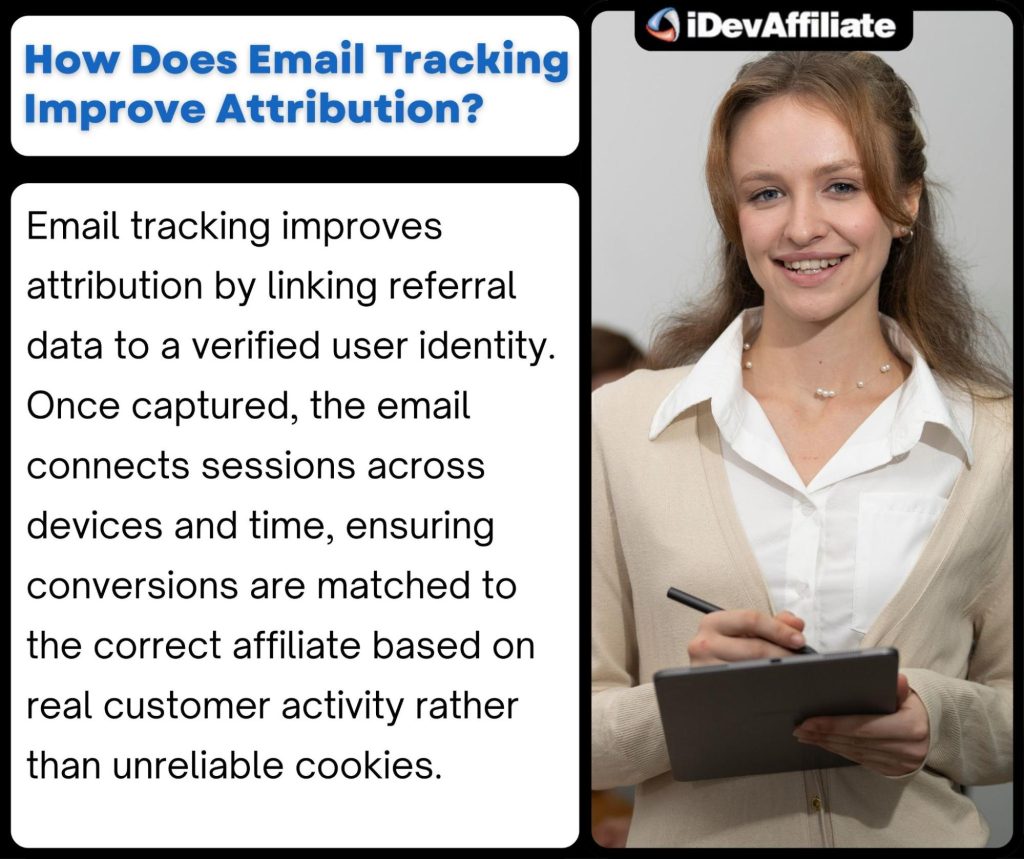
Email tracking in affiliate marketing is less about inbox activity and more about identity continuity.
The goal is to connect referral activity with real customers across sessions, devices, and time. This section breaks down how attribution actually works when email becomes the core identifier.
1. Identity-Based Tracking Over Engagement Signals
Email tracking focuses on identifying the same user across visits rather than measuring opens or clicks.
Reliable attribution depends on verified identifiers like email or login data, while engagement signals remain inconsistent and unsuitable for accurate commission decisions.
2. Email Capture During the Referral Journey
Email becomes valuable when captured during or shortly after an affiliate-driven visit.
Common points include signup forms, account creation, or checkout. Early capture ensures the referral context is preserved, even if the customer converts later or on another device.
3. Referral Click Establishes Initial Context
Affiliate attribution begins with a referral click that records the partner ID and session data.
This creates the initial relationship between the visitor and the affiliate, forming the foundation for later matching once identity is captured.
4. Email Connects Sessions to a Known User
Once an email is captured, the system links multiple sessions to a single identity.
This allows attribution to persist across devices, browsers, and time gaps. iDevAffiliate use this approach to maintain continuity where cookie-based tracking often breaks.
5. Conversion Events Complete the Attribution Chain
Attribution is finalized when a conversion event occurs, such as a purchase or signup.
The system matches this event back to the stored identity and original referral, ensuring commissions are assigned based on verified customer activity rather than assumptions.
When each stage is clearly defined, email tracking shifts from abstract concept to a repeatable attribution system.
That clarity makes it easier to understand how each step connects, from first click to final commission, in real-world conditions.
Email Tracking in Affiliate Marketing and How It Works
Instant account set up. All features unlocked in base plan. Professional onboarding included.
Create Your Affiliate Program
Email tracking in affiliate marketing is about building a reliable link between a referral and a real customer identity.
Instead of relying on fragile session data, it connects actions across time into one continuous attribution chain.
This section explains how that process works from first click to final commission.
1. Referral Click Creates Initial Attribution Context
Affiliate tracking begins when a user clicks a referral link containing a unique partner identifier.
This interaction stores attribution context, typically through first-party cookies or parameters, establishing the initial relationship between the visitor and the referring affiliate.
2. Email Capture Converts Anonymous Traffic into Identity
Email capture turns an anonymous visitor into a known user within your system.
When collected during signup, checkout, or gated content, the email connects the referral context to a persistent identity that can be matched later.
3. Attribution Data Is Stored Alongside Identity
Once captured, the system stores email data with key referral details such as affiliate ID, timestamp, and campaign source.
This creates a structured record that allows later actions to be traced back to the original referral without relying on session continuity.
4. Identity Matching Connects Multi-Session Behavior
When a user returns and logs in or completes a purchase, the system matches the email to prior records.
Platforms like iDevAffiliate use this deterministic matching to connect activity across devices and sessions without relying solely on cookies.
5. Conversion Events Trigger Commission Assignment
A conversion event, such as a purchase or subscription, activates attribution logic.
The system links the conversion to the stored identity and referral data, ensuring commissions are assigned based on verified user activity rather than inferred session behavior.
6. Attribution Rules Define Credit and Persistence
Attribution rules determine how long referrals remain valid and which affiliate receives credit.
With identity-based tracking in place, these rules can persist beyond cookie limits, maintaining consistent attribution even when users return later or switch devices.
When each step is connected through identity, attribution becomes consistent instead of session-dependent.
That shift highlights why traditional cookie-based tracking struggles, especially as user behavior moves across devices and time.
Why Email-Based Tracking Reduces Cookie and Device Dependence
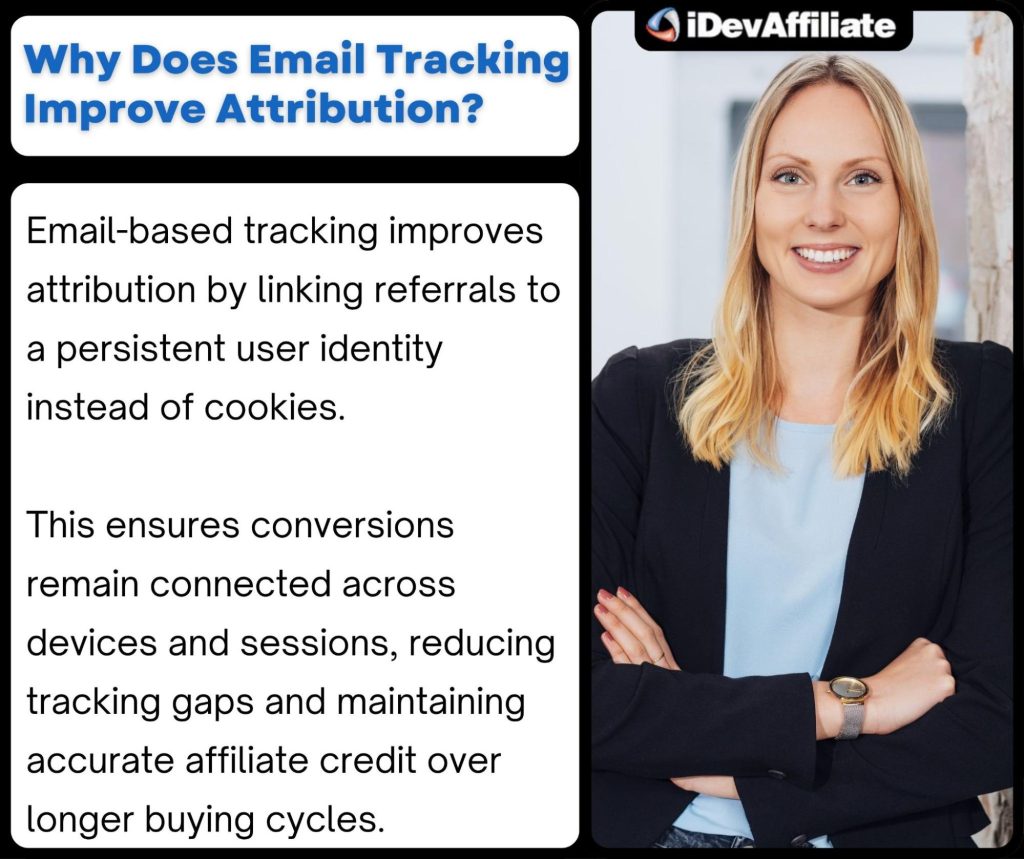
Affiliate attribution becomes unreliable when it depends only on browsers and sessions.
Email-based tracking shifts the focus to user identity, creating a more stable connection between referral and conversion.
This section explains why that shift improves accuracy and consistency in real-world scenarios.
1. Cookie-Based Tracking Breaks Across Sessions
Cookie-based attribution often fails when users switch devices or delay purchases.
Cookies expire, get cleared, or remain limited to a single browser, making it difficult to maintain a continuous attribution path across longer or multi-session buying journeys.
2. Device Fragmentation Splits User Journeys
Modern buyers frequently move between mobile, desktop, and apps before converting. Cookie tracking treats each interaction as separate, fragmenting the journey.
This breaks attribution continuity and can disconnect the original affiliate from the final conversion event.
3. Email-Based Identity Persists Across Touchpoints
Email tracking solves fragmentation by linking activity to a consistent user identity.
Once captured, platforms like iDevAffiliate match future sessions and conversions back to the same user, preserving attribution even when devices, browsers, or sessions change.
4. Attribution Becomes More Durable Over Time
Unlike cookies with fixed lifespans, email-based attribution can persist across longer decision cycles.
This allows affiliate credit to remain intact for delayed conversions, ensuring partners are rewarded even when purchases happen days or weeks after initial engagement.
5. Privacy Rules Define Tracking Boundaries
Email-based tracking still requires clear consent, transparency, and data governance.
Regulations limit how identity data is collected and used, making it essential to document attribution logic and ensure your tracking approach remains compliant and explainable.
When identity replaces session-based tracking, attribution becomes more stable and predictable across real-world journeys.
That reliability is what unlocks the practical benefits, where tracking accuracy directly impacts payouts, reporting clarity, and partner trust.
Benefits of Email-Based Tracking for Affiliate Accuracy
Email-based tracking improves attribution by connecting conversions to real customer identities instead of fragile session data.
This reduces uncertainty across tracking, payouts, and reporting as affiliate programs scale.
- No Cookie Failures: Eliminates reliance on cookies by linking referrals to user identity, ensuring commissions are preserved even when browser data expires or is blocked.
- Cross-Device Consistency: Maintains attribution across devices and sessions, ensuring a single user journey stays connected regardless of how or where the customer returns.
- Long Buying Cycles: Supports extended decision timelines by preserving affiliate relationships, ensuring attribution holds even when conversions happen days or weeks later.
- Prevents Overwrites: Protects original referral credit by preventing later interactions from overriding attribution, reducing commission leakage and partner conflicts.
- Verified Identity Accuracy: Connects activity to a confirmed user identity, ensuring commissions reflect real behavior instead of fragmented session or IP-based assumptions.
- Privacy-Safe Tracking: Operates independently of cookies, maintaining stable attribution in privacy-restricted environments while ensuring consistent and transparent tracking.
When these elements work together, affiliate tracking shifts from assumption-based decisions to verified outcomes, creating a system that scales with accuracy and trust.
Bottom Line: Does Email Tracking Improve Affiliate Attribution?
Instant account set up. All features unlocked in base plan. Professional onboarding included.
Create Your Affiliate Program
Email tracking improves affiliate attribution by shifting the focus from sessions to identity.
It connects referrals to real users, allowing conversions to be matched accurately even when cookies fail or journeys span multiple devices. Identity determines accuracy.
When your system captures email during the referral journey and uses it for deterministic matching, attribution becomes more reliable and easier to defend:
- Email-based identity matching: Connects sessions across devices and time.
- Persistent attribution logic: Maintains referral credit beyond cookie limits.
- Clear commission rules: Ensures payouts reflect real purchases and lifecycle events.
- Audit-ready tracking: Links every conversion to a verified referral path.
Together, these elements create a system where attribution is based on evidence, not assumptions.
Email tracking works best when implemented with clear rules, clean data capture, and consistent logic.
That combination is what turns affiliate attribution from a fragile setup into a system you can scale with confidence.
That’s what turns affiliate attribution into a system you can scale with confidence. Start a free trial of iDevAffiliate today.
Frequently Asked Questions (FAQS)
You may also like

How to Set Up an Affiliate Program on BigCommerce

How to Set Up an Affiliate Program on WooCommerce

How to Set Up an Affiliate Program on Shopify

First Steps: 6 FREE Marketing Ideas For Your New Affiliate Program
Create Your Affiliate Program
- Unlimited Affiliates
- Unlimited Commissions
- Built-In SEO Links
- Social Media Sharing
- Affiliate Program Directory
