
Inside Affiliate Programs: How They Really Work

Affiliate marketing sounds simple: share a link, earn a commission.
But if you’ve ever wondered how affiliate programs work behind the scenes, the real answer is more structured, and more precise, than most people realize.
At its core, every affiliate program depends on:
- Clear roles between merchants, affiliates, and customers
- Unique tracking links tied to verified transactions
- Cookie windows, identity-based tracking, and attribution rules that define who gets paid
- Commission triggers based on order status
- Holding periods and payout systems that protect revenue
But none of it works if tracking breaks.
Cookies expire. Devices change. Browsers block data. And when attribution fails, so does trust.
When tracking is built correctly, especially when it goes beyond simple cookie-based methods, affiliate marketing becomes predictable and scalable.
That’s exactly why over 65,000+ businesses use platforms like iDevAffiliate’s cloud software and self-hosted tracking solutions to manage affiliate programs with structure from day one.
If you understand these mechanics properly, you don’t just participate in affiliate marketing, you control it.
And once you see how the infrastructure works, the difference between a fragile program and a scalable one becomes impossible to ignore.
Understanding Affiliate Marketing and Its Key Players
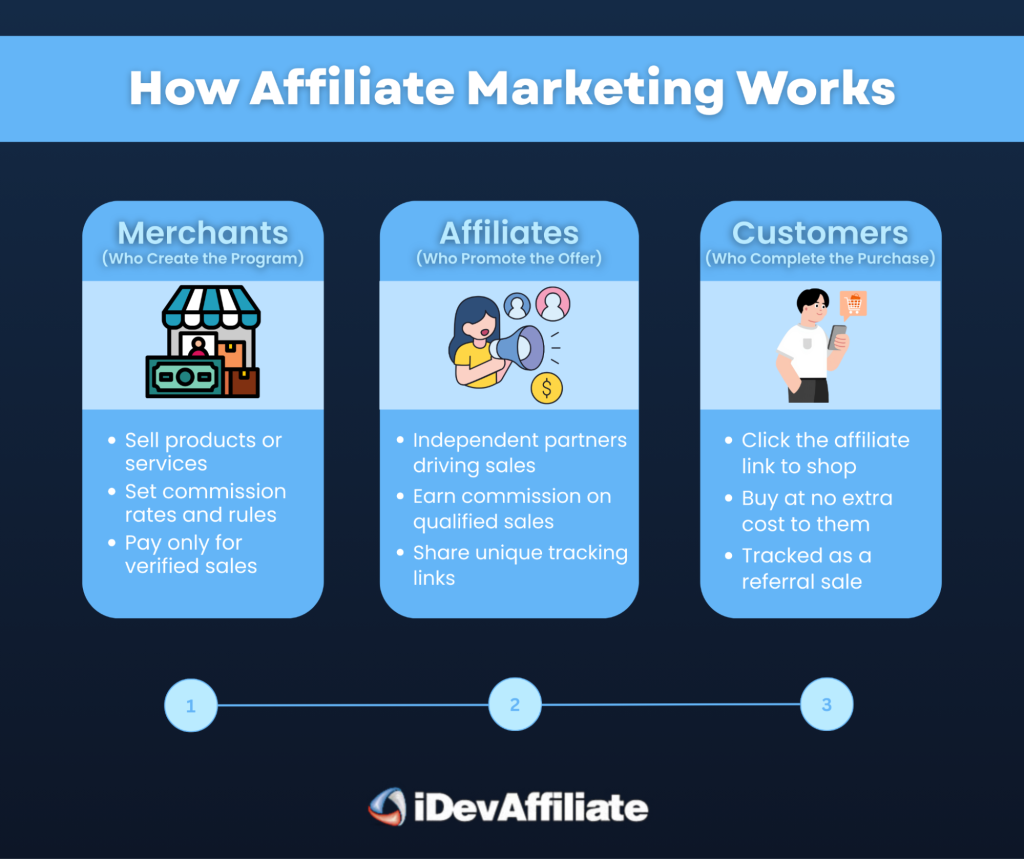
To fully answer the question on how affiliate programs work, you have to understand who is involved. Every affiliate transaction follows the same basic structure, built around clearly defined roles.
When each party understands their responsibility, the model works smoothly. And once you see who does what, the mechanics of affiliate marketing become much easier to understand.
Merchants Who Create the Program
Merchants are the businesses selling products or services.
They set the commission rates, define the program rules, and provide the tracking system that records referrals.
Instead of paying upfront for ads, merchants only pay when a verified sale occurs.
That keeps marketing spend tied directly to revenue. For this model to stay legitimate, merchants must provide reliable tracking and clear terms from the start.
Affiliates Who Promote the Offer
Affiliates are independent promoters who share a merchant’s product with their audience. They earn a commission when someone uses their unique referral link and completes a qualifying action.
Their role is simple: drive qualified traffic.
They do not handle payments, inventory, or fulfillment. Their success depends on trust, consistent messaging, and access to properly structured tracking links.
Customers Who Complete the Purchase
Customers interact with the merchant just as they normally would. They click a link, browse the website, and complete a purchase at no additional cost.
The commission is paid from the merchant’s margin. From the buyer’s perspective, nothing changes. The only difference is that the system records who referred them.
The Tracking System That Connects Them
Between the click and the commission sits the tracking system. It connects the affiliate’s referral to the completed order and ensures commissions are calculated correctly.
Without structured tracking, the entire relationship becomes unstable. With it, every sale is traceable and verifiable.
The Incentive Alignment That Makes It Work
Affiliate marketing succeeds because incentives align. Merchants pay only for results.
Affiliates earn only when value is delivered. Customers discover products through trusted recommendations.
When those incentives are supported by accurate tracking and clear structure, affiliate marketing becomes one of the most reliable performance-based growth models available.
How Affiliate Tracking Works Behind the Scenes

Now that you understand the three key players, the next step is seeing how they connect. This is where most confusion happens.
A click alone does nothing. The system behind that click is what makes affiliate marketing work.
1. Unique Affiliate Links Identify the Referrer
Every affiliate is assigned a unique tracking link. That link contains an embedded ID tied specifically to their account.
When a customer clicks the link, that ID is passed to the merchant’s system. It tells the tracking software exactly which affiliate referred the visitor.
The product page stays the same for everyone, but the tracking code at the end of the URL is what separates one affiliate from another. Without this identifier, there is no way to attribute the sale correctly.
2. Cookies Store the Referral Information
After the click, a tracking cookie is placed in the customer’s browser. This small data file records the affiliate ID and keeps it active for a defined period of time.
If the customer leaves and returns later, the system reads that stored information and connects the purchase back to the original affiliate.
This is how affiliate programs avoid losing credit when buyers take time to decide.
3. Cookie Duration Defines the Credit Window
Cookie duration determines how long that referral credit remains valid. A 30-day cookie means the affiliate gets credit for any purchase made within 30 days of the click.
Short windows favor quick purchases.
Longer windows protect affiliates promoting higher-ticket or research-heavy products. Clear cookie policies are part of a well-managed program.
4. Attribution Rules Decide Who Gets Paid
When multiple affiliates refer the same customer, most programs use last-click attribution. The final affiliate link clicked before purchase receives the commission.
Understanding this rule changes how affiliates create content. Decision-stage content often converts best because it captures buyers closer to checkout.
When tracking, cookies, and attribution rules are clearly defined, affiliate marketing becomes measurable and predictable.
Instant account set up. All features unlocked in base plan. Professional onboarding included.
Create Your Affiliate Program
The Problem With Cookie-Only Tracking
Cookies work until they don’t.
They can be:
- Cleared by the user
- Blocked by browsers
- Lost across devices
- Invalidated by privacy restrictions
- Overwritten by another affiliate
For low-ticket, impulse purchases, that might not matter.
But for higher-ticket offers, recurring subscriptions, or long buying cycles, cookie-only tracking creates gaps. And gaps create disputes.
Why Email-Based Tracking Changes Everything
Email-based tracking doesn’t rely on browsers, devices, or IP addresses.
Instead, it creates a relationship between the customer’s email address and the referring affiliate.
That means:
- Cross-device purchases are still credited
- Cleared cookies don’t break attribution
- Recurring subscriptions stay connected
- Lifetime relationships can be honored
Instead of hoping a cookie survives, you anchor attribution to something stable: the customer’s identity.
This is what separates fragile affiliate programs from durable ones.
How Commissions and Payouts Actually Work

Clicks and tracking explain how sales are attributed. But commissions only become meaningful when you understand how they’re created, verified, and paid.
This is where structure matters most, for both affiliates and businesses running the program.
When a Commission Is Officially Created
A tracked sale does not instantly become payable income. There is always a trigger point that determines when a commission record is created.
- Commission creation is tied to a defined order event (checkout, completed, or shipped).
- The tracking system matches the order to the affiliate’s unique ID.
- The commission rate (percentage or flat fee) is automatically calculated.
- The transaction is recorded inside the affiliate dashboard.
Clear trigger rules prevent confusion and disputes. If a program cannot clearly explain its trigger point, that’s a management issue.
Why Order Status Verification Matters
Not every placed order becomes revenue. That’s why well-run programs rely on order status verification before approving commissions.
- Commissions can be set to trigger only when orders are marked “Completed” or “Shipped.”
- Cancelled or failed payments never generate payouts.
- Fraudulent transactions can be filtered before commissions are finalized.
- Refunds during the hold period automatically adjust balances.
Verification protects margins and preserves trust. Without it, programs overpay and credibility declines.
The Different Commission Payment Models
Not all affiliate programs pay the same way. Choosing the right model affects both cash flow and long-term growth.
- Pay-per-sale: Commission based on confirmed revenue.
- Pay-per-lead: Commission for qualified signups or inquiries.
- Recurring commissions: Ongoing payouts for subscription renewals.
- Flat-rate vs percentage structures: Depending on pricing strategy.
Recurring and revenue-tied models are typically the most sustainable. Alignment between commission model and business economics is essential.
Holding Periods and Commission Clearance
Even after a commission is created, it is not immediately payable. Most programs apply a holding period before funds are released.
- Common hold windows range from 30 to 90 days.
- Reversals during this period adjust balances automatically.
- Holding protects against returns and chargebacks.
- Cleared commissions move from “pending” to “approved.”
Hold periods are not delays, they are risk controls. Programs without them often sacrifice financial stability.
Programs that rely solely on cookie/IP tracking often experience disputes during the holding period. Affiliates question reversals when tracking fails.
Email-based tracking dramatically reduces these issues because the attribution link is tied directly to the verified customer identity, not just a browser session.
How Payouts Actually Reach Affiliates
Once commissions clear, they move toward payout. This stage is governed by payment thresholds and schedules.
- Minimum payout thresholds must be met before release.
- Monthly or biweekly payment cycles are most common.
- Payment methods may include PayPal or direct deposit.
- Automated payout tools reduce manual accounting errors.
Well-structured payout systems reduce administrative overhead. As programs scale, automation becomes operationally critical.
When commission triggers, verification rules, hold periods, and payout systems are clearly defined, affiliate marketing becomes predictable and manageable.
That predictability is what separates structured affiliate programs from chaotic ones.
And it’s what ultimately determines whether a program scales smoothly or stalls under complexity.
How Businesses Can Start Their Own Affiliate Program
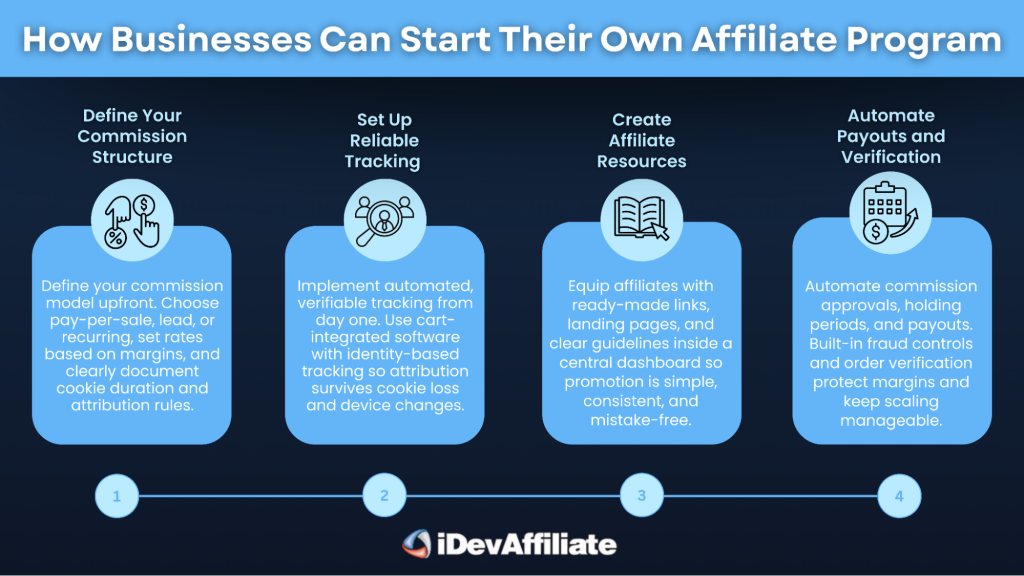
Understanding how affiliate programs work is one thing. Launching one that tracks accurately and scales smoothly is another.
The good news is that starting an affiliate program today is far more structured, and simpler, than most businesses assume.
Step 1: Define Your Commission Structure Clearly
Before inviting affiliates, decide exactly how you will pay them. Clarity prevents disputes later.
Choose whether you will offer pay-per-sale, pay-per-lead, or recurring commissions. Set your percentage or flat rate based on margins.
Define cookie duration and attribution rules upfront. Most importantly, document everything clearly so affiliates understand how earnings are calculated.
Strong programs are predictable before they are promotional.
Step 2: Set Up Reliable Tracking From Day One
Expecting affiliates to trust manual spreadsheets is unrealistic. Tracking must be automated and verifiable.
When evaluating tracking software, look beyond basic IP/cookie tracking. The most reliable systems use email address-based tracking to preserve attribution even when cookies fail.
If your tracking breaks, your affiliate relationships break with it.
Choose affiliate tracking software that connects directly to your shopping cart.
iDevAffiliate integrates with 150+ ecommerce systems and allows commission triggers based on order status, reducing fraud and payout errors.
When tracking is structured properly at launch, you avoid costly fixes later. Infrastructure first. Promotion second.
Step 3: Create Ready-to-Use Affiliate Resources
Affiliates should not have to build links or creatives from scratch. Mistakes happen when instructions are vague.
Provide pre-generated tracking links, tested landing pages, and simple usage guidelines. Organize these inside a clear affiliate dashboard so partners can quickly grab what they need.
Tools like iDevAffiliate make this centralized distribution easy and trackable. The easier you make promotion, the more consistently affiliates perform.
Step 4: Automate Payouts and Verification
Manual payout calculations slow growth and create accounting friction.
Configure commission approval rules, holding periods, and automated payment processing early.
Built-in fraud controls and order status verification protect margins while keeping reporting transparent. When payout systems run smoothly, administrative overhead stays low as your program scales.
Affiliate programs grow when management stays simple.
Businesses that focus on structure, tracking accuracy, and clear communication build programs affiliates trust, and trust is what turns a marketing channel into a long-term revenue engine.
Bottom Line: The Right Way to Run Affiliate Programs
Instant account set up. All features unlocked in base plan. Professional onboarding included.
Create Your Affiliate Program
Affiliate programs work because they are structured around measurable actions. Clicks are tracked. Sales are verified. Commissions are calculated. Payouts are controlled.
But the model only stays legitimate when the backend is built correctly.
Businesses that want affiliate marketing to become a reliable growth channel need:
- Automated commission tracking tied directly to order data
- Configurable order-status triggers to prevent premature payouts
- Email-based tracking that protects attribution beyond simple cookies
- Built-in fraud controls to safeguard margins
- 150+ shopping cart integrations with no-code setup
- Centralized dashboards for transparent reporting
- Guided onboarding to ensure proper configuration from day one
That is exactly what iDevAffiliate is built to handle.
With both cloud and self-hosted options, iDevAffiliate gives businesses full control over tracking accuracy, commission logic, fraud protection, and affiliate reporting.
Affiliate marketing works when tracking works. If you’re ready to move beyond just understanding how affiliate programs work, it’s time to build one the right way.
A program that is structured, scalable, and designed for long-term growth doesn’t happen by accident.
iDevAffiliate gives you the infrastructure to launch and manage it properly from day one.
Start your free trial today!
Frequently Asked Questions (FAQS)
You may also like

How to Set Up an Affiliate Program on BigCommerce

How to Set Up an Affiliate Program on WooCommerce

How to Set Up an Affiliate Program on Shopify

First Steps: 6 FREE Marketing Ideas For Your New Affiliate Program
Create Your Affiliate Program
- Unlimited Affiliates
- Unlimited Commissions
- Built-In SEO Links
- Social Media Sharing
- Affiliate Program Directory
