
How Affiliate Marketing Strengthens Your Growth Strategy

Affiliate marketing isn’t just another acquisition channel, it’s a structural shift in how growth works.
Instead of relying only on internal teams and paid media, you build a system where partners drive revenue tied to measurable outcomes.
If you’re evaluating whether this belongs in your strategy, here’s what actually matters:
- Growth becomes partner-driven, not just internally managed
- Tracking connects clicks to verified conversions, not assumptions
- Commission structures align incentives with your margins
- Expansion happens without increasing fixed operational overhead
- External partners bring reach you cannot build quickly yourself
If you want tracking, commissions, and reporting to work together without gaps, platforms like iDevAffiliate are built to support that system from the start.
Most businesses don’t struggle with growth ideas, they struggle with execution clarity.
Understanding how affiliate marketing fits, what gaps it fills, and how to launch it correctly is what separates programs that scale from those that stall.
Why Affiliate Marketing Fits Into a Modern Growth Strategy

Most businesses treat affiliate marketing as an add-on channel instead of a structured growth layer.
In reality, it works best when integrated into your core acquisition strategy alongside paid and organic efforts.
Its value comes from how it supports scale, consistency, and decision-making across your entire marketing system.
1. Partner-Driven Growth
Affiliate marketing introduces a partner-driven acquisition layer where external creators and publishers promote your product.
These partners use their own channels and audiences, helping you expand reach without increasing internal workload or restructuring your existing marketing operations.
2. Structured Tracking
Affiliate programs rely on systems that connect clicks, conversions, and commissions in a clear and traceable way.
Tracking software stores referral data and matches it at checkout, ensuring every action remains measurable and tied to verified customer activity.
3. Commission Alignment
A well-defined commission structure ensures affiliates promote in ways that support your business goals and margins.
By aligning payouts with specific outcomes or products, you guide partner behavior without needing to control how promotions are executed.
4. Channel Integration
Affiliate marketing works alongside your existing channels rather than replacing them or creating additional complexity.
It allows you to extend campaigns through partners while keeping your funnels intact and maintaining consistent tracking across all acquisition sources.
5. Governance And Control
As your affiliate program grows, governance becomes essential to maintain consistency and operational clarity.
Defined attribution rules and fraud controls help prevent misattribution, ensuring your program scales without introducing confusion or unnecessary operational risk.
Affiliate marketing works best when it is built as a structured system, not treated as an optional add-on.
And when that system is missing, the impact is not neutral, it creates clear gaps in how efficiently your business can grow.
What Businesses Miss Without an Affiliate Marketing Strategy
Instant account set up. All features unlocked in base plan. Professional onboarding included.
Create Your Affiliate Program
Many businesses focus on optimizing existing channels without realizing what is structurally missing.
Without affiliate marketing, growth often depends on higher spend, slower expansion, and limited external leverage.
These are the key advantages businesses leave on the table when affiliate programs are not part of the strategy.
1. Missed Low-Risk Acquisition Model
Most growth channels require upfront spend before results are proven. Without affiliate marketing, your acquisition remains tied to uncertain returns.
- Budgets are committed before performance is validated
- Failed campaigns result in unrecoverable sunk costs
- Scaling requires increasing spend without guaranteed outcomes
- Risk stays tied to traffic, not conversions
Affiliate marketing shifts cost toward verified outcomes instead of assumptions. As a result, growth becomes more controlled, predictable, and easier to manage.
2. Missed Cash Flow Efficiency
Many businesses overlook how timing impacts growth sustainability. Without affiliate programs, revenue and spend often move out of sync.
- Marketing spend happens weeks before revenue is realized
- Growth creates pressure on working capital and reserves
- Scaling campaigns increases financial strain during testing phases
- Delayed returns make forecasting more difficult
Affiliate programs align payouts with collected revenue instead of projections. That alignment helps stabilize cash flow and reduces pressure during scaling.
3. Missed Performance-Based Cost Control
Without affiliate marketing, spend is often tied to activity instead of outcomes. This creates inefficiencies when campaigns generate traffic but not revenue.
- Payments are based on clicks, impressions, or reach
- Low-quality traffic still consumes budget
- Conversion uncertainty increases overall acquisition cost
- Poorly defined outcomes lead to inconsistent returns
Affiliate models tie payouts directly to verified conversions. This creates stronger cost control and removes reliance on uncertain performance.
4. Missed Scalable Revenue Without Fixed Overhead
Scaling traditional channels often requires increasing fixed costs. Without affiliates, growth usually depends on hiring, tools, or media expansion.
- Growth requires larger teams or increased ad budgets
- Fixed costs rise regardless of performance consistency
- Expansion creates operational complexity and management overhead
- Scaling becomes slower due to resource limitations
Affiliate programs scale through partner output, not internal expansion. This keeps growth flexible while avoiding unnecessary operational complexity.
5. Missed Access To High-Intent External Audiences
Reaching new audiences internally takes time, budget, and experimentation. Without affiliates, expansion into niche markets becomes slower and less efficient.
- Limited reach beyond existing channels and audiences
- Higher cost to test new markets or segments
- Slower entry into niche communities with established trust
- Dependence on internal messaging to drive conversions
Affiliates bring pre-built audiences with established credibility. This shortens the path from discovery to conversion and improves efficiency.
These gaps are not always obvious at first, but they compound as your business grows and scales.
Once you recognize them, the next step is building a structured affiliate program that actually captures these advantages instead of missing them.
How To Launch An Affiliate Program That Scales
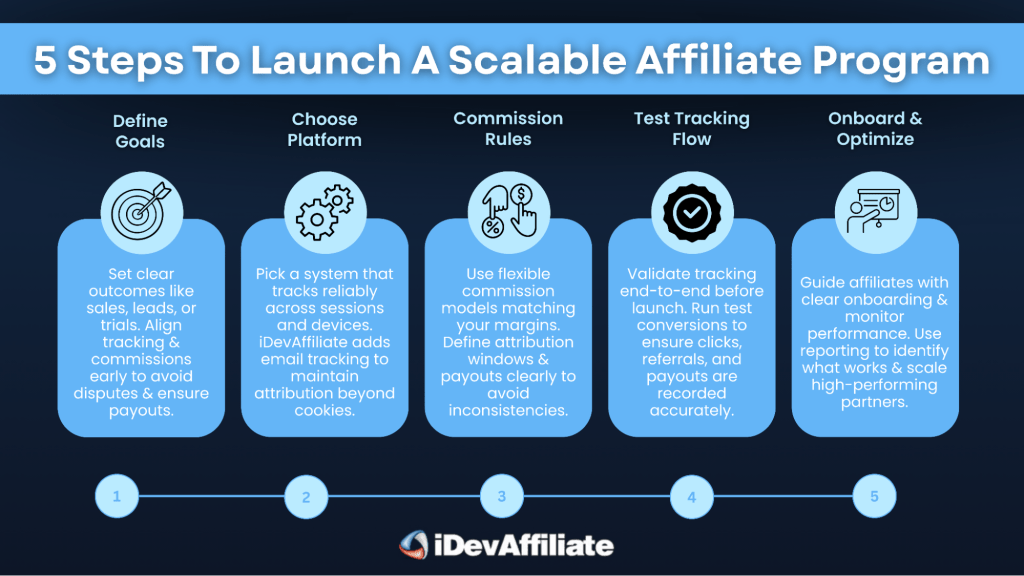
Starting an affiliate program is not about adding another channel, it is about building a system that runs predictably.
The difference between programs that grow and those that stall comes down to structure, tracking, and clarity from day one.
These steps help you launch with control instead of fixing problems later.
1. Define Program Goals And Conversion Events
Start by deciding what outcomes your affiliate program should drive. Clear goals ensure your tracking, commissions, and partner expectations stay aligned from the beginning.
Define whether you are rewarding sales, leads, or trial activations, and how those events are validated.
This clarity helps prevent disputes, keeps payouts consistent, and ensures your program supports actual business growth.
2. Choose A Reliable Affiliate Platform
Your platform determines whether tracking holds or breaks as you scale. A reliable system ensures every referral is recorded, stored, and matched correctly at conversion.
Affiliate software assigns unique identifiers and tracks activity across sessions and devices.
iDevAffiliate strengthens this by using email-based tracking, helping maintain attribution even when cookies fail or users switch environments.
3. Set Commission Structures And Attribution Rules
Your commission model should reflect how your business makes money. Poorly aligned payouts can quickly turn growth into a margin problem.
Use flexible structures such as percentage-based, flat-rate, or product-level commissions.
Clear rules around attribution windows, reversals, and bonuses ensure affiliates are rewarded fairly without creating payout inconsistencies.
4. Configure Tracking And Validate The Full Funnel
Before onboarding affiliates, validate that your tracking works end-to-end. Even small gaps in tracking can lead to missed commissions and lost trust.
Run controlled test conversions to confirm clicks, referrals, and payouts are recorded accurately.
This ensures your system reflects real customer behavior instead of relying on assumptions.
5. Onboard, Monitor, And Optimize Performance
Affiliates perform better when they know exactly how to promote your product. A structured onboarding process reduces confusion and accelerates early results.
Provide clear positioning, approved messaging, and simple setup instructions, then continuously monitor performance.
Track which affiliates, content types, and offers drive real conversions and refine your program accordingly.
With iDevAffiliate, clear reporting helps you identify what works and scale it efficiently.
When these elements are in place, your affiliate program becomes a reliable growth system rather than a channel that needs constant fixing.
Bottom Line: Building Affiliate Marketing As A Growth System
Instant account set up. All features unlocked in base plan. Professional onboarding included.
Create Your Affiliate Program
Affiliate marketing works when it is treated as a system, not a side channel.
It connects partner incentives, tracking, and payouts into a structure where growth becomes measurable, controllable, and scalable over time.
Structure determines outcomes.
For businesses building or improving their affiliate strategy, a few core elements define success:
- Reliable Tracking: Every referral must connect to a verified conversion without gaps or broken attribution.
- Commission Alignment: Payouts should reflect your margins and reward behavior that supports real business outcomes.
- Platform Stability: Your system must handle tracking, reporting, and payouts without constant manual fixes.
When these elements work together, your affiliate program stops being reactive and starts becoming predictable.
iDevAffiliate is designed around this exact principle, combining tracking accuracy, flexible commission structures, and clear reporting into one system, so you can scale without losing control.
Growth becomes easier when your systems are built for it, and affiliate marketing works best when it’s treated as part of that foundation, not an afterthought.
Something you can put into practice by starting a free trial of iDevAffiliate and seeing how a structured system performs in real conditions.
Frequently Asked Questions (FAQS)
You may also like

How to Set Up an Affiliate Program on BigCommerce

How to Set Up an Affiliate Program on WooCommerce

How to Set Up an Affiliate Program on Shopify

First Steps: 6 FREE Marketing Ideas For Your New Affiliate Program
Create Your Affiliate Program
- Unlimited Affiliates
- Unlimited Commissions
- Built-In SEO Links
- Social Media Sharing
- Affiliate Program Directory
