
Types of Affiliate Marketing

Types of affiliate marketing include relationship-based models, pay-per-sale programs, pay-per-lead partnerships, recurring commission structures, and promotion channels like blogging, influencers, email marketing, and review websites. Each approach affects trust, attribution, and long-term conversion behavior differently.
Affiliate marketing performance depends on trust, attribution accuracy, and how well promotions match audience expectations.
When recommendations feel disconnected or overly promotional, conversions become harder to sustain long-term.
Affiliate tracking software helps create consistency by connecting clicks, attribution rules, commission activity, and affiliate marketing partners into one measurable system.
Instead of relying only on traffic volume, businesses can track which affiliate interactions actually influence conversions and customer value.
Here’s what matters most:
- Match affiliate models with audience trust and platform behavior
- Choose promotion channels that support long-term engagement
- Use attribution tracking to measure real conversion influence
- Align commission structures with long-term customer value
- Track clicks, conversions, and affiliate activity consistently
iDevAffiliate also supports email address-based tracking, helping businesses maintain reliable attribution even when cookies expire or users switch devices during the buying journey.
Keep reading to understand how different affiliate marketing types, channels, and commission models work together to create more predictable long-term affiliate growth.
What Affiliate Marketing Is and How It Works
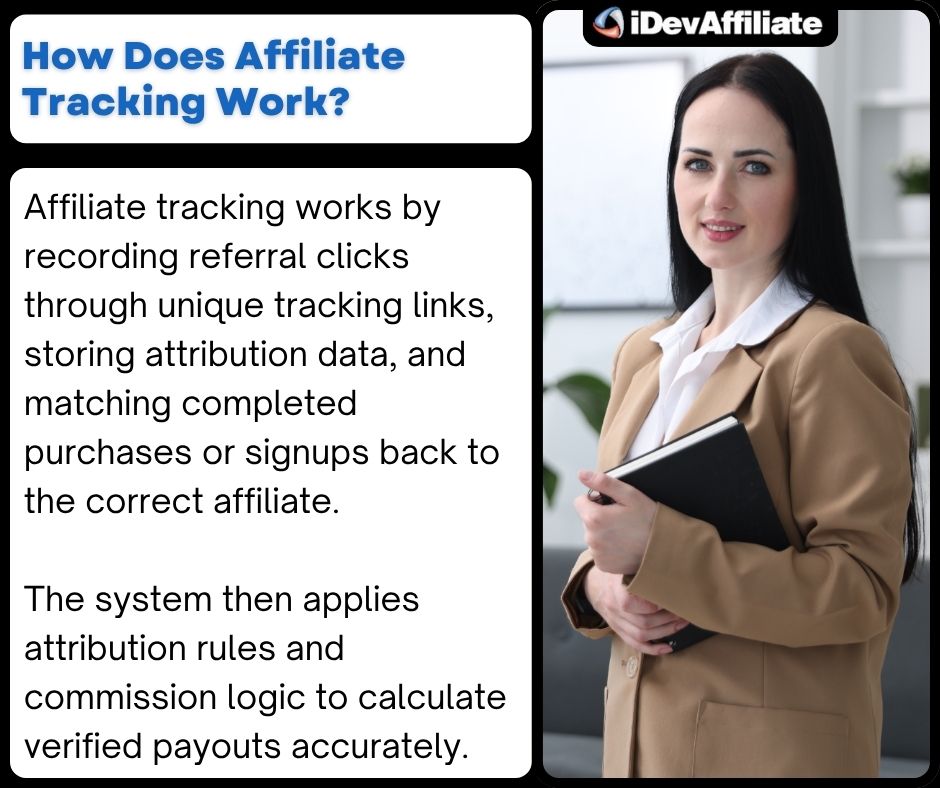
Affiliate marketing is a performance-based system where affiliates earn commissions when their referral generates a measurable action, usually a sale, lead, or trial signup. Every commission depends on accurate tracking between the affiliate click and the final conversion.
Affiliate software manages this through a click-to-commission process. A visitor clicks a unique affiliate tracking link, referral data is recorded, and the completed conversion is matched back to the correct affiliate for commission calculation.
Here’s what drives the process:
- Traffic Source: Where the affiliate click originates, including search, social media, email, or paid ads
- Tracking Link: The unique identifier connecting the visitor to the affiliate
- Conversion Event: The purchase, signup, or action that triggers commission eligibility
- Commission Rules: The logic controlling attribution and payout calculations
- Payout Workflow: The process used to approve and release commissions
More advanced platforms, like iDevAffiliate, also support email address-based tracking. This keeps referrals connected to verified customer identity data, even if cookies expire or customers switch devices before purchasing.
Attribution windows also shape earnings. Short windows favor immediate purchases, while longer windows support research-heavy buying decisions that convert later in the customer journey.
Main Types of Affiliate Marketing Models
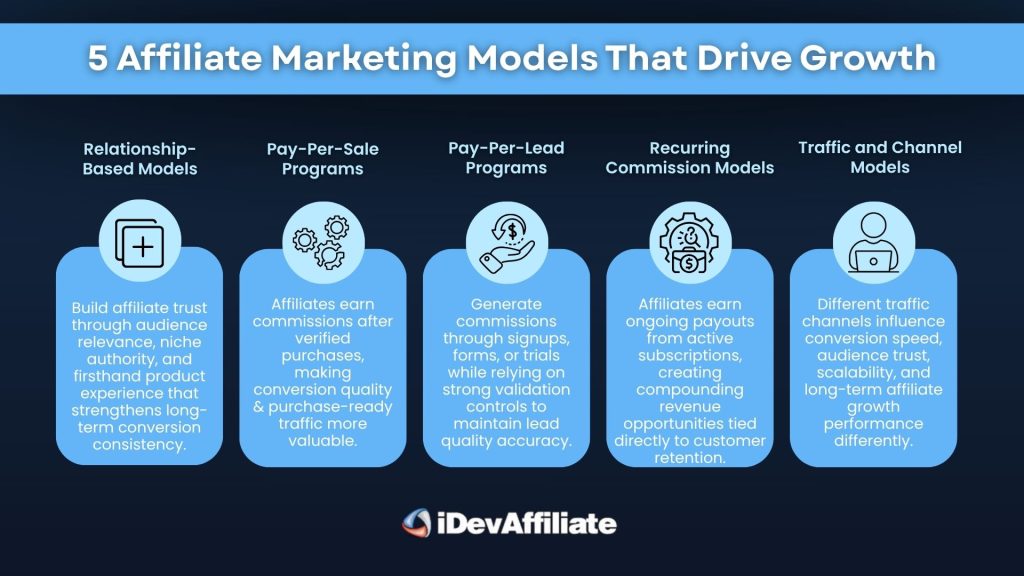
Affiliate marketing models differ based on product relationship, commission structure, and traffic source.
Those differences directly affect trust, conversion behavior, and how predictable your affiliate income becomes over time.
The strongest affiliate strategies usually align audience intent, tracking accuracy, and promotion style instead of relying only on traffic volume.
1. Relationship-Based Affiliate Models
Relationship models determine how closely you are connected to the product you promote.
The more direct your experience and authority, the more your recommendation influences buyer trust and conversion behavior.
- Unattached models rely heavily on targeting and ads
- Related models depend on niche relevance and alignment
- Involved models build authority through firsthand product experience
- Trust increases as recommendation credibility becomes more personal
Best For: Influencers, educators, creators, niche publishers, and brands built around audience trust and long-term authority.
Each relationship model changes how audiences interpret your recommendation. Stronger trust usually creates better long-term conversions and more repeat affiliate engagement.
2. Pay-Per-Sale Programs
Pay-per-sale affiliate programs reward commissions only after verified customer purchases.
This structure usually aligns affiliate incentives closely with conversion quality, revenue generation, and long-term customer value instead of raw traffic volume.
- Commissions activate only after completed customer purchases
- Higher-intent traffic usually performs better long term
- Conversion quality matters more than click volume alone
- Revenue alignment reduces low-quality affiliate traffic risks
Best For: Ecommerce stores, subscription businesses, DTC brands, and companies focused on revenue-driven affiliate growth.
This model favors affiliates who create purchase-ready traffic. Better audience targeting and stronger trust often produce more stable affiliate revenue over time.
3. Pay-Per-Lead Programs
Pay-per-lead programs generate commissions from signups, form submissions, or trial registrations.
They often convert faster than purchase-based programs but require stronger validation controls to maintain lead quality and reporting accuracy.
- Lead submissions trigger commission eligibility instead of purchases
- Faster conversion cycles increase short-term affiliate activity
- Low-quality traffic can distort performance reporting quickly
- Validation workflows help maintain trustworthy conversion data
Best For: SaaS companies, agencies, education platforms, consultants, and service businesses focused on lead generation.
Lead-based programs work best when conversion quality stays measurable. Reliable tracking and clear qualification rules help prevent inflated or low-value affiliate performance.
4. Recurring Commission Models
Recurring commission programs continue paying affiliates while referred customers remain subscribed or active.
This structure is common in SaaS affiliate marketing because long-term customer retention directly affects affiliate earnings and profitability.
- Affiliates earn recurring payouts from active customer subscriptions
- Retention quality matters more than one-time conversions alone
- SaaS programs commonly use recurring commission structures
- Long-term referrals create compounding affiliate revenue opportunities
Best For: SaaS platforms, membership communities, subscription products, and businesses with strong recurring customer retention.
Recurring commissions encourage affiliates to focus on customer fit instead of short-term clicks. Better retention usually creates stronger affiliate trust and more predictable payouts.
5. Traffic and Channel Models
Traffic models define where affiliate clicks originate and how quickly performance data becomes available.
Different channels influence testing speed, audience trust, conversion stability, and long-term scalability in different ways.
- Paid traffic delivers faster testing and conversion feedback
- SEO content builds slower but compounds over time
- Social traffic depends heavily on consistent content visibility
- Email audiences improve follow-up and repeat conversion opportunities
Best For: Businesses balancing short-term testing speed with long-term audience ownership and sustainable affiliate growth.
Different affiliate models shape how commissions are earned, but promotion channels determine how audiences actually discover and interact with those recommendations.
The combination of affiliate model, traffic source, and audience behavior ultimately influences trust, attribution visibility, and long-term conversion consistency.
Helpful Resource → Inside Affiliate Programs: How They Really Work
9 Popular Affiliate Marketing Channels and Promotion Types
Affiliate marketing performance also depends on where promotions are published and how audiences interact with recommendations.
Different channels influence trust, conversion behavior, audience retention, and attribution visibility in different ways.
The strongest affiliate strategies usually align promotion style with audience intent, platform behavior, and long-term traffic consistency.
1. Blogging and SEO Content
Blogging helps affiliates attract search-driven users researching products, comparisons, and purchase decisions online.
SEO-focused affiliate content compounds gradually while generating more stable traffic and predictable long-term conversion performance consistently.
Strong search intent usually improves affiliate trust, audience retention, and purchase-ready conversion behavior over time.
2. Influencer Affiliate Marketing
Influencer affiliate marketing relies heavily on audience trust, recommendation credibility, and consistent platform engagement online.
Creators usually promote products through short videos, tutorials, livestreams, and social media recommendation content regularly.
Authentic product recommendations often outperform aggressive promotional campaigns across audience-driven affiliate marketing channels long term.
3. Review and Comparison Websites
Review websites help users compare products before making final purchasing decisions across different product categories online.
These affiliate sites usually focus on testing, pricing analysis, feature comparisons, and recommendation transparency consistently.
Detailed comparisons often improve buyer confidence while supporting stronger affiliate conversion rates and attribution visibility systems.
4. Email Newsletter Promotions
Email affiliate marketing promotes offers directly to engaged subscribers through newsletters and recurring audience communication consistently.
Subscribers often convert better because trust and familiarity already exist between creators and their audience relationships.
Email-driven affiliate traffic also supports repeat engagement and stronger long-term customer retention opportunities over time.
5. Closed Communities and User Groups
Private communities often generate stronger affiliate engagement through relevance, discussion quality, and focused audience trust consistently.
Recommendations inside forums, memberships, Discord groups, and Slack communities usually feel more authentic and conversational naturally.
Affiliate promotions work best when products solve genuine community problems instead of interrupting normal discussions unnecessarily.
6. YouTube and Video Content
Video affiliate marketing helps audiences understand products visually before comparing options or making purchasing decisions online.
Tutorials, walkthroughs, demonstrations, and product reviews usually create stronger buyer confidence than short written promotions alone.
Video content also supports longer research cycles because audiences frequently revisit recommendations before purchasing later online.
7. Brand-to-Brand Partnerships
Brand partnerships involve businesses promoting complementary products to overlapping audiences through structured affiliate collaborations strategically.
These partnerships usually depend on aligned customer interests, shared audience trust, and mutual promotional value long term.
Reliable attribution tracking becomes important because partnerships often involve multiple campaigns and recurring customer interactions simultaneously.
8. Coupon and Deal Websites
Coupon affiliate websites attract users actively searching for discounts, promotions, and lower purchase prices before checkout.
These platforms usually generate high click activity because buyers already show strong commercial purchase intent consistently online.
Conversion tracking becomes especially important because discount-driven traffic often moves quickly across multiple affiliate touchpoints simultaneously.
9. Podcast and Audio Promotions
Podcast affiliate marketing relies on host credibility, audience loyalty, and long-form conversational recommendation styles naturally.
Hosts usually promote affiliate offers through sponsorship mentions, product discussions, and audience-focused educational content regularly.
Audio-based promotions often perform well because listeners develop stronger trust through recurring long-form content engagement over time.
How Affiliate Types Influence Trust and Conversion Behavior
Affiliate marketing performance changes based on how audiences interpret recommendations across different promotion styles and traffic channels.
Trust, attribution visibility, and audience alignment directly influence conversion quality and long-term affiliate growth consistency.
Stronger affiliate strategies usually combine credible recommendations with reliable tracking and audience-focused promotion styles.
Relationship Strength and Buyer Trust
Relationship-based affiliate marketing changes how audiences interpret product recommendations during buying decisions online.
Involved affiliate marketing usually builds stronger trust through firsthand experience and authentic recommendations.
Unattached promotions depend more on visibility, targeting, and faster conversion-focused campaigns instead.
Channel Context and Audience Intent
Different affiliate channels attract audiences at different stages of the buying journey online. SEO blogs and review sites usually attract higher-intent users researching products actively.
Social and discount-driven traffic often depends more on timing and visibility consistency.
Offer Relevance and Conversion Quality
Affiliate conversions improve when promotions align naturally with audience interests and purchase intent consistently.
Related affiliate marketing performs better because products match audience expectations more closely.
Better relevance usually improves conversion quality while reducing lower-intent affiliate traffic significantly.
Promotion Frequency and Audience Fatigue
Audience trust weakens when affiliate promotions feel repetitive or overly focused on selling constantly.
Content-driven channels manage promotion frequency better through education and balanced recommendations naturally.
Stronger promotion balance helps maintain engagement and long-term audience trust more effectively.
Transparency and Recommendation Credibility
Affiliate disclosure improves trust by clearly explaining promotional relationships before recommendation clicks happen online.
Transparent affiliates usually explain product limitations and realistic audience expectations consistently.
This strengthens recommendation credibility while reducing skepticism around affiliate-driven promotions significantly.
Attribution Visibility and Performance Accuracy
Different affiliate models rely on different attribution signals depending on traffic and conversion behavior patterns.
SEO, email, and video promotions often support longer attribution windows naturally. iDevAffiliate helps businesses track attribution and affiliate performance across multiple channels accurately.
Retention and Long-Term Affiliate Growth
Affiliate marketing becomes more sustainable when promotions prioritize audience fit over short-term clicks consistently.
Recurring commission models especially benefit from stronger trust and customer retention long term. Better audience relationships usually create more predictable affiliate revenue growth over time.
The affiliate type you choose affects how quickly trust builds, how consistently conversions happen, and how sustainable growth becomes.
That makes choosing the right affiliate marketing approach less about reach alone and more about long-term audience alignment.
Choosing the Right Affiliate Marketing Approach
The best affiliate marketing approach depends on audience trust, platform behavior, and long-term content consistency.
Different affiliate models create different expectations around promotion style, conversion quality, and audience credibility.
The strongest affiliate strategies usually prioritize audience fit before aggressive traffic or revenue scaling begins.
Platform Fit and Content Style
Different affiliate models perform better on specific platforms depending on audience expectations and content depth.
SEO blogs, newsletters, and YouTube tutorials usually support involved affiliate marketing more effectively.
Short-form promotional content often depends more heavily on visibility and faster audience attention cycles.
Audience Trust and Recommendation Style
Affiliate marketing becomes more sustainable when recommendations match the audience relationship and content experience naturally.
Involved affiliate marketing usually performs better for creators focused on long-term audience trust consistently.
Firsthand experience often improves recommendation credibility and long-term conversion behavior significantly over time.
Traffic Speed and Testing Cycles
Traffic sources influence how quickly affiliates can test offers and optimize conversion performance consistently online.
Paid campaigns generate faster feedback but usually require tighter attribution and tracking visibility systems.
SEO and email marketing grow slower while creating more predictable long-term affiliate traffic patterns.
Realistic Growth Expectations
Affiliate revenue usually grows through testing, trust, and audience alignment instead of immediate scaling efforts.
Related and involved affiliate marketing often require more time before generating stable conversion performance consistently.
Stronger audience relationships usually create lower promotion fatigue and more sustainable affiliate growth long term.
Sustainable Promotion Expansion
Most affiliates scale more safely by building trust before increasing promotional frequency or offer complexity gradually.
Related affiliate marketing often creates a smoother transition toward involved recommendation-based promotional strategies naturally.
As audience trust increases, affiliates can scale promotions without weakening recommendation credibility significantly.
Attribution Tracking and Visibility
Reliable attribution becomes more important as affiliate campaigns expand across multiple channels and traffic sources.
Longer buying journeys usually require stronger tracking visibility beyond short-term cookie-based attribution systems alone.
iDevAffiliate helps businesses track clicks, commissions, and attribution activity more accurately across campaigns consistently.
Long-Term Affiliate Strategy Alignment
Affiliate marketing performs best when promotion style, traffic sources, and audience expectations stay properly aligned.
Mismatch between audience intent and promotion style often weakens trust and conversion consistency over time.
Balanced affiliate strategies usually create stronger retention, cleaner attribution, and more predictable long-term growth.
Bottom Line: The Right Affiliate Marketing Model Depends on Trust and Tracking
Instant account set up. All features unlocked in base plan. Professional onboarding included.
Create Your Affiliate Program
Affiliate marketing works best when audience trust, attribution tracking, and commission structures stay aligned inside one reliable system.
The goal is not just to generate clicks, but to create sustainable conversions that affiliates and businesses can confidently measure over time.
When your affiliate platform clearly defines how referrals are tracked, how commissions are calculated, and how attribution windows are applied, affiliate growth becomes easier to scale without sacrificing reporting accuracy or partner trust:
- Identity-Based Tracking: Keep referrals connected to verified customer identities instead of relying only on browser sessions.
- Consistent Attribution Rules: Apply the same commission and attribution logic across every affiliate interaction.
- Flexible Commission Structures: Support pay-per-sale, pay-per-lead, and recurring commission models with accurate tracking.
- Reliable Performance Reporting: Maintain clear visibility into clicks, conversions, payouts, and long-term affiliate performance.
Together, these systems help businesses build affiliate programs that grow sustainably instead of depending on inconsistent attribution or short-term traffic spikes.
If you want to manage affiliate tracking, attribution, and commissions more reliably, start a free trial with iDevAffiliate and test the platform against your real affiliate workflow.
Frequently Asked Questions (FAQS)
You may also like

How to Set Up an Affiliate Program on BigCommerce

How to Set Up an Affiliate Program on WooCommerce

How to Set Up an Affiliate Program on Shopify

First Steps: 6 FREE Marketing Ideas For Your New Affiliate Program
Create Your Affiliate Program
- Unlimited Affiliates
- Unlimited Commissions
- Built-In SEO Links
- Social Media Sharing
- Affiliate Program Directory
