
How to Automate Affiliate Payments | Systems & Workflow

Automating affiliate payments means connecting attribution, commission logic, and payouts into a single system that runs consistently from click to cash flow. When tracking breaks or rules vary, payouts turn into disputes instead of decisions.
Affiliate payment automation depends on attribution accuracy, commission clarity, and how well your system handles real-world edge cases like refunds, delays, and multi-device journeys.
When these elements are misaligned, even small gaps can create long-term trust issues with your top-performing affiliates.
Affiliate tracking software helps standardize this process by linking clicks, attribution rules, commission calculations, and payout workflows into one controlled system.
Instead of relying on manual calculations or fragmented tools, businesses can ensure every commission is tied to verified customer activity and consistent logic.
Here’s what matters most:
- Connect tracking links directly to verified order data
- Define attribution windows that match real buying cycles
- Apply commission rules consistently across refunds and subscriptions
- Use approval workflows before releasing affiliate payouts
- Maintain transparent reporting for dispute-free validation
iDevAffiliate goes beyond tracking and attribution by providing built-in affiliate payment software that helps businesses manage commissions, automate payout workflows, and pay affiliates through popular payment methods directly from the platform.
Keep reading to understand how automated affiliate payments work, what systems are required, and how to build a payout process that scales without creating tracking gaps or commission disputes.
How Automated Affiliate Payments Actually Work
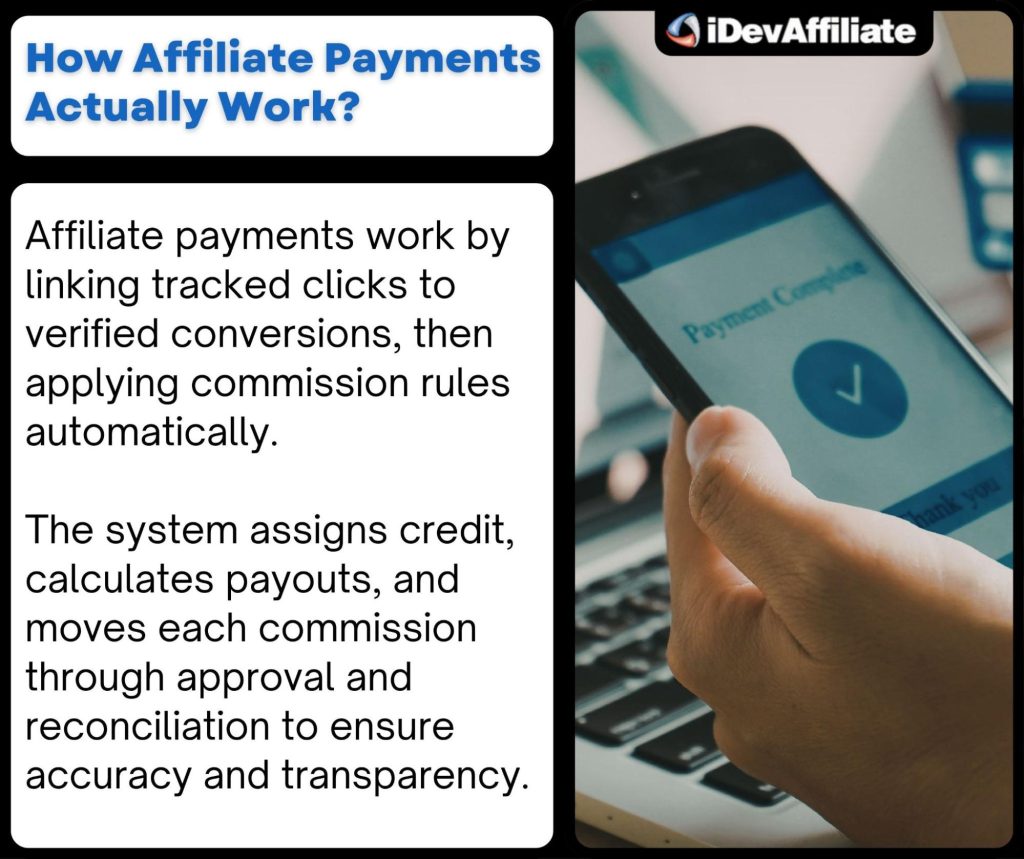
To automating affiliate payments, you need to build a system that connects attribution, commission logic, and payouts into a consistent workflow.
When each step is clearly defined, disputes decrease and payouts become predictable.
From Click to Conversion Attribution Explained Clearly
Affiliate software assigns each partner a unique tracking link that captures referral data at the moment of the click. Attribution rules and windows determine who gets credit and how long that credit remains valid.
When implemented correctly, the system consistently connects conversions back to verified affiliate activity.
Attribution Rules and Windows Define Commission Accuracy
Attribution rules control how credit is assigned when multiple affiliates influence a single conversion. Attribution windows define how long a referral remains eligible after the initial click.
Together, these settings ensure commissions reflect real customer journeys instead of creating gaps or disputes.
Handling Cross-Device and Missing Attribution Gaps
Modern buying journeys often span multiple devices, which can break traditional cookie-based tracking.
To maintain attribution continuity, systems rely on fallback methods like coupon codes or identity-based tracking.
This ensures commissions remain connected even when the original click path is incomplete.
Commission Logic Applied to Real Order Data
Once attribution is confirmed, commission rules calculate payouts based on actual order data such as product, subtotal, or status.
Clear, rule-based logic removes ambiguity across refunds, discounts, and subscription changes. This consistency ensures affiliates and internal teams calculate the same outcome every time.
Approval, Payout, and Reconciliation Workflow
Automated payments follow a structured lifecycle from pending to approved to paid, based on defined order conditions.
After payouts are processed, reconciliation ensures commissions match finalized transactions and identifies any reversals.
This loop maintains accuracy while giving teams a clear audit trail for every payout.
Benefits of Automating Affiliate Payouts at Scale
Automation is not about speed alone, it’s about making your payout system consistent, predictable, and easy to defend.
When rules are enforced automatically, disputes drop, workloads stabilize, and affiliates trust the process.
- Consistent Commission Logic: Apply the same attribution and payout rules every time, eliminating manual interpretation and reducing disputes caused by inconsistent commission calculations across similar transactions.
- Dispute Reduction Through Visibility: Give affiliates access to clicks, conversions, and payout status so they can verify performance independently without relying on support conversations.
- Scalable Payout Operations: Replace manual spreadsheets with automated workflows that calculate commissions, flag exceptions, and streamline reconciliation as affiliate volume grows.
- Predictable Payout Cycles: Set clear payout schedules and approval triggers so affiliates know exactly when and how commissions will be processed without uncertainty.
- Error Prevention Through Automation: Reduce missed conversions, tracking gaps, and manual calculation mistakes by enforcing structured rules across attribution, refunds, and commission logic.
When payouts follow consistent rules and transparent workflows, affiliate programs scale without creating operational friction or trust issues.
But automation only performs as well as the system behind it.
To make these benefits sustainable, you need clearly defined components that ensure tracking, commissions, and payouts stay aligned as complexity grows.
Key Components Needed to Set Up Payment Automation
Instant account set up. All features unlocked in base plan. Professional onboarding included.
Create Your Affiliate Program
Automation only works when the underlying system is clearly defined and consistently enforced.
These components ensure your tracking, commission logic, and payouts operate as one connected workflow without introducing errors at scale.
Tracking, Attribution Windows, and Validation
Everything starts with accurate tracking that reflects how your customers actually convert. If attribution breaks here, automation only amplifies the problem instead of solving it.
- Set attribution windows based on real buying cycles
- Define clear rules for multi-touch attribution scenarios
- Test cross-device and multi-session tracking reliability
- Validate coupon tracking as a fallback attribution method
When tracking is validated across real scenarios, attribution becomes predictable instead of assumed. This creates a reliable foundation where commissions can be defended with data, not guesswork.
Commission Logic for Subscriptions and Refunds
Commission automation depends on rules that reflect real revenue behavior, not simplified assumptions. Subscriptions and refunds introduce complexity that must be handled consistently.
- Define recurring, one-time, or tiered commission structures
- Set clear rules for upgrades and plan changes
- Automate refund reversals before and after payouts
- Tie commission approval to verified order status
When commission logic is clearly defined, payouts follow predictable outcomes across all edge cases. This removes ambiguity and ensures affiliates understand exactly how earnings are calculated.
Payout Methods, Thresholds, and Scheduling
Once tracking and commissions are stable, payout configuration controls how money actually moves. These settings determine how predictable and manageable your payout operations become.
- Choose payout methods aligned with operational capabilities
- Set minimum thresholds to avoid micro transactions
- Define payout schedules with clear approval cutoffs
- Handle negative balances and payout adjustments consistently
Structured payout settings turn financial operations into a repeatable process instead of manual coordination.
This ensures payouts remain accurate, timely, and scalable as your program grows.
But even well-defined systems face pressure from real-world edge cases and unpredictable user behavior.
Understanding where automation breaks down is what helps you reinforce these systems before they turn into payout disputes.
Common Challenges in Automating Affiliate Payments
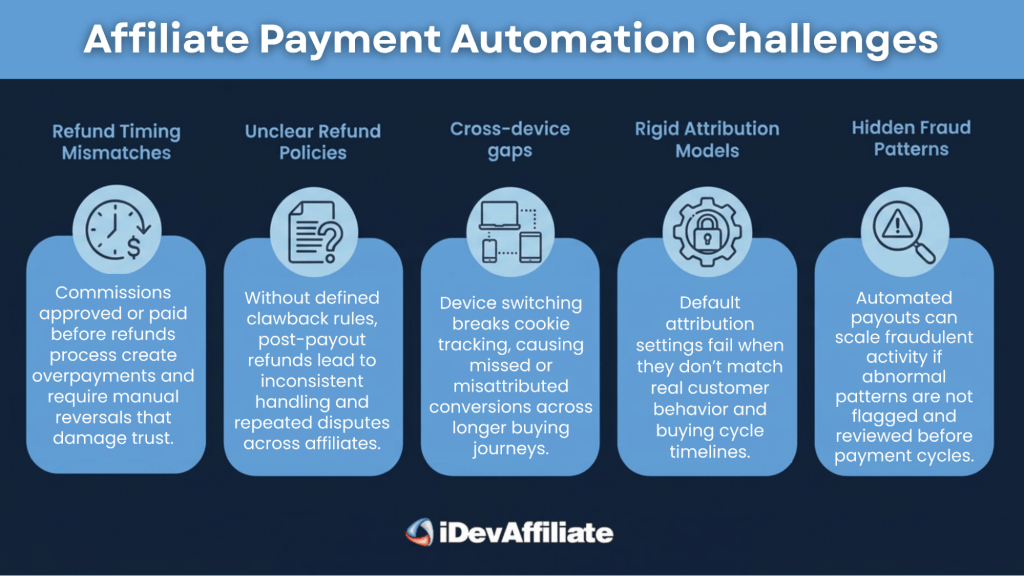
Automation works best when edge cases are handled before they turn into payout issues.
These are the most common breakdowns that create disputes, tracking gaps, and inconsistent commission outcomes at scale.
- Refund Timing Mismatches: Commissions approved or paid before refunds process create overpayments and require manual reversals that damage affiliate trust.
- Unclear Refund Policies: Without defined clawback rules, post-payout refunds lead to inconsistent handling and repeated disputes across affiliates.
- Cross-Device Attribution Gaps: Device switching breaks cookie tracking, causing missed or misattributed conversions across longer buying journeys.
- Rigid Attribution Models: Default attribution settings fail when they don’t match real customer behavior and buying cycle timelines.
- Hidden Fraud Patterns: Automated payouts can scale fraudulent activity if abnormal patterns are not flagged and reviewed before payment cycles.
When these gaps are left unaddressed, automation increases errors instead of reducing them.
The goal is not perfect tracking, but consistent, explainable systems that hold up under real-world conditions.
Best Practices to Build a Reliable Automated Payment System
Strong automation comes from controlled validation, not instant rollout.
These practices ensure your payout system remains accurate, explainable, and stable as complexity increases.
Run a Parallel Payout Cycle Before Full Automation
Before fully switching, validate your system against real payout scenarios. This helps identify mismatches early and ensures automation reflects actual commission outcomes.
- Compare platform payouts with existing manual calculations
- Test refunds, cancellations, and delayed conversion scenarios
- Freeze rules during testing to isolate discrepancies clearly
- Log mismatches with clear reason codes for review
A single clean parallel cycle builds confidence in your system. It ensures payouts remain predictable before automation takes full control.
Create Reporting That Explains Every Commission Decision
Disputes reduce significantly when affiliates can clearly see how commissions are calculated. Transparent reporting turns questions into self-serve verification instead of support tickets.
- Show click source and attribution method clearly
- Display commission payout status with timestamps and updates
- Track events like refunds, approvals, and reversals
- Maintain consistent definitions across all reporting views
When reporting answers “why” without explanation, trust improves automatically. Both affiliates and teams rely on the same data to validate payouts.
Use Versioned Policies to Control Rule Changes
Commission structures evolve, but changes must remain predictable and documented. Versioned policies ensure every payout can be traced back to the rules applied at that time.
- Assign version numbers to each commission policy update
- Define effective dates for all rule changes clearly
- Avoid retroactive changes unless explicitly communicated
- Maintain accessible changelog inside affiliate dashboard
Versioning removes ambiguity from rule changes and prevents disputes. It creates a system where every commission decision is traceable and defensible.
Bottom Line: Automate Affiliate Payments with Reliable Systems
Instant account set up. All features unlocked in base plan. Professional onboarding included.
Create Your Affiliate Program
Automating affiliate payments works best when attribution accuracy, commission logic, and payout workflows operate together inside one consistent system.
The goal is not just to process payouts faster, but to ensure every commission is tied to verified activity that both your team and affiliates can trust over time.
When your affiliate platform clearly defines how referrals are tracked, how commissions are calculated, and how payouts are approved and reconciled, automation becomes predictable instead of reactive:
- Identity-Based Tracking: Keep referrals connected to verified customer identities across devices and sessions.
- Consistent Commission Logic: Apply the same rules across refunds, subscriptions, and all affiliate interactions.
- Structured Payout Workflows: Automate approvals, schedules, and reconciliation without manual intervention.
- Transparent Reporting Systems: Give affiliates full visibility into clicks, conversions, and payout decisions.
Together, these systems turn affiliate payments into a controlled process instead of a source of disputes or manual fixes.
If you want to automate affiliate payouts with accuracy and confidence, start a free trial with iDevAffiliate and test the platform against your real workflow.
Frequently Asked Questions (FAQS)
You may also like

How to Set Up an Affiliate Program on BigCommerce

How to Set Up an Affiliate Program on WooCommerce

How to Set Up an Affiliate Program on Shopify

First Steps: 6 FREE Marketing Ideas For Your New Affiliate Program
Create Your Affiliate Program
- Unlimited Affiliates
- Unlimited Commissions
- Built-In SEO Links
- Social Media Sharing
- Affiliate Program Directory
