
Automating Affiliate Programs Without Losing Control

Most affiliate programs do not fail because of weak offers. They stall because manual management quietly becomes the bottleneck.
Spreadsheets feel manageable. Inbox threads feel controllable. Until growth exposes the cracks.
If you want to understand how to automate affiliate marketing properly, here is what you should know:
- Manual systems break around 50 active affiliates
- Commission errors damage affiliate trust
- Fraud compounds when monitoring is delayed
- Onboarding slows when everything runs through email
- Automation removes repetitive operational tasks
- Order-status triggers prevent invalid payouts
- Integrated tracking eliminates reconciliation gaps
If your affiliate program is growing, now is the time to replace friction with structure. Platforms like iDevAffiliate’s Cloud and self-hosted solutions make that transition predictable rather than disruptive.
Because automation is not about replacing people.
It is about removing the invisible ceilings that limit scale. And once you see where manual systems quietly fail, the logic behind structured automation becomes impossible to ignore.
Where Manual Affiliate Management Starts to Break Down

Manual processes often feel manageable at the beginning of an affiliate program. The real issue is not whether they work, but how quickly they stop working as growth accelerates.
- Scaling Pressure Builds: Tracking 15 affiliates feels simple, but around 50 partners operational strain becomes difficult to manage reliably.
- Administrative Overload Expands: Each new affiliate adds more tracking records, commission checks, emails, and performance data to monitor consistently.
- Calculation Complexity Increases: Refunds, partial orders, coupon codes, and tiered structures turn simple math into time-consuming verification work.
- Error Risk Multiplies: As manual payout reviews grow, human mistakes increase and affiliate trust becomes harder to maintain.
- Fraud Detection Lags: Reviewing past transactions manually delays spotting suspicious activity and allows invalid commissions to accumulate.
- Inbox Chaos Grows: Onboarding, payout confirmations, and tracking questions compete for attention, slowing response times and weakening consistency.
- Spreadsheet Clutter Expands: Fragmented tracking files create reporting gaps and prevent commission data from staying clean and reliable.
Manual systems rarely collapse overnight.
They strain quietly under growth until administrative overhead replaces strategic oversight, creating a ceiling that limits long-term scalability.
That ceiling is not caused by affiliate count alone.
It is created by processes that were never designed to scale in the first place, which is exactly where automation changes the equation.
How Automation Changes the Way Affiliate Programs Operate
Instant account set up. All features unlocked in base plan. Professional onboarding included.
Create Your Affiliate Program
Manual management keeps affiliate programs running. Automation allows them to grow without adding complexity.
Automatic Commission Tracking
Automation connects directly to your shopping cart and records commissions in real time. Every verified order is attributed instantly to the correct affiliate without spreadsheet reconciliation.
This eliminates missed payouts, manual cross-checking, and calculation errors. Accurate tracking becomes the default instead of a monthly audit task.
Rule-Based Commission Calculation
Once commission structures are configured, the system applies them consistently. Percentage rates, flat fees, and tiered payouts are calculated automatically based on predefined logic.
There is no manual adjustment after refunds or special cases. The rules run continuously in the background, reducing disputes and preserving affiliate trust.
Order-Status Commission Control
Automation allows commissions to trigger only when orders reach a defined status such as Completed or Shipped.
This prevents payouts on cancelled, refunded, or fraudulent transactions. Instead of correcting errors after payment, the system avoids creating invalid commissions altogether.
Structured Affiliate Onboarding
Automated registration and approval workflows remove repetitive email exchanges. Affiliates receive portal access, tracking links, and resources immediately after approval.
The onboarding experience becomes consistent for every new partner. You are not manually sending links or troubleshooting avoidable setup mistakes.
Built-In Performance Reporting
Real-time dashboards provide instant visibility into clicks, conversions, and commissions. Both administrators and affiliates access updated data without exporting reports.
Transparency increases while administrative overhead decreases. Reporting stops being a weekly obligation.
Automation does not replace oversight. It replaces operational friction that prevents affiliate programs from scaling efficiently.
The next step is choosing the right platform to support that structure without reintroducing complexity.
Affiliate Automation Software That Helps You Scale Properly
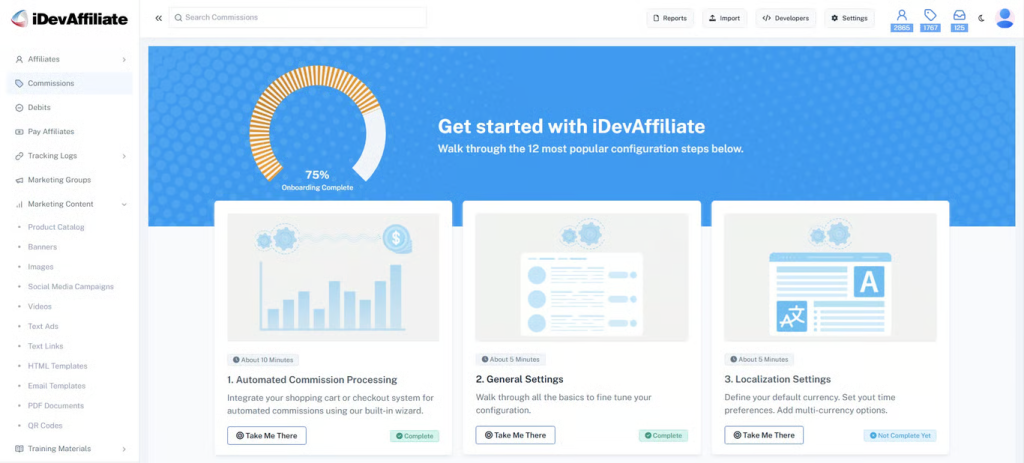
Not all affiliate automation platforms are built with the same priorities. Some focus on networks. Some prioritize enterprise analytics. Others emphasize simplicity.
The right choice depends on how much control, flexibility, and long-term ownership you want.
1. iDevAffiliate
For businesses that want full control over their affiliate program, iDevAffiliate is built as the infrastructure-first solution.
While many platforms rely primarily on cookie tracking or shared affiliate networks, iDevAffiliate combines traditional link tracking with email address-based attribution, the silver bullet for protecting commissions beyond a single browser session.
Key advantages include:
- Real-time commission tracking with 150+ direct shopping cart integrations
- Email-based tracking that preserves lifetime affiliate-to-customer relationships
- Order status commissioning to prevent payouts on refunded or cancelled transactions
- Built-in affiliate portal with structured onboarding and reporting
- Cloud and self-hosted deployment options for businesses that want true ownership
There are no network overrides. No forced marketplaces. No shared affiliate pools competing for your margins.
You control the rules. You control the data. You control the relationships.
That level of ownership is what turns affiliate marketing from a hopeful experiment into a reliable growth channel.
2. Post Affiliate Pro
Post Affiliate Pro is known for extensive customization and complex commission configurations.
Core features include:
- Multi-tier commission structures
- Multiple tracking methods (cookies, IP, etc.)
- Customizable dashboards
- International language support
While feature-heavy, the platform can feel configuration-intensive. Setup often requires technical involvement, and the system may be overly complex for small to mid-sized businesses that want streamlined, scalable tracking without ongoing adjustments.
3. Tapfiliate
Tapfiliate is a cloud-based affiliate tool often used by SaaS companies for recurring billing setups.
Core features include:
- Recurring commission support
- Stripe and Shopify integrations
- Branded affiliate portals
- Automated onboarding workflows
The platform relies heavily on cookie-based tracking and offers limited deployment flexibility. Customization and attribution control can be restrictive, particularly for businesses that need durable tracking and deeper infrastructure as they scale.
4. Refersion
Refersion is primarily built for Shopify-based ecommerce brands and is closely tied to that ecosystem.
Core features include:
- Native Shopify integration
- Automated commission tracking
- Coupon-based attribution
- Built-in payment processing tools
While convenient for Shopify users, the platform is heavily cart-dependent. Businesses operating across multiple systems or needing broader deployment flexibility may find its scope limiting as programs expand.
5. Everflow
Everflow is designed for high-volume, enterprise-level affiliate and performance programs with complex reporting needs.
Core features include:
- Real-time reporting dashboards
- Advanced fraud detection tools
- Multi-channel attribution
- API-driven integrations
While powerful, the platform is typically aligned with larger budgets and technical teams. For small to mid-sized businesses, the depth and cost can introduce unnecessary complexity beyond what most affiliate programs require.
6. Impact.com
Impact.com operates as a large-scale partnership automation platform combining affiliate, influencer, and strategic partnership management.
Core features include:
- Cross-device attribution
- Contract and partner management tools
- Enterprise-level analytics
- Influencer campaign tracking
While comprehensive, the platform is built for enterprise environments with complex partnership structures. Its scale, pricing, and layered feature set can be excessive for mid-sized businesses seeking focused affiliate tracking without enterprise overhead.
7. PartnerStack
PartnerStack is built primarily for B2B SaaS partner ecosystems, with a strong focus on reseller and channel-style partnerships.
Core features include:
- Recurring commission automation
- CRM integrations
- Partner lifecycle management
- Performance-based reward systems
While effective for SaaS channel programs, the platform is heavily oriented toward B2B models. Ecommerce and product-focused businesses may find it less aligned with retail-driven affiliate strategies and traditional commission structures.
Automation software should reduce friction.
For businesses that want full tracking control, fraud protection through order-status commissioning, and the flexibility of cloud or self-hosted deployment, iDevAffiliate stands apart.
It is one of the few platforms built specifically around ownership rather than reliance on third-party networks.
This is where the difference between tools becomes real, because the platform you choose determines how smoothly those operational benefits actually materialize in practice.
What Businesses Gain When They Automate Affiliate Marketing

Choosing automation is not just about saving time. It is about removing structural friction that quietly limits growth and profitability.
- Time Reclaimed: Administrative workload drops as commission tracking, approvals, and reporting run automatically in the background.
- Accuracy Standardized: Automated commission rules reduce calculation errors and prevent payout disputes before they escalate.
- Fraud Contained Early: Order-status triggers block invalid commissions before refunds or chargebacks affect margins.
- Affiliate Confidence Strengthened: Real-time dashboards give partners transparent visibility into clicks, conversions, and earnings.
- Scalability Unlocked: Adding new affiliates no longer increases administrative overhead proportionally.
- Integration Simplicity Preserved: Direct cart connections eliminate reconciliation gaps between sales data and commission records.
- Manual Process Clutter Removed: Centralized tracking dashboards maintain clean reporting workflows and prevent spreadsheet sprawl from distorting commission data.
Automation does not just streamline operations.
It creates a stable foundation where affiliate programs grow predictably instead of becoming harder to manage with every new partner added.
Choosing the Right Affiliate Automation Platform for Long-Term Growth
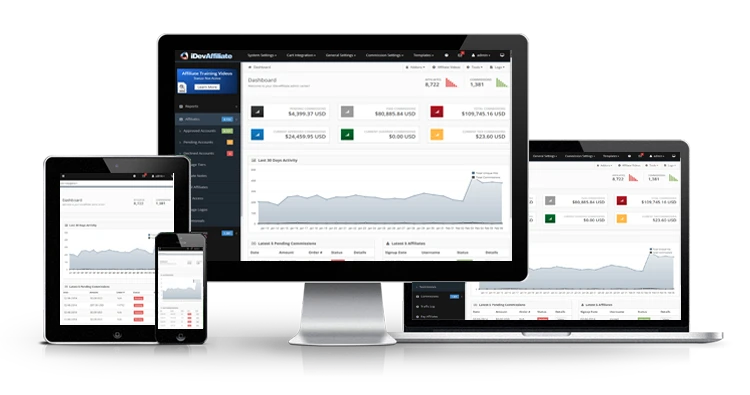
Selecting affiliate automation software is not simply a technical decision.
It is a structural choice that affects how efficiently your program runs, how confidently it scales, and how much control you retain over your growth channel.
- Operational Readiness: The right platform should allow you to get live quickly without unnecessary setup friction or developer dependency.
- Infrastructure Burden: Strong solutions reduce ongoing maintenance, updates, and security oversight so your team can focus on growth.
- Data Ownership and Control: Some businesses require full control over hosting environments, while others prioritize simplicity and managed infrastructure.
- Cost Alignment: Subscription models lower upfront commitment, while one-time licensing can support long-term scaling strategies.
- Scalability Without Disruption: Platforms that offer both cloud and self-hosted paths provide flexibility as your program evolves.
- Integration Compatibility: Direct connections to your existing shopping cart eliminate reconciliation gaps and technical delays.
- Sustained Operational Simplicity: Clean system architecture prevents backend complexity from distracting you from commission strategy and affiliate recruitment.
The best choice is not about features alone.
It is about selecting a platform, such as iDevAffiliate, that aligns with your current stage while leaving room for controlled expansion as your affiliate program matures.
Bottom Line: Automation Turns Affiliate Marketing Into Infrastructure
Instant account set up. All features unlocked in base plan. Professional onboarding included.
Create Your Affiliate Program
Affiliate programs grow sustainably when structured systems replace manual oversight. What may begin as a manageable spreadsheet process eventually turns into operational drag as commission errors increase, fraud detection slows, communication fragments, and growth stalls.
Learning how to automate affiliate marketing means removing those friction points before they limit performance. Real-time tracking, rule-based commission logic, order-status verification, structured onboarding, and clean shopping cart integrations create stability that manual systems cannot maintain.
Automation does not add complexity. It removes hidden inefficiencies.
If you are ready to replace manual oversight with reliable infrastructure, start your free iDevAffiliate trial today and experience email-based tracking, automated commission management, and full program control from day one.
Structured automation can transform your affiliate program from a time-consuming task into a controlled, performance-driven growth engine.
Frequently Asked Questions (FAQS)
You may also like

How to Set Up an Affiliate Program on BigCommerce

How to Set Up an Affiliate Program on WooCommerce

How to Set Up an Affiliate Program on Shopify

First Steps: 6 FREE Marketing Ideas For Your New Affiliate Program
Create Your Affiliate Program
- Unlimited Affiliates
- Unlimited Commissions
- Built-In SEO Links
- Social Media Sharing
- Affiliate Program Directory
