
Affiliate Marketing Resources That Help You Scale

Most affiliate programs don’t fail because of lack of effort, they fail because the resources behind them don’t support how the program actually runs.
Tools get added, affiliates get onboarded, but tracking gaps, unclear commissions, and inconsistent workflows quietly slow everything down.
If you’re building or improving an affiliate program, here’s what actually matters:
- Tracking that connects every click to a verified conversion
- Commission rules that match your margins and prevent overpaying
- Clear attribution so affiliates trust what they’re earning
- Centralized systems instead of scattered tools and spreadsheets
- Resources that help affiliates promote effectively from day one
If you want a system that handles tracking, commissions, and reporting cleanly, iDevAffiliate is built to support exactly that, without adding operational complexity.
Because once your foundation is clear, the challenge shifts from “what tools do I need” to “how do I make them work together.”
That’s where most programs either stabilize and scale, or slowly become harder to manage over time.
What Affiliate Marketing Resources Are and Why They Matter
Instant account set up. All features unlocked in base plan. Professional onboarding included.
Create Your Affiliate Program
Affiliate marketing resources are the tools, systems, and processes businesses use to build, manage, and scale affiliate programs effectively.
But their real value comes from how well they support tracking accuracy, commission control, and partner management, not how many features they offer.
Resources as a Structured System
Affiliate marketing resources are not just tools or dashboards, they form a system that connects partner onboarding, tracking, commission logic, and reporting.
When structured correctly, this system allows businesses to run affiliate programs predictably without relying on manual fixes or disconnected workflows.
Consistent System Over Scattered Tools
Resources work best when they follow a repeatable operational process instead of disconnected tools.
A consistent system ensures affiliates are onboarded the same way, tracking behaves reliably, and performance data is reviewed without confusion or constant reconciliation.
Clear Attribution and Tracking Visibility
Strong resources give businesses clear visibility into how referrals turn into conversions and commissions.
When attribution is transparent and verifiable, teams can resolve disputes quickly, maintain affiliate trust, and scale partnerships without uncertainty around tracking accuracy.
Defined Commission Structure Understanding
Reliable resources help businesses define and manage commission structures that match their revenue model.
Clear rules around payouts, attribution windows, and bonuses prevent overpaying affiliates while ensuring high-performing partners are rewarded consistently and fairly.
Practical Validation Before Scaling
Effective resources prioritize validation before growth. Testing tracking, commission logic, and integrations
in real scenarios ensures that the program runs correctly, reducing the risk of missed commissions, manual corrections, or operational issues after scaling.
Focused Execution Over Information Overload
The most valuable resources reduce complexity instead of adding to it.
A focused system helps businesses manage affiliates, optimize performance, and grow their program without relying on excessive tools or creating unnecessary operational overhead.
When your resources are structured correctly, your affiliate program becomes easier to manage, more predictable, and far less dependent on manual fixes.
But clarity alone is not enough, the next step is choosing the tools that actually enforce that structure in day-to-day operations.
Helpful Resource → Best Affiliate Tool Stack for Scalable Growth
Essential Tools and Platforms to Run a Reliable Affiliate Program
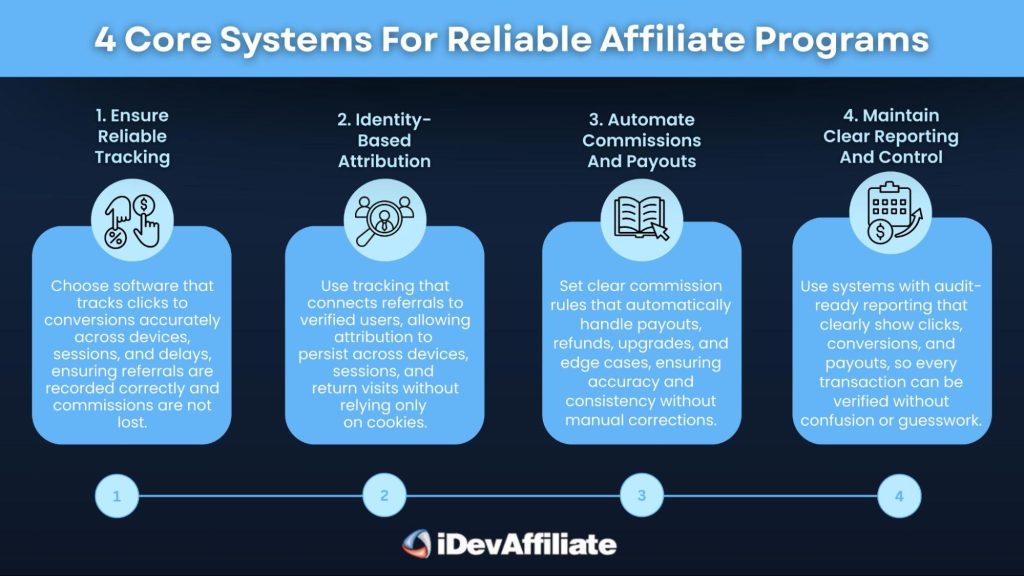
Once you define what affiliate marketing resources are, the next step is choosing tools that actually support how your program operates.
For businesses, the goal is simple: ensure tracking holds, commissions stay accurate, and payouts remain defensible as you scale.
These are the core systems that make that possible.
Reliable Tracking That Holds Under Real Conditions
Affiliate tracking software must connect every click to a verified conversion without gaps.
A strong system records referral data, stores it correctly, and matches it at checkout, so commissions are based on actual customer activity, not assumptions or broken sessions.
Email-Based Tracking That Extends Attribution (Key Advantage)
Traditional tracking relies heavily on cookies, which often break across devices, sessions, or privacy restrictions.
iDevAffiliate solves this by using email-based tracking alongside standard methods, allowing the system to reconnect users through verified identity instead of relying only on browser data.
This means attribution can still hold when users return later, switch devices, or complete purchases outside the original session, reducing lost commissions and improving overall tracking accuracy.
Tracking Comparison Snapshot:
- Cookie tracking → limited to browser/session
- Link tracking → only handles routing
- Email tracking → persists across devices & time
Commission Rules That Reflect Your Business Model
Your commission engine should support how you actually sell, not force you into rigid structures.
Businesses need flexibility to apply percentage, flat-rate, and product-level commissions while keeping payout rules clear, consistent, and easy to manage as the program grows.
Clear Attribution Across Multiple Touchpoints
Modern buying journeys are not linear, so your system must handle multiple attribution inputs.
Whether referrals come through links, coupon codes, or repeat purchases, your software should ensure commissions stay connected to the right affiliate without overlap or confusion.
Attribution Flow Overview:
Click → Tracking Stored → User Returns → Conversion Matched → Commission Assigned
When any step breaks, attribution is lost, this is where stronger tracking methods make a measurable difference.
Fraud Controls That Protect Payout Accuracy
As your affiliate program grows, so does the risk of invalid activity.
Built-in fraud controls should detect duplicate conversions, block self-referrals, and flag suspicious patterns early, so you avoid paying for activity that does not represent real revenue.
Integration That Reduces Operational Overhead
Your affiliate platform should connect cleanly with your store or billing system.
Reliable integrations ensure conversions are recorded automatically, reducing manual work and preventing tracking failures that often appear after updates or changes in your checkout flow.
Platforms like iDevAffiliate simplify this by maintaining stable integrations that continue working as your business evolves.
Reporting That You Can Actually Verify
Reporting is only useful if it can be trusted.
Businesses need visibility into clicks, conversions, commissions, and payouts with clear audit trails, so every transaction can be traced and validated without relying on assumptions or manual reconciliation.
With iDevAffiliate, this visibility becomes a control layer rather than just a dashboard.
When these systems are in place, your affiliate program becomes stable, measurable, and easier to scale without constant intervention.
But tools alone don’t drive performance, the real leverage comes from how well your affiliates use them and how clearly you guide their actions.
Helpful Resource → How Affiliate Marketing Programs Really Work
Educational Resources That Help Your Affiliates Perform Better

Even with the right tools in place, affiliate performance depends on how well your partners understand what to promote and how to convert.
Businesses that provide structured, practical resources reduce confusion, improve conversion rates, and build stronger affiliate relationships.
The goal is to guide affiliates toward actions that actually generate revenue.
Clear Promotion Guidelines and Positioning
Affiliates perform better when they understand exactly how to position your product.
Providing clear messaging, use cases, and audience fit helps them create content that aligns with your offer instead of guessing what might convert.
Ready-to-Use Content and Conversion Assets
Giving affiliates structured assets like landing pages, product highlights, and content angles reduces their setup time.
When affiliates can start promoting quickly with proven materials, they are more likely to drive consistent and accurate conversions.
Transparent Commission and Attribution Education
Affiliates need to understand how commissions are earned and tracked.
Clear explanations of attribution rules, payout conditions, and tracking behavior help prevent confusion, reduce disputes, and build trust in your affiliate program over time.
Performance Feedback and Optimization Guidance
Affiliates improve faster when they know what is working.
Sharing performance insights, common mistakes, and optimization suggestions helps them refine their approach and focus on strategies that generate higher-quality traffic and conversions.
Structured Onboarding and Setup Support
A guided onboarding process ensures affiliates start correctly from day one.
Providing step-by-step setup instructions, tracking validation steps, and initial promotion guidance reduces errors and increases the likelihood of early success.
Focused Communication and Ongoing Support
Consistent communication keeps affiliates engaged and aligned.
Regular updates, campaign insights, and direct support channels help affiliates stay informed, adjust their strategies, and continue promoting effectively as your program evolves.
When affiliates clearly understand how to position, promote, and validate their efforts, performance becomes more consistent and predictable.
But even with strong resources in place, gaps in usage and understanding can still create friction, which is where most programs begin to lose efficiency.
Common Affiliate Resource Mistakes (And How to Prevent Them)
Even with the right systems in place, affiliate programs often underperform because affiliates misuse or misunderstand available resources.
Most issues come from gaps in clarity, tracking visibility, or guidance, not lack of effort. Businesses that address these early reduce friction, disputes, and missed revenue.
Disconnected Tools and No Single Source of Truth
Affiliates often rely on multiple tools and spreadsheets, leading to conflicting data and confusion around commissions.
Businesses can prevent this by providing a centralized system where tracking, reporting, and payouts are clearly defined and consistently visible.
Focusing on Clicks Instead of Verified Conversions
Affiliates tend to optimize for traffic and clicks without understanding attribution quality.
Businesses can guide better behavior by emphasizing conversion validation, showing how clicks translate into commissions, and highlighting metrics that reflect real revenue instead of surface activity.
Misunderstanding Attribution and Commission Rules
Many affiliates promote without fully understanding how attribution works, leading to disputes and incorrect expectations.
Businesses should clearly explain attribution logic, coupon overrides, and payout conditions so affiliates know exactly how commissions are earned and credited.
Relying on Manual Fixes Instead of System Validation
When tracking gaps appear, affiliates often assume errors instead of validating setups.
Businesses can reduce this by offering clear testing processes, sample conversions, and onboarding steps that confirm tracking and commission logic before affiliates begin scaling traffic.
Ignoring Program Policies and Promotion Guidelines
Affiliates sometimes overlook program rules around traffic sources, disclosures, or coupon usage.
Businesses should provide simple, repeatable guidelines and checklists so affiliates stay compliant and avoid reversals or penalties that impact long-term trust.
Lack of Ongoing Feedback and Performance Direction
Affiliates may continue ineffective strategies without realizing what needs improvement.
Businesses can support better outcomes by sharing performance insights, common mistakes, and optimization suggestions that help affiliates adjust and improve over time.
When businesses close these gaps early, affiliate performance becomes easier to manage and scale.
Clear systems, guidance, and validation reduce uncertainty, allowing affiliates to focus on driving conversions instead of troubleshooting attribution.
Helpful Resource → Partner Management Software Guide
Bottom Line: Building Affiliate Resources That Actually Work
Instant account set up. All features unlocked in base plan. Professional onboarding included.
Create Your Affiliate Program
Affiliate marketing resources only matter if they help your program run predictably.
If tracking breaks, commissions become unclear, or affiliates lack direction, growth quickly turns into operational overhead instead of a scalable channel.
Clarity determines performance.
For businesses building or improving an affiliate program, the focus should stay on a few core foundations:
- Reliable tracking: ensure every referral connects to a verified conversion without gaps.
- Defined commission rules: align payouts with margins and avoid unnecessary complexity.
- Clear attribution: remove confusion so affiliates trust your system and stay engaged
When these elements are supported by the right tools and structured resources, your affiliate program becomes easier to manage and far more scalable.
iDevAffiliate is designed around these fundamentals, giving you a system where tracking, commissions, and reporting stay consistent without constant fixes.
The difference is simple: when your resources are aligned with how your program actually runs, scaling stops being reactive and starts becoming predictable.
That’s something you can validate firsthand by starting a free trial of iDevAffiliate. It gives you a clear view of how consistently your program performs under real conditions.
Frequently Asked Questions (FAQS)
You may also like

How to Set Up an Affiliate Program on BigCommerce

How to Set Up an Affiliate Program on WooCommerce

How to Set Up an Affiliate Program on Shopify

First Steps: 6 FREE Marketing Ideas For Your New Affiliate Program
Create Your Affiliate Program
- Unlimited Affiliates
- Unlimited Commissions
- Built-In SEO Links
- Social Media Sharing
- Affiliate Program Directory
