
Key Tools Needed for Affiliate Marketing

Affiliate marketing can generate steady revenue, but only when the system behind it is built correctly.
Most affiliate disputes don’t come from bad partners, they come from unclear tracking, messy commission rules, or tools that don’t connect properly to the checkout.
If you want a program that runs smoothly, the structure matters more than the hype. Here are the fundamentals that keep affiliate programs stable:
- Track referrals using systems connected directly to checkout.
- Set commission rules based on margins and refunds.
- Give affiliates one dashboard for links and reporting.
- Use controls that block self-referrals and suspicious activity.
- Test tracking and commissions before inviting affiliates.
Platforms like iDevAffiliate are often used for this reason, they bring tracking, commissions, and affiliate dashboards into one system so programs don’t rely on scattered tools.
If you plan to run affiliate marketing seriously, understanding how these systems work together will save you months of troubleshooting later.
The rest of this guide breaks down the structure, tools, and setup process that keep affiliate programs stable as they grow.
Build a Strong Foundation Before Launching an Affiliate Program

Affiliate programs succeed when the structure behind them is planned carefully from the start.
Clear rules for tracking, commissions, and partner tools help create a system affiliates trust and businesses can manage consistently over time.
Clear Program Structure From the Beginning
Affiliate programs work best when the operational structure is defined before affiliates start promoting.
This includes establishing how referrals will be tracked, how commissions are calculated, and when payouts are approved or reversed.
Documenting these rules early removes ambiguity.
Affiliates understand how commissions are earned, while businesses avoid the operational chaos that comes from fixing attribution and payout problems after the program has already launched.
Consistent Tracking and Attribution Rules
Tracking rules determine which affiliate receives credit for a conversion, making attribution one of the most important early decisions.
Every referral should follow the same defined path from click to conversion. Consistent attribution logic keeps reporting aligned with real customer behavior.
When every referral is evaluated using the same rules, affiliates gain confidence that commissions are credited fairly and accurately.
Commission Logic That Reflects Real Revenue
Commission structures should reflect real business economics rather than simple promotional incentives. If payouts ignore refunds, cancellations, or product margins, commissions can quickly drift away from actual revenue performance.
Aligning commissions with real order events ensures payouts stay predictable and sustainable. Affiliates benefit from clear expectations while businesses maintain profitability as the program grows.
Tools That Support Affiliates From Day One
Affiliates perform better when the program provides clear tools and simple guidance from the beginning. Ready-made referral links, organized promotional assets, and accessible reporting reduce the chances of tracking mistakes.
When partners can easily access the resources they need, they spend less time troubleshooting and more time promoting products to their audiences.
A Program Built for Long-Term Stability
Affiliate marketing should be designed as a durable revenue channel rather than a short-term campaign. Programs built on clear structure, reliable tracking, and supportive partner systems tend to scale far more smoothly.
Once this foundation is established, businesses can confidently move forward with selecting the tools that will power tracking, commissions, and affiliate program management.
Tools Needed to Run and Scale an Affiliate Marketing Program
Instant account set up. All features unlocked in base plan. Professional onboarding included.
Create Your Affiliate Program
Affiliate marketing rarely runs on a single tool.
A stable program usually requires systems for tracking referrals, calculating commissions, supporting affiliates, and protecting payouts.
Understanding what tools are needed for affiliate marketing helps businesses avoid fragile setups built on spreadsheets or disconnected plugins.
When the right systems are chosen early, the program becomes easier to manage and far more reliable as it grows.
1. Affiliate Tracking and Commission Management Software
Every affiliate program needs a central system that records referrals, attributes conversions, and calculates commissions automatically.
Without this foundation, it becomes difficult to verify which affiliate actually generated a sale.
- Affiliate tracking software connected directly to checkout
- Automatic commission calculation tied to order events
- Referral links and affiliate IDs for attribution
- Reporting dashboards for clicks, conversions, and commissions
Platforms like iDevAffiliate are designed specifically for running in-house affiliate programs, combining tracking, commissions, and reporting in one system.
This approach reduces the need to connect multiple tools and helps maintain a clear system of record for attribution.
Other options exist as well.
For example, Post Affiliate Pro offers flexible tracking and a strong feature set, but many teams find the setup and customization process more technical. Tapfiliate focuses on simplicity and SaaS integrations, although some advanced commission rules require higher-tier plans.
The key takeaway is simple: whichever tool you choose must reliably track referrals and commissions tied directly to real orders.
2. Ecommerce and Checkout Integration
Affiliate tracking must connect directly to the system that processes customer orders. If checkout integration is unreliable, referral data and purchases will not align correctly.
- Direct integrations with platforms like Shopify or WIX
- Webhook or event-based tracking tied to order lifecycle
- Commission adjustments when orders are cancelled or refunded
- Conversion tracking based on confirmed purchase events
Tools like iDevAffiliate integrate with store events so commissions reflect actual order activity rather than simple pageviews.
Some affiliate platforms rely on script-based tracking alone, which can break during theme updates or checkout changes.
Because of this, many teams prioritize solutions that listen to order events rather than relying only on browser scripts.
3. Affiliate Portal and Partner Management Tools
Affiliates need a clear place to access links, monitor performance, and download marketing materials. Without a structured portal, partners often rely on emails or manual requests to get basic information.
- Affiliate dashboards displaying clicks, sales, and commissions
- Easy access to referral links and coupon codes
- Libraries for banners, product images, and promotional copy
- Registration workflows for onboarding new affiliates
Most dedicated affiliate tools include a partner portal.
For example, Refersion is popular with Shopify stores and provides a clean dashboard experience for affiliates.
However, some businesses note that commission customization and reporting depth can feel limited for more complex programs.
Platforms like iDevAffiliate include a branded affiliate portal where partners can generate links, view conversions, and track payout progress in one place.
4. Fraud Prevention and Payout Control Tools
Affiliate programs should include safeguards to prevent abuse while maintaining transparency with legitimate partners.
Without basic protections, self-referrals and duplicate accounts can quietly inflate commission payouts.
- Self-referral blocking to prevent affiliates purchasing through own links
- Duplicate account detection for suspicious signups
- IP monitoring for unusual referral patterns
- Commission hold periods aligned with refund windows
Most modern affiliate platforms provide fraud controls, but the level of automation varies.
Some tools require manual review processes, while others allow configurable rules that block suspicious activity automatically.
Tools that combine fraud prevention with commission approval workflows help reduce payout disputes before they escalate.
5. Analytics and Reporting Tools for Program Optimization
Tracking tools record affiliate activity, but reporting tools help businesses understand which partners actually drive revenue.
These insights are essential for improving recruitment and commission strategies.
- Conversion reports showing affiliate-driven revenue
- Performance comparisons between affiliates and campaigns
- Traffic insights identifying high-performing partners
- Exportable data for finance reconciliation and reporting
Some businesses use external analytics tools alongside affiliate platforms to analyze long-term trends.
However, iDevAffiliate already provides built-in reporting dashboards that track clicks, conversions, and payouts.
A Tool Stack That Supports Long-Term Growth
Affiliate programs tend to run more smoothly when the core functions, tracking, commissions, dashboards, and reporting, work together inside a coordinated system.
Many businesses choose all-in-one affiliate software because it combines tracking, commission automation, partner dashboards, and reporting into a single environment.
This reduces operational complexity while still supporting scalable programs.
Other tools can work well depending on the situation, but they may require combining multiple services or accepting certain feature limitations.
The most important factor is choosing a tool stack that keeps attribution clear and commissions aligned with real orders as the program grows.
Set Up an Affiliate Program Using the Right Tools
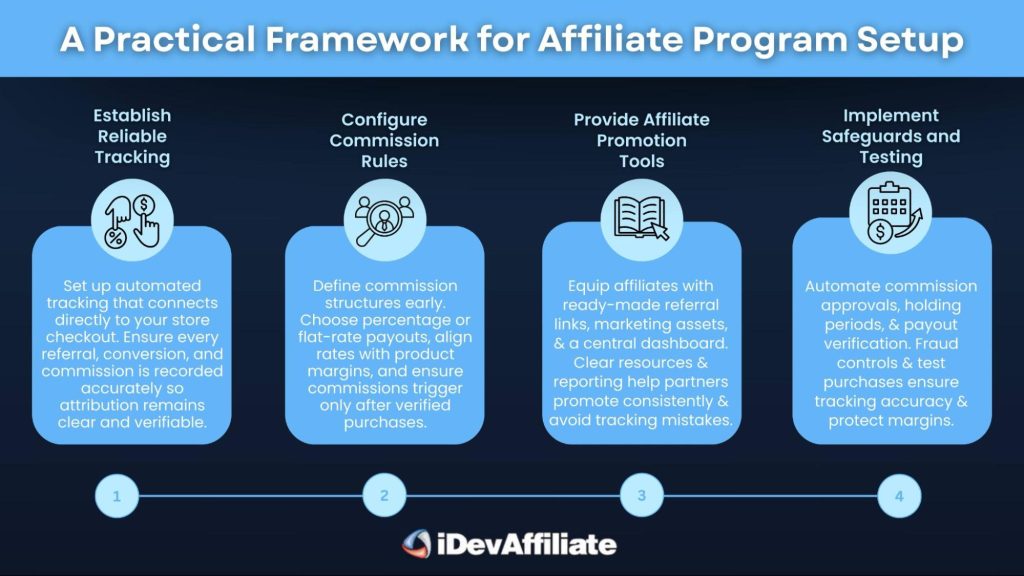
Once the structure of your affiliate program is clear, the next step is building the system step by step. Each stage relies on tools that automate tracking, commissions, reporting, and payout workflows.
When these systems are implemented in the right order, the program becomes easier to manage, easier for affiliates to promote, and far less likely to create disputes later.
Step 1: Establish Reliable Tracking and Attribution
The first step is implementing tracking that connects directly to your store checkout and records referral activity automatically.
This ensures every click, conversion, and commission is captured consistently from the beginning.
Reliable tracking creates a single source of truth for reporting and allows businesses to verify exactly which affiliate generated each sale.
Step 2: Configure Commission Rules and Payout Logic
Once tracking is operational, the next step is defining commission rules that reflect how your business sells products. Systems can automatically apply percentage payouts, flat-rate commissions, or product-level rates based on predefined logic.
Setting these rules inside the system ensures commissions are calculated consistently and aligned with real order activity.
Step 3: Provide Affiliates With Tools and Resources
After commissions are defined, affiliates need access to the tools that help them promote effectively. These typically include referral links, performance dashboards, and organized marketing assets.
Centralized partner tools make it easier for affiliates to access resources, monitor performance, and promote products without relying on constant support.
Step 4: Implement Safeguards and Test the System
Before scaling the program, safeguards should be implemented to protect payouts and prevent abuse.
Monitoring systems can identify suspicious referral patterns, duplicate accounts, or self-referrals before commissions are approved.
Running test referrals and purchases confirms that tracking, commissions, and reporting behave as expected before affiliates begin generating real traffic.
Bottom Line: Tools Create the Backbone of Affiliate Programs
Instant account set up. All features unlocked in base plan. Professional onboarding included.
Create Your Affiliate Program
Affiliate marketing works best when the operational system is clear long before affiliates begin promoting.
Programs built on strong tracking, transparent commission rules, and reliable partner tools avoid the disputes and manual cleanup that derail many new programs.
The most successful setups focus on a few fundamentals:
- Accurate referral tracking tied directly to real orders
- Commissions calculated based on verified purchases
- Affiliate dashboards showing clicks, conversions, and payouts
- Clear reporting that keeps partners informed about performance
- Safeguards that protect payouts from fraud or abuse
When these elements work together, the program becomes easier to manage and easier for affiliates to trust.
For businesses that want these systems working together in one environment, iDevAffiliate provides an all-in-one backbone for affiliate programs.
It combines tracking, commissions, dashboards, fraud controls, and reporting inside a single platform. This allows teams to focus on recruiting affiliates and scaling revenue instead of troubleshooting infrastructure.
Start your free iDevAffiliate trial and see how quickly you can launch a fully tracked, reliable affiliate program.
You may also like

How to Set Up an Affiliate Program on BigCommerce

How to Set Up an Affiliate Program on WooCommerce

How to Set Up an Affiliate Program on Shopify

First Steps: 6 FREE Marketing Ideas For Your New Affiliate Program
Create Your Affiliate Program
- Unlimited Affiliates
- Unlimited Commissions
- Built-In SEO Links
- Social Media Sharing
- Affiliate Program Directory
