
Choosing Affiliate Tracking Software That Actually Works

Most affiliate programs don’t struggle with growth, they struggle with tracking.
When attribution breaks, commissions get disputed, reporting becomes unreliable, and affiliates lose trust in your system.
That’s where the right affiliate tracking software changes everything.
If you want a system that actually holds up under real conditions, here’s what matters most:
- Every conversion must connect to verified referral
- Track users beyond cookies and browser limitations
- Real-time data improves faster, more accurate decisions
- Commission rules apply automatically without manual intervention
- Every payout must be traceable to source activity
iDevAffiliate is built around this exact approach, combining traditional tracking with email-based attribution to keep commissions accurate and verifiable as your program grows.
If your tracking feels inconsistent or hard to trust, the issue usually isn’t performance, it’s attribution.
Understanding how tracking systems actually work will change how you manage payouts, reduce disputes, and scale without losing control.
What Defines The Best Affiliate Tracking Software Today

The best tracking software for affiliate marketing is not defined by how many features it offers, but by how reliably it connects referrals to conversions.
Strong systems focus on accurate attribution, real-time visibility, and built-in protection against invalid activity.
Accurate Attribution Across The Full Customer Journey
Affiliate software assigns each partner a unique tracking link that captures referral data and connects visitors to the correct affiliate.
More advanced platforms extend this with email-based tracking, ensuring attribution persists across devices, sessions, and longer buying cycles.
Real-Time Reporting And Immediate Visibility
Reliable platforms surface conversion data as it happens, allowing affiliates and managers to act on current performance instead of outdated reports.
Real-time visibility ensures campaigns can be optimized quickly and underperformance is identified before it impacts revenue.
Identity-Based Tracking Beyond Cookies
Traditional tracking relies on cookies that break across devices or expire over time.
Systems like iDevAffiliate use email address-based tracking to create a persistent relationship between the customer and affiliate, maintaining attribution even when browser-based tracking fails.
Built-In Fraud Detection And Validation Controls
Fraud prevention works best when embedded directly into the tracking system.
Strong platforms automatically flag suspicious activity, such as abnormal click patterns or inflated conversions. This helps protect commission budgets from invalid or manipulated traffic.
It also ensures that only legitimate referrals are rewarded accurately.
Consistent Commission Attribution And Rule Enforcement
Accurate tracking extends into how commissions are applied and enforced. The system matches conversions to verified referral data.
It then applies predefined commission rules automatically. This ensures payouts remain consistent, auditable, and aligned with actual customer activity.
When attribution, visibility, and validation are built into the system, tracking becomes dependable instead of reactive.
That foundation is what determines which features actually matter, and how they contribute to accurate attribution, controlled payouts, and scalable affiliate program growth.
Helpful Resource → Running a Profitable Affiliate Program for Your Online Store
Key Features That Top Affiliate Tracking Tools Offer
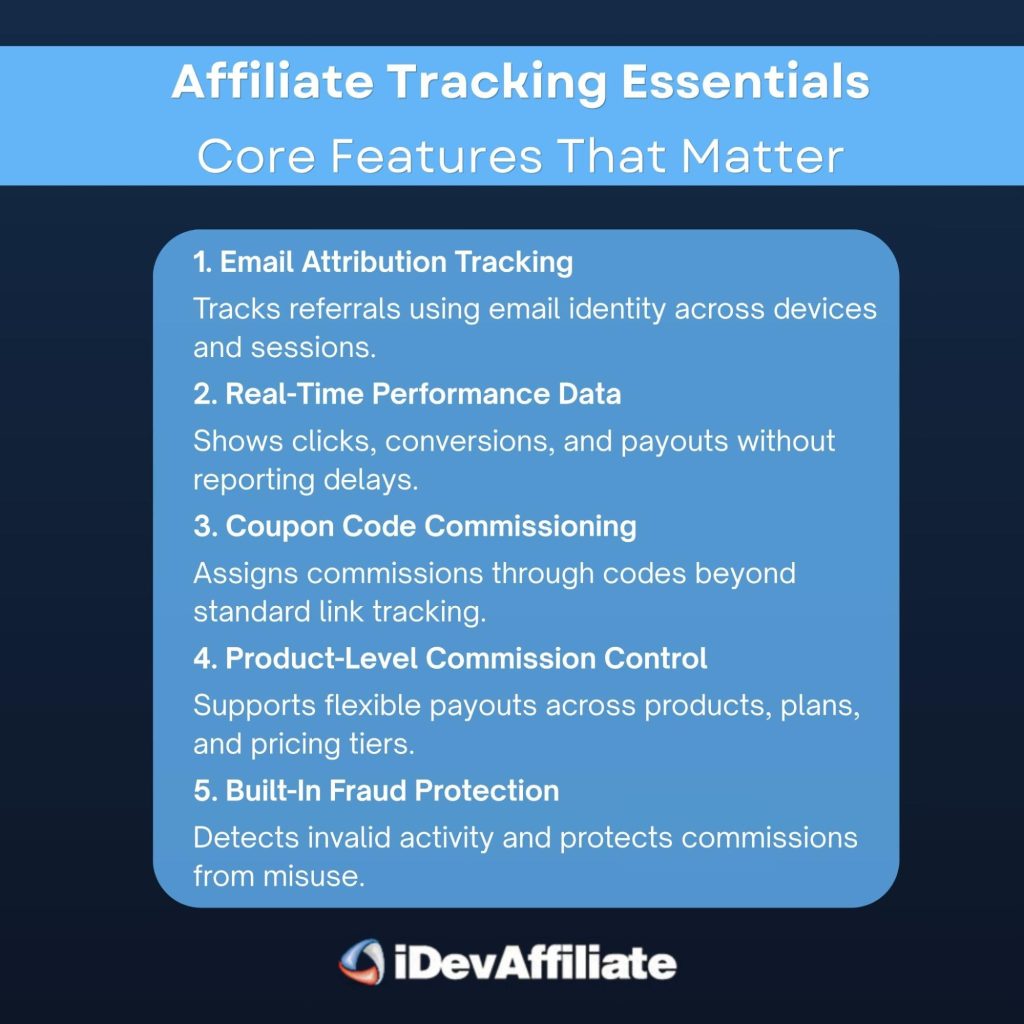
Not all affiliate tracking software operates with the same level of reliability.
The best tracking software for affiliate marketing combines identity-based attribution, real-time visibility, and built-in controls that protect commissions while supporting flexible, scalable program structures.
1. Email-Based Attribution Tracking
Modern affiliate systems go beyond cookies and IP tracking by tying referrals to customer email addresses.
iDevAffiliate creates a persistent, lifetime relationship between the affiliate and the customer, ensuring attribution remains intact across devices, sessions, and repeat purchases.
2. Real-Time Performance Visibility
Strong platforms provide immediate access to traffic, conversions, commissions, and payouts.
iDevAffiliate surfaces this data in real time, allowing affiliates and managers to act quickly, optimize campaigns, and maintain full visibility without relying on delayed reporting.
3. Coupon Code Commission Tracking
Coupon code commissioning allows affiliates to earn credit without relying solely on links.
When a unique code is used at checkout, the system assigns the conversion accurately, supporting offline promotions and multi-channel journeys where traditional tracking may miss attribution.
4. Product Catalog And Commission Control
Advanced tools allow businesses to upload product catalogs and assign commissions at a granular level.
This enables product-specific payouts, supports varied margin structures, and ensures commission logic reflects actual business economics instead of applying one flat rate across all sales.
5. Built-In Fraud Protection Controls
Reliable tracking software includes fraud detection as a core feature, not an add-on.
iDevAffiliate flags suspicious activity like abnormal click patterns or inflated conversions, protecting commission budgets and ensuring only verified, legitimate referrals are rewarded.
When these features are clearly defined, it becomes easier to evaluate which platforms actually deliver on them in practice.
That’s where comparing real tools helps, not by feature lists alone, but by how reliably they execute attribution, reporting, and commission control at scale.
Helpful Resource → How to Scale Affiliate Marketing Programs
Comparison Of Top Affiliate Tracking Software Options
Instant account set up. All features unlocked in base plan. Professional onboarding included.
Create Your Affiliate Program
Choosing the best tracking software for affiliate marketing depends on how well the platform handles attribution, scalability, and operational complexity.
The tools below represent widely used solutions, each suited to different program needs and growth stages.
iDevAffiliate
iDevAffiliate focuses on attribution accuracy and long-term tracking reliability. It is built for businesses that need consistent performance across devices and customer journeys.
- Email-based tracking connects referrals to verified customer identity
- No transaction fees, protecting margins as program scales
- Flexible commission rules for products, tiers, and performance bonuses
- Real-time reporting with built-in fraud detection and validation
iDevAffiliate stands out by solving the core problem most platforms ignore: attribution breakdown.
By combining traditional tracking with identity-based matching, it ensures commissions remain accurate even in complex, multi-device journeys.
This makes it a strong fit for businesses that want a dependable system that scales without constant fixes or manual intervention.
Post Affiliate Pro
Post Affiliate Pro provides a wide range of configuration options for tracking and commissions. It is typically used by teams that want detailed control over how attribution is handled.
- Multiple tracking methods including cookies, IP, and fingerprinting
- Advanced commission structures with tiers and multi-level payouts
- Wide integration support across ecommerce and payment platforms
- Custom dashboards with detailed reporting and tracking insights
Post Affiliate Pro offers strong flexibility for complex setups.
However, it often requires significant configuration and ongoing management, making it less suitable for teams looking for simplicity or faster execution.
Tapfiliate
Tapfiliate is a cloud-based tool focused on ease of setup and usability. It is commonly used by SaaS businesses launching affiliate programs quickly.
- Easy setup with clean interface and minimal onboarding steps
- Integrates with Stripe, Shopify, and subscription-based platforms
- Supports recurring commissions for subscription affiliate programs
- Automated onboarding and link generation for affiliate partners
Tapfiliate works well for getting started quickly.
But as programs scale, limitations in attribution control and commission flexibility can restrict more advanced use cases.
PartnerStack
PartnerStack is designed for managing structured partner and affiliate programs. It is commonly used in SaaS environments with long-term partner relationships.
- Supports recurring, tiered, and partner-based commission structures
- Includes partner onboarding, enablement, and payout management tools
- Provides access to a partner marketplace for recruitment
- Reporting focused on partner-driven revenue and performance
PartnerStack is effective for structured partner ecosystems.
However, it can introduce additional complexity and cost for teams focused primarily on affiliate tracking and performance management.
Refersion
Refersion is often used in ecommerce environments, especially with Shopify. It focuses on standard affiliate tracking and basic commission workflows.
- Shopify integration with product-level commission tracking support
- Affiliate portal for managing links, payouts, and performance
- Automated commission calculations with standard payout workflows
- Basic fraud monitoring with simple reporting tools
Refersion fits straightforward ecommerce use cases.
But it may lack deeper attribution control and flexibility needed for more advanced or multi-channel affiliate programs.
When you compare these tools, differences come down to how reliably they handle attribution in real-world conditions.
That clarity helps you make better decisions and avoid costly mistakes when selecting the right platform.
Common Mistakes When Choosing Tracking Software
Even with the right feature set in mind, selection mistakes can quietly undermine attribution accuracy and program performance.
These issues often surface later, when payouts, reporting, and partner trust are already affected.
- Choosing Price Over Accuracy: Lower-cost tools often rely on basic attribution models that misrepresent which affiliates actually drive conversions and revenue.
- Skipping Trial Validation: Without testing real scenarios like refunds, multi-product orders, and delayed conversions, tracking gaps remain hidden until after payouts.
- Ignoring Attribution Logic: Failing to verify how conversions are credited leads to inconsistent commission assignment and ongoing affiliate disputes.
- Overlooking Scalability Limits: Tools that work at small scale may introduce reporting delays, pricing spikes, or integration gaps as affiliate volume increases.
- Missing Edge Case Handling: Lack of support for refunds, proration, or multi-touch journeys creates manual reconciliation work and inconsistent payouts.
- Underestimating Data Transparency: Without clear audit trails, teams struggle to verify commissions, resolve disputes, and maintain reporting confidence.
- Delaying System-Level Decisions: Treating tracking as a tool choice instead of a system decision leads to reactive fixes instead of structured, scalable workflows.
These mistakes rarely appear during setup, but they compound as your program grows.
Avoiding them early ensures your tracking system remains accurate, reliable, and aligned with long-term program performance.
How To Choose The Right Affiliate Tracking Software
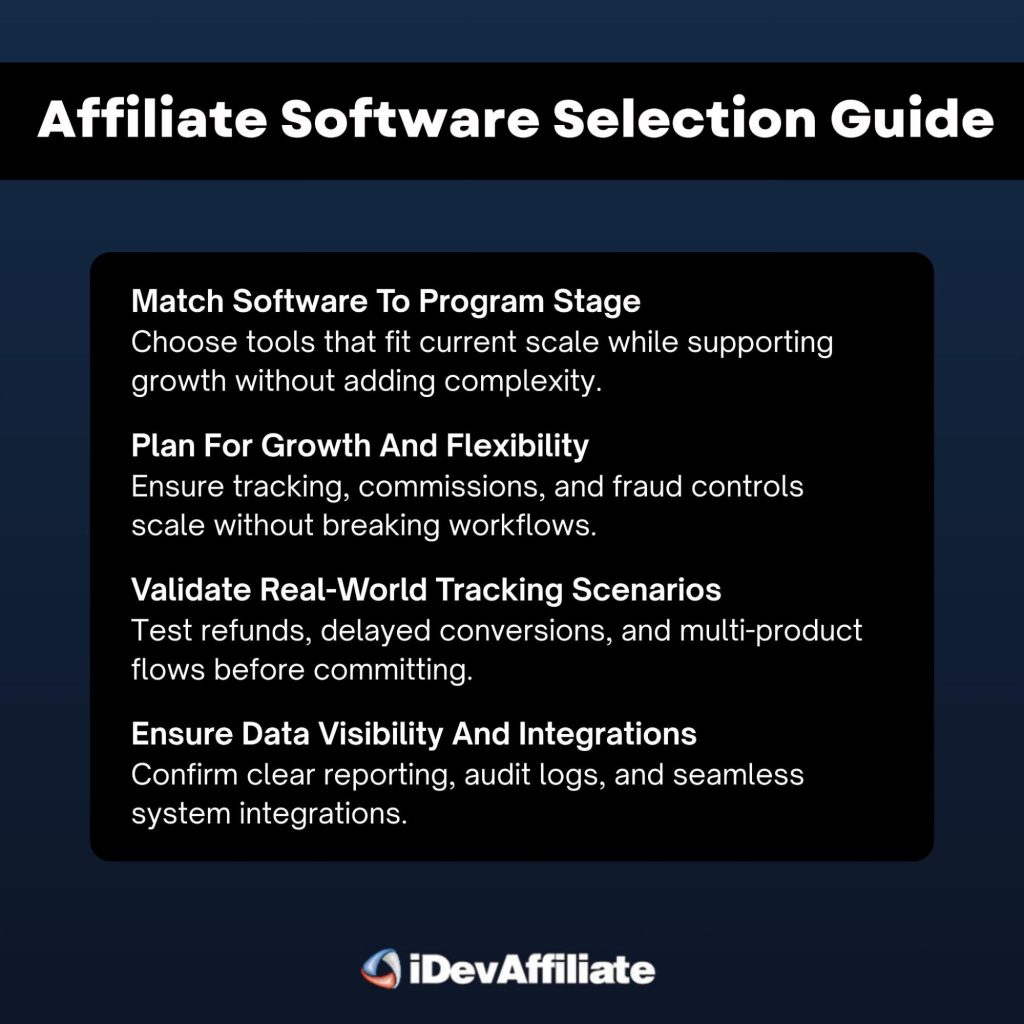
Once you understand common tracking pitfalls, choosing the right tool becomes a matter of alignment, not comparison.
The goal is to match your program’s current stage, operational needs, and future growth with a system that can support it consistently.
- Match Tool To Program Stage: Select software that fits your current affiliate volume, avoiding unnecessary complexity or limitations that restrict growth later.
- Plan For Growth Early: Choose a system that supports advanced attribution, reporting, and fraud controls before scaling exposes tracking limitations.
- Validate Real-World Scenarios: Test how the platform handles refunds, multi-product orders, and delayed conversions before committing long-term.
- Check Attribution Transparency: Ensure the system clearly defines how referrals are credited across sessions, devices, and conversion timelines.
- Evaluate Integration Depth: Confirm compatibility with billing, checkout, and CRM systems to avoid manual reconciliation and fragmented data flows.
- Understand Commission Flexibility: Verify that payout rules support tiers, product-level rates, and adjustments without requiring manual intervention.
- Confirm Data And Audit Visibility: Choose tools that provide clear, traceable logs so every commission can be verified and explained.
The right choice is rarely the tool with the most features, but the one that enforces your rules reliably.
When your tracking system matches your workflow, scaling becomes predictable instead of operationally complex.
Bottom Line: Does Affiliate Tracking Software Really Matter?
Instant account set up. All features unlocked in base plan. Professional onboarding included.
Create Your Affiliate Program
Affiliate tracking software is not just a tool, it defines how your entire program operates. When attribution is unreliable, everything downstream suffers: payouts, reporting accuracy, and partner trust.
Tracking accuracy determines everything.
When your system is built on verified attribution and consistent data flow, affiliate programs become easier to manage and scale:
- Email-based tracking: connects referrals to verified customer identity across devices and sessions.
- Consistent attribution: ensures conversions are credited accurately without relying on fragile browser data.
- Automated commission logic: applies payout rules consistently without manual intervention.
- Audit-ready reporting: links every commission to clear, traceable source activity
Platforms like iDevAffiliate bring these elements together into a structured system that eliminates tracking gaps and protects revenue as your program grows.
Reliable tracking does more than improve reporting.
It creates a foundation you can scale with confidence, so start your free trial of iDevAffiliate today and see it in action.
Frequently Asked Questions (FAQS)
You may also like

How to Set Up an Affiliate Program on BigCommerce

How to Set Up an Affiliate Program on WooCommerce

How to Set Up an Affiliate Program on Shopify

First Steps: 6 FREE Marketing Ideas For Your New Affiliate Program
Create Your Affiliate Program
- Unlimited Affiliates
- Unlimited Commissions
- Built-In SEO Links
- Social Media Sharing
- Affiliate Program Directory
