
Guide to Recurring Affiliate Commissions

Recurring commission affiliate programs aren’t just about getting paid more, they’re about getting paid repeatedly for the same customer.
But that only works when renewals are tracked correctly, commissions are triggered at the right time, and payout rules are clearly defined. Most confusion doesn’t come from the idea of recurring income. It comes from poor structure.
If you want recurring commissions that are predictable instead of frustrating, here’s what matters most:
- Renewal-based triggers: Every successful rebill must create a new commission event.
- Clear approval rules: Locking periods prevent premature payouts and reversals.
- Attribution stability: Customer tracking must survive device changes and renewals.
- Refund logic: Clawback policies must be defined upfront.
- Flexible duration rules: Lifetime doesn’t always mean forever. Confirm the limits.
If you’re building your own recurring affiliate model, iDevAffiliate gives you control over renewal tracking and payout logic without enterprise-level complexity.
Recurring commissions can become a powerful growth engine but only when the structure behind them is solid.
The details below explain what separates reliable recurring income from recurring headaches.
Recurring Commissions Are Defined by the Payout Trigger
Instant account set up. All features unlocked in base plan. Professional onboarding included.
Create Your Affiliate Program
Recurring commissions are payouts earned each time a referred customer renews a subscription or repeat billing plan.
Instead of a one-time payment, affiliates earn on every confirmed billing cycle while the customer remains active.
Once that definition is clear, you can evaluate any program by looking at how it handles renewals, retention, billing structure, and payout rules.
Clear Payout Triggers
A legitimate recurring commission structure clearly defines the billing event that creates a commission.
In most cases, that means a successful renewal that reaches a confirmed order status. If the trigger is vague or loosely defined, commissions can become inconsistent and difficult to verify.
Renewals as Separate Commission Events
Each renewal should be processed as its own commission event. When a customer is billed again and the payment clears, a new commission should automatically be recorded.
This keeps earnings aligned with actual subscription activity instead of assumptions.
Retention Drives Recurring Income
Recurring commissions are tied directly to customer retention.
If a customer cancels, fails payment, or receives a refund, future commissions typically stop. Predictable recurring revenue only happens when the underlying subscription remains active.
Billing Model Consistency
Subscriptions, memberships, and refill billing can all qualify as recurring models.
What matters is predictable billing that can be attributed to the same customer account each time. If renewals are not tied to a stable customer identifier, tracking gaps are likely.
What Recurring Commissions Are Not
Recurring commissions are not one-time payouts dressed up with better wording. They are not flat influencer fees, pay-per-click deals, or multi-level recruiting bonuses.
True recurring programs pay on confirmed renewals with clearly defined rules around cancellations, refunds, and payout timing.
Understanding what qualifies as a recurring commission is only the first step.
The real clarity comes when you examine how those commissions are calculated, approved, and ultimately paid out over time.
What Gets Paid and When

Once you understand that recurring commissions are triggered by renewals, the next step is understanding the mechanics behind those payouts.
Not all recurring programs calculate or release commissions the same way.
If you do not review the structure carefully, recurring income can look predictable on paper but behave very differently in reality.
Commission Base Matters
Recurring commissions are typically calculated on gross revenue, net revenue, or revenue after refunds and chargebacks. That distinction directly impacts what you earn.
A program paying on gross subscription price will produce different numbers than one deducting discounts and fees first.
Refund and Clawback Policies
Many programs finalize commissions only after a payment is considered settled.
If a customer cancels, disputes a charge, or receives a refund within a defined window, commissions may be reversed. Clear clawback policies reduce surprises and protect both sides from disputes later.
Locking Periods
Most recurring commissions go through a locking period before they are approved for payout.
A renewal may appear in your dashboard immediately, but remain pending until the refund window closes or payment clears. This delay is normal, but it must be defined clearly.
Payout Schedule
Approval does not always mean instant payment.
Programs typically release payouts monthly or quarterly, often with minimum thresholds. Mapping the timeline from renewal date to approved status to paid status helps you forecast cash flow realistically.
Rate Structure Across Renewals
Recurring rates may be percentage-based, flat per renewal, or tiered based on performance.
Some apply to every billing cycle, while others only cover the first few renewals. Always confirm how long the rate applies and whether it changes across products or plans.
When you break down how commissions are calculated, approved, and paid, it becomes clear that recurring income is not automatic. It is structured.
And that structure is what separates recurring commissions that compound steadily from those that create confusion, volatility, and payout disputes.
Pros and Risks of Recurring Affiliate Income
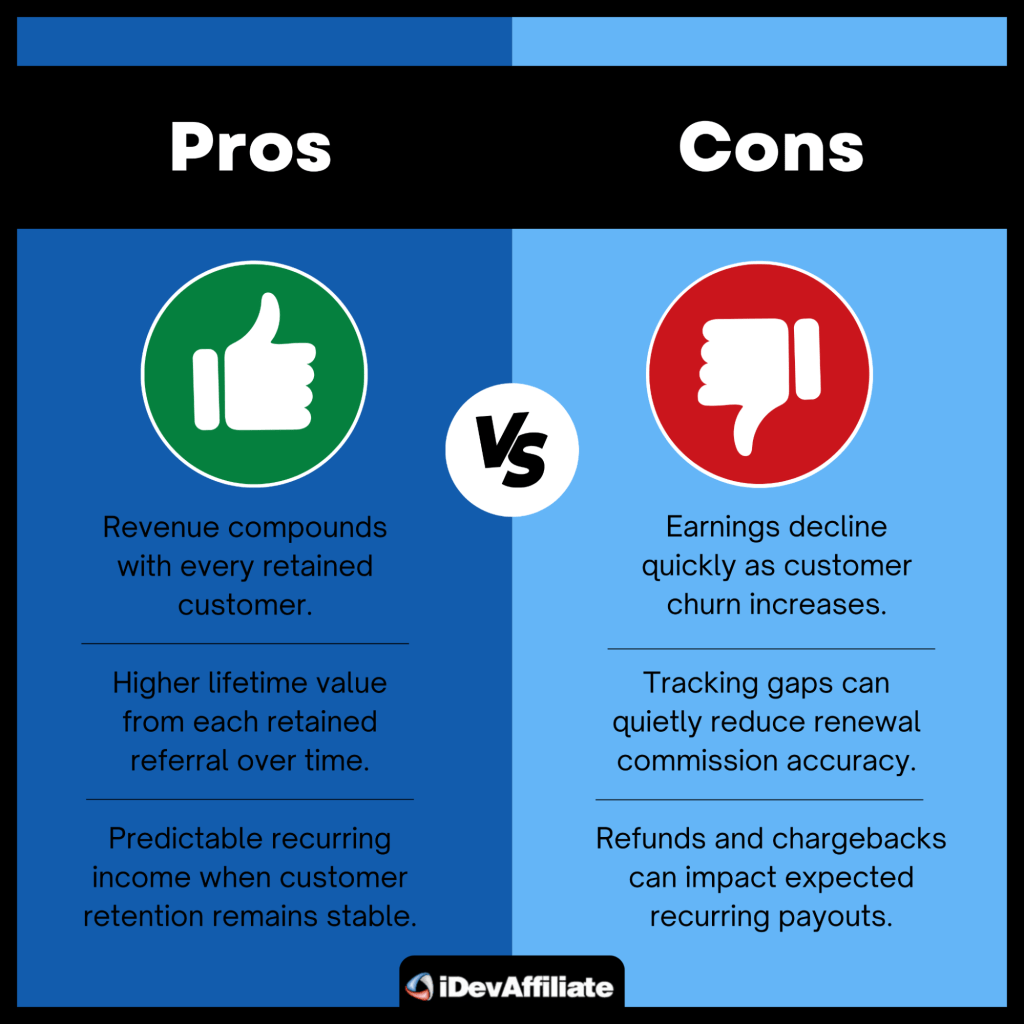
Recurring commission affiliate programs are attractive for one simple reason: predictable income. But predictable does not mean guaranteed.
The same structure that creates long-term upside also introduces specific operational risks. Understanding both sides helps you evaluate programs realistically instead of relying on marketing claims.
The Advantages of Recurring Commissions
Recurring income can look simple from the outside. You refer a customer once and continue earning as long as they stay subscribed.
In practice, the benefits come from how recurring structures compound and stabilize earnings over time.
1. Compounding Revenue Over Time
Recurring commissions allow income to stack. Each new referral adds another renewal stream, which means earnings can grow without restarting every month.
Over time, this creates momentum that one-time commissions simply cannot replicate.
2. Higher Lifetime Value Per Referral
Instead of earning once, you earn across multiple billing cycles.
A retained customer can generate significantly more revenue than a one-time payout, especially in subscription businesses with strong retention.
3. More Stable Forecasting
When renewals are tracked accurately, recurring commissions create patterns you can model.
If churn rates are consistent and payout timing is clear, affiliates can estimate expected monthly income with reasonable confidence.
The Risks Behind “Recurring” Income
Recurring models are powerful, but they are not passive. They depend on systems, retention, and clearly defined payout rules.
If any of those pieces are weak, recurring income can become inconsistent quickly.
1. Retention Dependency
Recurring commissions depend entirely on customer retention.
If churn is high, revenue drops just as quickly as it builds. Strong acquisition does not compensate for poor long-term customer value.
2. Tracking and Attribution Gaps
If renewals are not properly tied to the original affiliate, commissions can quietly disappear.
Weak tracking systems, limited attribution logic, or poor subscription integrations create gaps that directly impact earnings.
3. Refunds and Reversals
Refund windows, chargebacks, and clawback policies can reduce earnings even after they appear in your dashboard.
Clear order-status rules and defined locking periods are essential to avoid unexpected adjustments.
Structure Determines the Outcome
Recurring commissions are neither automatic wins nor built-in liabilities.
They amplify whatever system sits behind them, strong tracking creates stability, weak processes create friction.
If the foundation is clear, recurring income compounds. If it is loose, small issues turn into ongoing payout disputes.
That is why the conversation naturally shifts from opportunity and risk to execution, because long-term recurring programs depend entirely on how payouts are managed in practice.
Managing Recurring Commission Payouts Without Errors

Recurring commissions only work long term if businesses can track and pay them accurately. If payouts are delayed, miscalculated, or inconsistent, affiliate trust drops quickly.
The key is removing manual processes and relying on systems that connect renewals directly to commission logic.
When tracking, attribution, and payout rules are aligned, recurring programs become predictable instead of stressful.
1. Automated Renewal Tracking
Recurring commissions should be triggered automatically by confirmed subscription renewals.
When your affiliate platform integrates directly with your cart or billing system, each successful rebill creates a commission without manual entry.
This eliminates spreadsheet tracking and reduces human error.
2. Email-Based Customer Attribution
Customers change devices, browsers, and locations. If attribution depends only on cookies, renewals can disconnect from the original affiliate.
Email-based tracking creates a stable, lifetime relationship between customer and affiliate, ensuring recurring commissions remain attached across billing cycles.
3. Status-Based Commission Approval
Commissions should only move from pending to approved when order status rules are met.
Built-in locking periods tied to refunds, chargebacks, and payment confirmation prevent premature payouts. This protects your margins while giving affiliates transparency into what is happening.
4. Flexible Recurring Commission Rules
Some businesses pay for life. Others limit the number of rebills.
Clear configuration options allow you to define recurring duration, product-level rates, and performance incentives without creating overly complex structures.
Simple rules reduce disputes and administrative overhead.
5. Built-In Affiliate Payments
Once commissions are approved, payouts should not require exporting files and reconciling data manually.
Integrated payment tools allow businesses to process affiliate payments directly from the dashboard, reducing calculation errors and saving time each payout cycle.
When recurring commissions are managed through automation, clear attribution, and structured approval rules, businesses can scale confidently.
Platforms like iDevAffiliate are built to support this model, combining renewal tracking, email-based attribution, flexible commissioning, and integrated payments into one reliable system.
Bottom Line: Recurring Commissions Only Work When the Structure Works
Instant account set up. All features unlocked in base plan. Professional onboarding included.
Create Your Affiliate Program
Recurring commission affiliate programs are not inherently good or risky, they are structural systems.
When renewal tracking, attribution, approval rules, and payout workflows are aligned, recurring income becomes predictable. When they are loose or manual, problems surface quickly.
Businesses that want to offer recurring commissions need more than percentage settings. They need:
- Automated Renewal Tracking: Confirmed subscription rebills that automatically generate commissions tied to real order statuses.
- Email-Based Attribution: Lifetime customer-to-affiliate relationships that survive browser changes, device shifts, and repeat purchases.
- Structured Approval Controls: Locking periods and refund logic that prevent premature payouts and unnecessary reversals.
- Flexible Recurring Rules: Options to define lifetime commissions, limited rebills, product-level rates, and performance incentives without creating unnecessary complexity.
- Integrated Affiliate Payments: Clear pending → approved → paid workflows that remove spreadsheet reconciliation and manual payout errors.
iDevAffiliate was built with this operational clarity in mind.
Launch a Reliable Recurring Affiliate Program
If you want recurring commissions to feel predictable instead of complicated, the structure behind your affiliate program has to be intentional from day one.
Start your free iDevAffiliate trial and build your program on email-based tracking, automated renewal commissions, flexible recurring rules, and integrated payout management.
Set the right foundation. Support your affiliates properly. Grow recurring revenue without the operational friction.
Frequently Asked Questions (FAQS)
You may also like

How to Set Up an Affiliate Program on BigCommerce

How to Set Up an Affiliate Program on WooCommerce

How to Set Up an Affiliate Program on Shopify

First Steps: 6 FREE Marketing Ideas For Your New Affiliate Program
Create Your Affiliate Program
- Unlimited Affiliates
- Unlimited Commissions
- Built-In SEO Links
- Social Media Sharing
- Affiliate Program Directory
